Division of Epidemiology and Community Health, University of Minnesota, Minneapolis, Minnesota 55454, USA.
Environ Health Perspect. 2013 May;121(5):619-24. doi: 10.1289/ehp.1205431. Epub 2013 Jan 25.
Acetylcholinesterase (AChE) inhibitors are commonly used pesticides that can effect hemodynamic changes through increased cholinergic stimulation. Children of agricultural workers are likely to have paraoccupational exposures to pesticides, but the potential physiological impact of such exposures is unclear.
We investigated whether secondary pesticide exposures were associated with blood pressure and heart rate among children living in agricultural Ecuadorian communities.
This cross-sectional study included 271 children 4-9 years of age [51% cohabited with one or more flower plantation workers (mean duration, 5.2 years)]. Erythrocyte AChE activity was measured using the EQM Test-mate system. Linear regression models were used to estimate associations of systolic blood pressure (SBP), diastolic blood pressure (DBP), and heart rate with AChE activity, living with flower workers, duration of cohabitation with a flower worker, number of flower workers in the child's home, and number of practices that might increase children's exposure to pesticides.
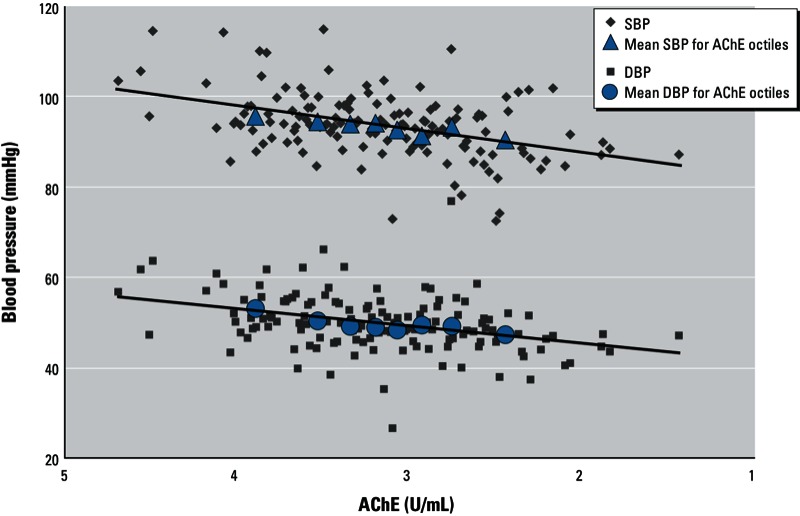
Mean (± SD) AChE activity was 3.14 ± 0.49 U/mL. A 1-U/mL decrease in AChE activity was associated with a 2.86-mmHg decrease in SBP (95% CI: -5.20, -0.53) and a 2.89-mmHg decrease in DBP (95% CI: -5.00, -0.78), after adjustment for potential confounders. Children living with flower workers had lower SBP (-1.72 mmHg; 95% CI: -3.53, 0.08) than other children, and practices that might increase exposure also were associated with lower SBP. No significant associations were found between exposures and heart rate.
Our findings suggest that subclinical secondary exposures to pesticides may affect vascular reactivity in children. Additional research is needed to confirm these findings.
乙酰胆碱酯酶 (AChE) 抑制剂是常用的杀虫剂,通过增加胆碱能刺激来影响血流动力学变化。农业工人的子女可能会接触职业相关的农药,但这种接触的潜在生理影响尚不清楚。
我们研究了厄瓜多尔农业社区中生活的儿童是否会因次要的农药接触而导致血压和心率发生变化。
这是一项横断面研究,共纳入 271 名 4-9 岁的儿童[51%与一名或多名花卉种植工人共同居住(平均时长 5.2 年)]。采用 EQM Test-mate 系统测量红细胞 AChE 活性。使用线性回归模型来评估收缩压 (SBP)、舒张压 (DBP) 和心率与 AChE 活性、与花卉工人共同居住、与花卉工人共同居住的时间、儿童家中的花卉工人数量以及可能增加儿童接触农药的实践活动的关系。
平均(±SD)AChE 活性为 3.14±0.49U/mL。在调整潜在混杂因素后,AChE 活性每降低 1U/mL,SBP 降低 2.86mmHg(95%CI:-5.20,-0.53),DBP 降低 2.89mmHg(95%CI:-5.00,-0.78)。与其他儿童相比,与花卉工人共同居住的儿童 SBP 较低(-1.72mmHg;95%CI:-3.53,0.08),且可能增加暴露的实践活动也与 SBP 降低有关。未发现暴露与心率之间存在显著关联。
我们的研究结果表明,亚临床的次要农药接触可能会影响儿童的血管反应性。需要进一步的研究来证实这些发现。