Kapwata Thandi, Morris Natashia, Campbell Angela, Mthiyane Thuli, Mpangase Primrose, Nelson Kristin N, Allana Salim, Brust James C M, Moodley Pravi, Mlisana Koleka, Gandhi Neel R, Shah N Sarita
Environment and Health Research Unit, South African Medical Research Council, Johannesburg, South Africa.
Biostatistics Unit, South African Medical Research Council, Durban, KwaZulu-Natal, South Africa.
PLoS One. 2017 Oct 13;12(10):e0181797. doi: 10.1371/journal.pone.0181797. eCollection 2017.
KwaZulu-Natal province, South Africa, has among the highest burden of XDR TB worldwide with the majority of cases occurring due to transmission. Poor access to health facilities can be a barrier to timely diagnosis and treatment of TB, which can contribute to ongoing transmission. We sought to determine the geographic distribution of XDR TB patients and proximity to health facilities in KwaZulu-Natal.
We recruited adults and children with XDR TB diagnosed in KwaZulu-Natal. We calculated distance and time from participants' home to the closest hospital or clinic, as well as to the actual facility that diagnosed XDR TB, using tools within ArcGIS Network analyst. Speed of travel was assigned to road classes based on Department of Transport regulations. Results were compared to guidelines for the provision of social facilities in South Africa: 5km to a clinic and 30km to a hospital.
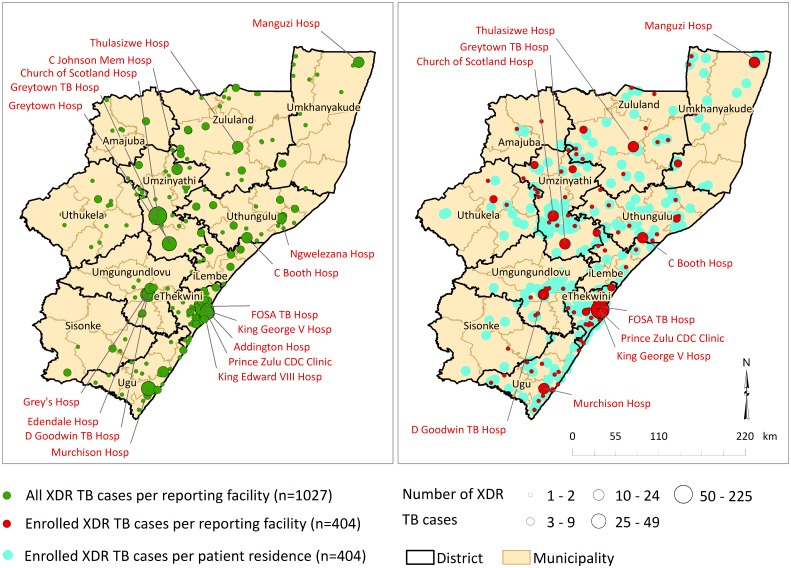
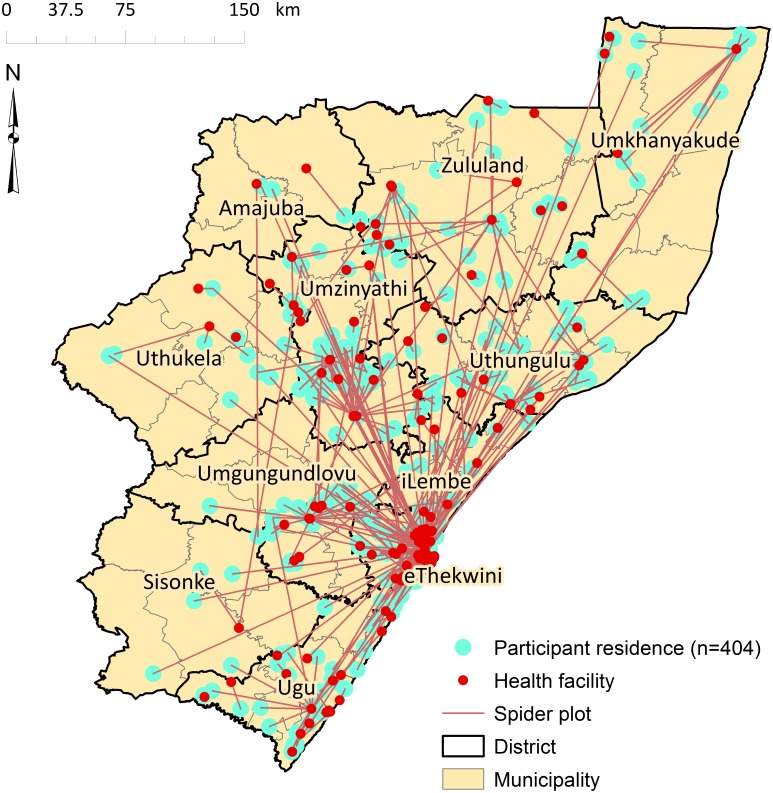
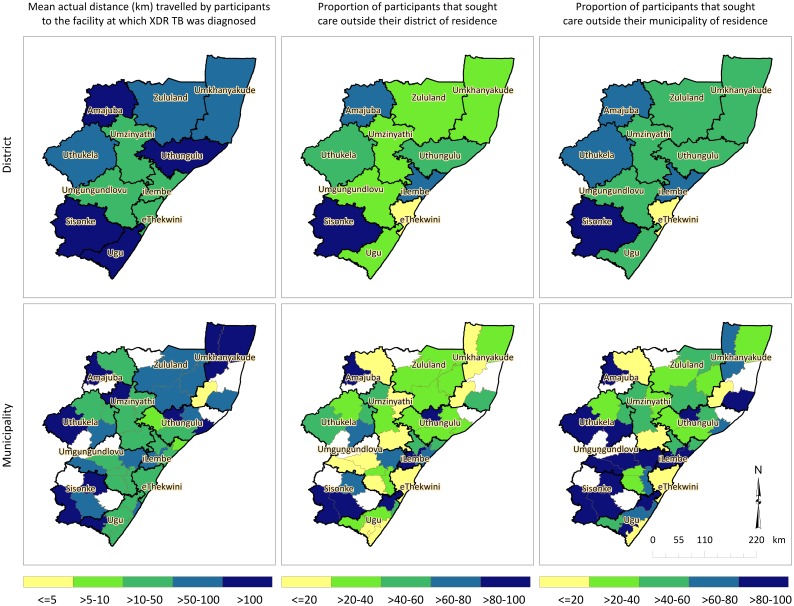
During 2011-2014, 1027 new XDR TB cases were diagnosed throughout all 11 districts of KwaZulu-Natal, of whom 404 (39%) were enrolled and had geospatial data collected. Participants would have had to travel a mean distance of 2.9 km (CI 95%: 1.8-4.1) to the nearest clinic and 17.6 km (CI 95%: 11.4-23.8) to the nearest hospital. Actual distances that participants travelled to the health facility that diagnosed XDR TB ranged from <10 km (n = 143, 36%) to >50 km (n = 109, 27%), with a mean of 69 km. The majority (77%) of participants travelled farther than the recommended distance to a clinic (5 km) and 39% travelled farther than the recommended distance to a hospital (30 km). Nearly half (46%) of participants were diagnosed at a health facility in eThekwini district, of whom, 36% resided outside the Durban metropolitan area.
XDR TB cases are widely distributed throughout KwaZulu-Natal province with a denser focus in eThekwini district. Patients travelled long distances to the health facility where they were diagnosed with XDR TB, suggesting a potential role for migration or transportation in the XDR TB epidemic.
南非夸祖鲁 - 纳塔尔省是全球广泛耐药结核病负担最高的地区之一,大多数病例是由于传播所致。难以获得医疗设施可能成为结核病及时诊断和治疗的障碍,这可能导致疾病持续传播。我们试图确定夸祖鲁 - 纳塔尔省广泛耐药结核病患者的地理分布以及与医疗设施的距离。
我们招募了在夸祖鲁 - 纳塔尔省被诊断为广泛耐药结核病的成人和儿童。我们使用ArcGIS网络分析工具计算了参与者从家到最近医院或诊所的距离和时间,以及到实际诊断广泛耐药结核病的机构的距离和时间。根据交通部规定为道路类别设定了行驶速度。将结果与南非社会设施提供指南进行比较:距离诊所5公里,距离医院30公里。
在2011 - 2014年期间,夸祖鲁 - 纳塔尔省所有11个区共诊断出1027例新的广泛耐药结核病病例,其中404例(39%)被纳入研究并收集了地理空间数据。参与者前往最近诊所的平均距离为2.9公里(95%置信区间:1.8 - 4.1),前往最近医院的平均距离为17.6公里(95%置信区间:11.4 - 23.8)。参与者前往诊断广泛耐药结核病的医疗机构的实际距离从小于10公里(n = 143,36%)到大于50公里(n = 109,27%)不等,平均为69公里。大多数(77%)参与者前往诊所的距离超过了推荐距离(5公里),39%参与者前往医院的距离超过了推荐距离(30公里)。近一半(46%)的参与者在伊泰奎尼区的医疗机构被诊断,其中36%居住在德班大都市区以外。
广泛耐药结核病病例在夸祖鲁 - 纳塔尔省广泛分布,在伊泰奎尼区更为密集。患者前往诊断其广泛耐药结核病的医疗机构的距离很远,这表明迁移或交通在广泛耐药结核病流行中可能发挥了作用。