Fan Weibing, Fan Shuang-Shi, Feng Juan, Xiao Desheng, Fan Songqing, Luo Jiadi
Department of Neurology, The Third Hospital of Changsha, Changsha, Hunan, China.
Department of Surgery, Children's Hospital of Hunan Province, Changsha, Hunan, China.
PLoS One. 2017 Oct 13;12(10):e0185563. doi: 10.1371/journal.pone.0185563. eCollection 2017.
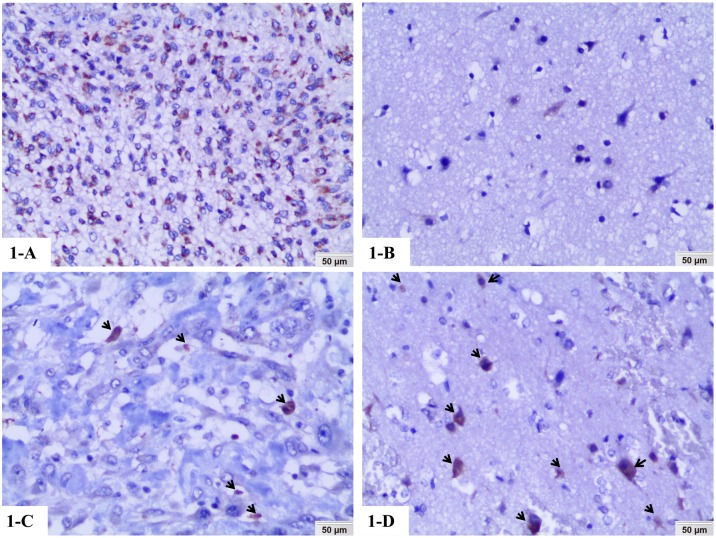
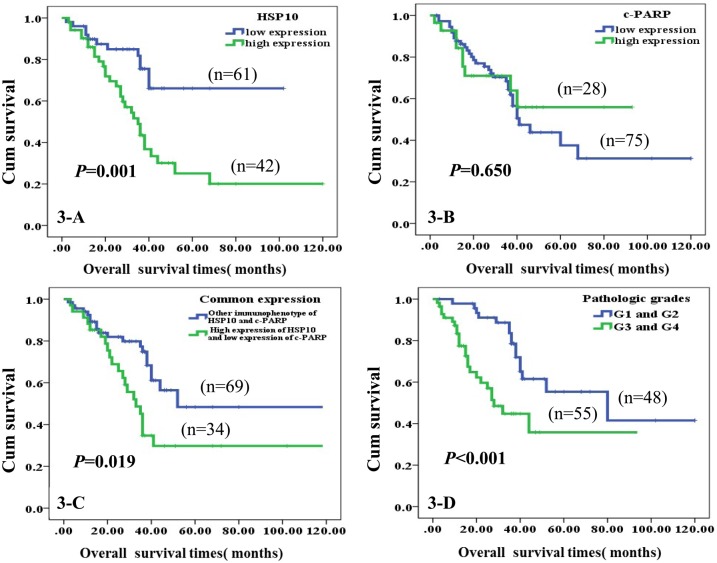
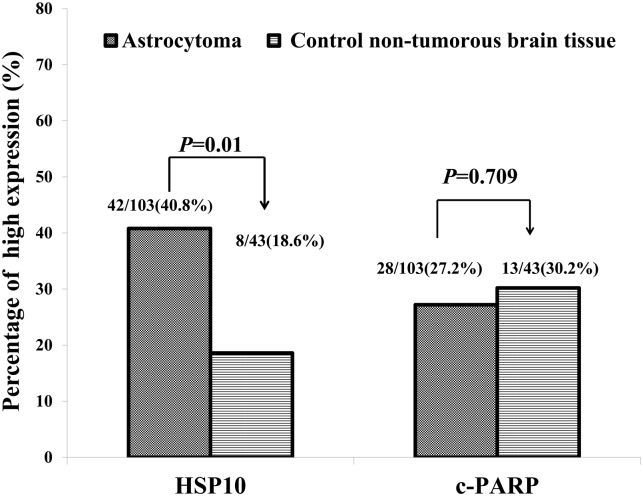
Astrocytoma is the most common type of primary malignant brain tumor, with pretty lowly 5-year survival rate in patients. Although extended surgical removal of the tumor and postoperative chemotherapy/radiotherapy executed, still there is large recurrence rate, mainly because diffuse glioma tumor cells ubiquitously infiltrate into normal parenchyma. So it becomes a priority to hunt novel molecular and signaling pathway targets to suppress astrocyma progression. HSP10, an important member of Heat shock proteins (Hsps) family, classically works as molecular chaperone folding or degradating of target proteins. Evolutionarily, HSP10 is also reported to be involved in immunomodulation and tumor progression. Poly (ADP-ribose) polymerase (PARP), important in DNA repair, is one of the main cleavage targets of caspase. And cleaved PARP (c-PARP) can serve as a marker of cells undergoing apoptosis. So far, whether the expression of HSP10 or c-PARP is associated with clinicopathologic implication for astrocytoma has not been reported. Meanwhile, it is unclear about the relationship between HSP10 and cell apoptosis. The purpose of this research is to elucidate the association between the expression of HSP10 and c-PARP and clinicopathological characteristics of astrocytoma by immunohistochemistry. The results showed that positive percentage of high HSP10 expression in astrocytoma 42/103, 40.8%) was significantly higher than that in the non-tumor control brain tissues (8/43, 18.6%) (P = 0.01). While no apparent difference of high c-PARP expression existed between astrocytoma and non-tumor control brain tissues. Furthermore, elevated expression of HSP10 was negative related to low expression of c-PARP (r = -0.224, P = 0.023), indicating high expression of HSP10 in astrocytoma inhibited apoptosis process effectively. And overexpression of HSP10 was proved to be the independent poor prognostic factor for astrocytoma by multivariate analysis. Taken together, our results suggest that elevated expression of HSP10 protein inhibits apoptosis and associates with poor prognosis of astrocytoma.
星形细胞瘤是最常见的原发性恶性脑肿瘤类型,患者的5年生存率相当低。尽管实施了肿瘤的扩大手术切除及术后化疗/放疗,但复发率仍然很高,主要是因为弥漫性胶质瘤肿瘤细胞广泛浸润到正常实质中。因此,寻找新的分子和信号通路靶点以抑制星形细胞瘤进展成为当务之急。热休克蛋白10(HSP10)是热休克蛋白(Hsps)家族的重要成员,经典地作为分子伴侣发挥作用,参与靶蛋白的折叠或降解。在进化过程中,也有报道称HSP10参与免疫调节和肿瘤进展。聚(ADP - 核糖)聚合酶(PARP)在DNA修复中起重要作用,是半胱天冬酶的主要切割靶点之一。而裂解的PARP(c - PARP)可作为细胞凋亡的标志物。到目前为止,尚未有关于HSP10或c - PARP的表达与星形细胞瘤临床病理意义相关性的报道。同时,HSP10与细胞凋亡之间的关系也不清楚。本研究的目的是通过免疫组织化学阐明HSP10和c - PARP的表达与星形细胞瘤临床病理特征之间的关联。结果显示,星形细胞瘤中HSP10高表达的阳性率为42/103(40.8%),显著高于非肿瘤对照脑组织(8/43,18.6%)(P = 0.01)。而星形细胞瘤与非肿瘤对照脑组织之间c - PARP高表达无明显差异。此外,HSP10的高表达与c - PARP的低表达呈负相关(r = -0.224,P = 0.023),表明星形细胞瘤中HSP10的高表达有效抑制了凋亡过程。多因素分析证明HSP10的过表达是星形细胞瘤独立的不良预后因素。综上所述,我们的结果表明HSP10蛋白的高表达抑制凋亡并与星形细胞瘤的不良预后相关。