Zeng Da-Xiong, Wang Chang-Guo, Lei Wei, Huang Jian-An, Jiang Jun-Hong
Department of Respiratory and Critical Care, The First Affiliated Hospital of Soochow University, Suzhou, China.
Oncotarget. 2017 Aug 3;8(39):66248-66253. doi: 10.18632/oncotarget.19908. eCollection 2017 Sep 12.
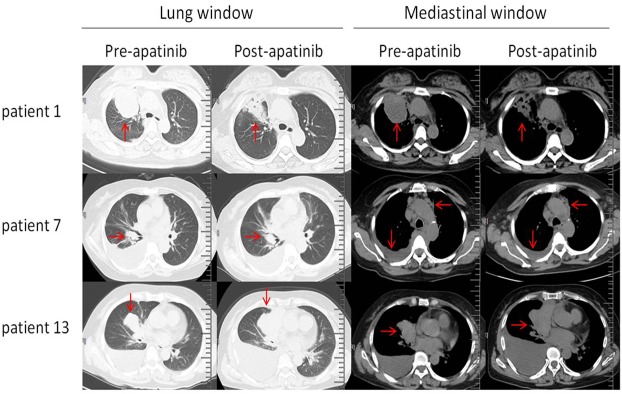
Chemotherapy is the standard treatment of in advanced lung adenocarcinoma patients without driver mutation. However, few drugs could be selected when diseases progressed after second-line treatment. As a small molecule inhibitor of vascular endothelial growth factor receptor-2 (VEGFR-2), apatinib was suggested mainly using in advanced gastric cancer. In this study, we showed the results of apatinib as second-line to fourth-line treatment in EGFR wild-type advanced lung adenocarcinoma patients. 16 EGFR wild-type advanced lung adenocarcinoma patients were administrated apatinib (250-500 mg/d) orally. 3 patients showed partial response and 8 patients showed stable diseases response to apatinib, with a medium progression-free survival (PFS) of 4.4 month (2-10 months). The objective remission rate (ORR) was 18.75%(3/16). The total disease control rate (DCR) was 68.75% (11/16). The main toxicities were hypertension, hand-foot syndrome, proteinuria and thrombocytopenia which were tolerable and manageable. So, apatinib might be an optional choice for post-first-line treatment of EGFR wild-type advanced lung adenocarcinoma patients.
化疗是晚期无驱动基因突变肺腺癌患者的标准治疗方法。然而,二线治疗后疾病进展时可供选择的药物很少。阿帕替尼作为一种血管内皮生长因子受体-2(VEGFR-2)小分子抑制剂,主要用于晚期胃癌。在本研究中,我们展示了阿帕替尼作为表皮生长因子受体(EGFR)野生型晚期肺腺癌患者二线至四线治疗的结果。16例EGFR野生型晚期肺腺癌患者口服阿帕替尼(250 - 500mg/天)。3例患者出现部分缓解,8例患者对阿帕替尼表现为疾病稳定,中位无进展生存期(PFS)为4.4个月(2 - 10个月)。客观缓解率(ORR)为18.75%(3/16)。疾病总控制率(DCR)为68.75%(11/16)。主要毒性为高血压、手足综合征、蛋白尿和血小板减少,这些毒性是可耐受和可管理的。因此,阿帕替尼可能是EGFR野生型晚期肺腺癌患者一线治疗后的一个可选选择。