Department of Bioengineering, Swanson School of Engineering, University of Pittsburgh, Pittsburgh, PA, 15219, USA.
Center for Cellular and Molecular Engineering, Department of Orthopaedic Surgery, University of Pittsburgh School of Medicine, 450 Technology Drive, Room 221, Pittsburgh, PA, 15219, USA.
Stem Cell Res Ther. 2017 Oct 13;8(1):226. doi: 10.1186/s13287-017-0665-4.
Adult mesenchymal stem cells (MSCs) have been shown to increase nerve regeneration in animal models of nerve injury. Traumatized muscle-derived multipotent progenitor cells (MPCs) share important characteristics with MSCs and are isolated from severely damaged muscle tissue following surgical debridement. Previous investigations have shown that MPCs may be induced to increase production of several neurotrophic factors, suggesting the possible utility of autologous MPCs in peripheral nerve regeneration following injury. Recent findings have also shown that components of the vascular niche, including endothelial cells (ECs) and vascular endothelial growth factor (VEGF)-A, regulate neural progenitor cells and sensory neurons.
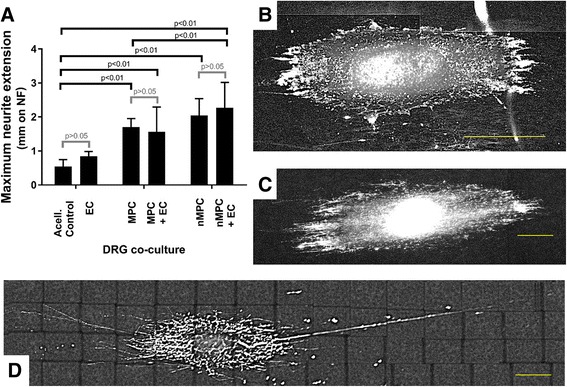
In this study, we have investigated the neuroinductive activities of MPCs, particularly MPC-produced VEGF-A, in the context of an aligned, neuroconductive nerve guide conduit and the endothelial component of the vascular system. Embryonic dorsal root ganglia (DRG) seeded on poly-ϵ-caprolactone aligned nanofibrous scaffold (NF) constructs and on tissue culture plastic, were cocultured with induced MPCs or treated with their conditioned medium (MPC-CM).
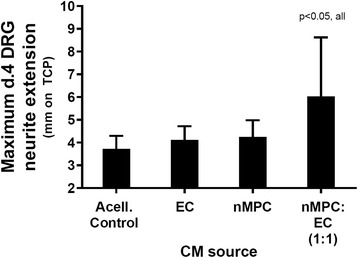
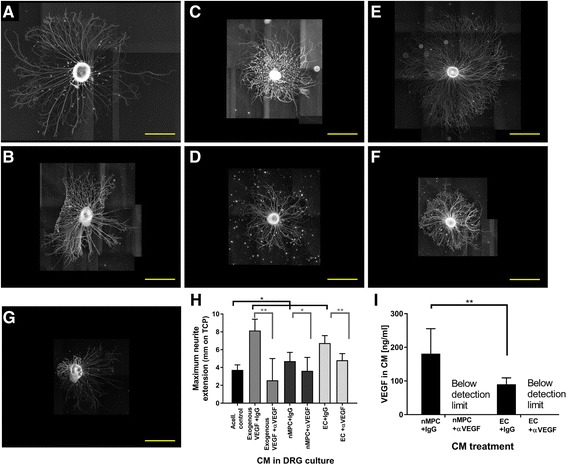
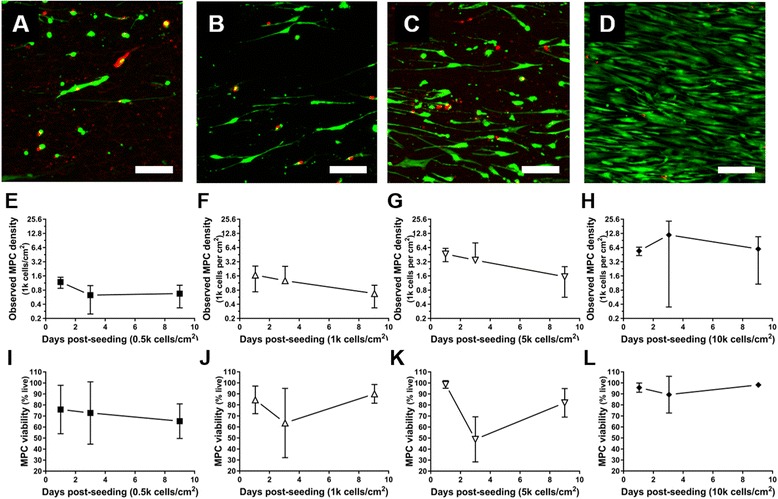
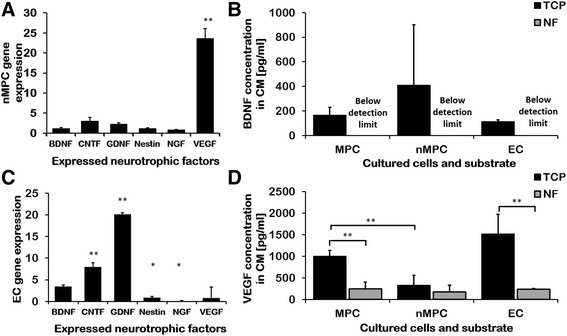
Increased neurite extension was observed on both NF and tissue culture plastic in the presence of MPC-CM versus cell-free control CM. The addition of CM from ECs significantly increased the neurotrophic activity of induced MPC-CM, suggesting that MPC and EC neurotrophic activity may be synergistic. Distinctly higher VEGF-A production was seen in MPCs following neurotrophic induction versus culture under normal growth conditions. Selective removal of VEGF-A from MPC-CM reduced the observed DRG neurite extension length, indicating VEGF-A involvement in neurotrophic activity of the CM.
Taken together, these findings suggest the potential of MPCs to encourage nerve growth via a VEGF-A-dependent action, and the use of MPC-CM or a combination of MPC and CM from ECs for peripheral nerve repair in conjunction with NFs in a nerve guide conduit. Due to the ease of use, application of bioactive agents derived from cultured cells to enhance neurotrophic support presents a promising line of research into peripheral nerve repair.
成体间充质干细胞(MSCs)已被证明可增加动物神经损伤模型中的神经再生。创伤性肌肉来源的多能祖细胞(MPCs)与 MSCs 具有重要的特征,并在外科清创术后从严重受损的肌肉组织中分离出来。先前的研究表明,MPCs 可能被诱导增加几种神经营养因子的产生,这表明在损伤后,自体 MPCs 可能有助于周围神经再生。最近的研究结果还表明,血管壁龛的组成部分,包括内皮细胞(ECs)和血管内皮生长因子(VEGF-A),可调节神经祖细胞和感觉神经元。
在这项研究中,我们研究了 MPCs 的神经诱导活性,特别是在排列整齐的神经引导导管和血管系统的内皮成分的背景下,MPC 产生的 VEGF-A。胚胎背根神经节(DRG)接种在聚-ε-己内酯排列的纳米纤维支架(NF)构建体和组织培养塑料上,与诱导的 MPCs 共培养或用其条件培养基(MPC-CM)处理。
与无细胞对照 CM 相比,在 MPC-CM 存在的情况下,NF 和组织培养塑料上均观察到神经突延伸增加。EC 产生的 CM 的添加显著增加了诱导的 MPC-CM 的神经营养活性,表明 MPC 和 EC 的神经营养活性可能具有协同作用。与正常生长条件下的培养相比,在诱导神经营养后,MPC 中明显产生了更高水平的 VEGF-A。从 MPC-CM 中选择性去除 VEGF-A 降低了观察到的 DRG 神经突延伸长度,表明 VEGF-A 参与了 CM 的神经营养活性。
综上所述,这些发现表明 MPC 具有通过 VEGF-A 依赖性作用促进神经生长的潜力,并且可以使用 MPC-CM 或 MPC 和来自 EC 的 CM 的组合与 NF 一起在神经引导导管中用于周围神经修复。由于易于使用,应用源自培养细胞的生物活性物质来增强神经营养支持为周围神经修复的研究提供了一个有前途的方向。