Mitchell David, Ritchey Laura E, Park Hongmarn, Babitzke Paul, Assmann Sarah M, Bevilacqua Philip C
Department of Chemistry, The Pennsylvania State University, University Park, Pennsylvania 16802, USA.
Center for RNA Molecular Biology, The Pennsylvania State University, University Park, Pennsylvania 16802, USA.
RNA. 2018 Jan;24(1):114-124. doi: 10.1261/rna.064014.117. Epub 2017 Oct 13.
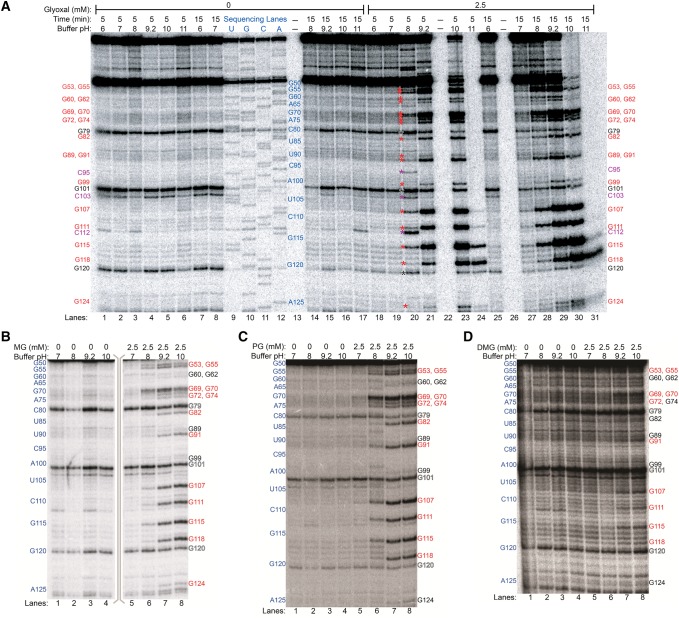
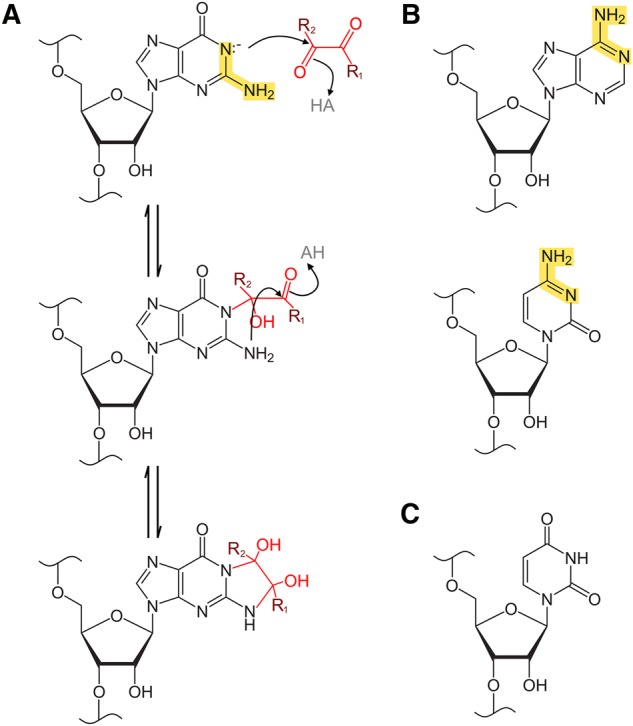
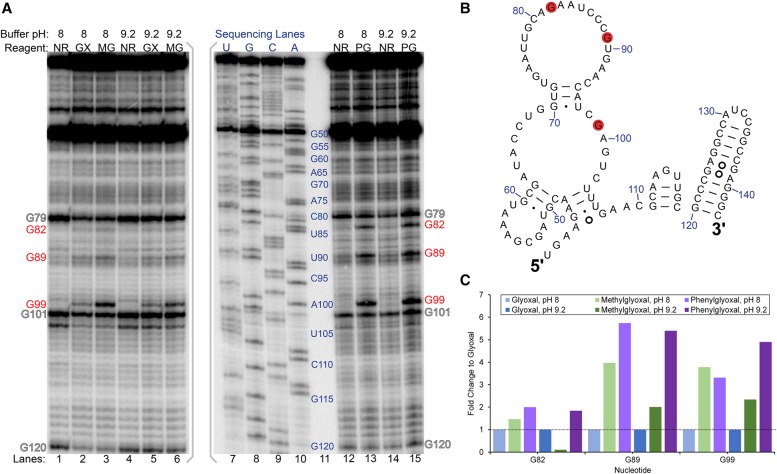
Elucidation of the folded structures that RNA forms in vivo is vital to understanding its functions. Chemical reagents that modify the Watson-Crick (WC) face of unprotected nucleobases are particularly useful in structure elucidation. Dimethyl sulfate penetrates cell membranes and informs on RNA base-pairing and secondary structure but only modifies the WC face of adenines and cytosines. We present glyoxal, methylglyoxal, and phenylglyoxal as potent in vivo reagents that target the WC face of guanines as well as cytosines and adenines. Tests on rice ( 5.8S rRNA in vitro read out by reverse transcription and gel electrophoresis demonstrate specific modification of almost all guanines in a time- and pH-dependent manner. Subsequent in vivo tests on rice, a eukaryote, and and , Gram-positive and Gram-negative bacteria, respectively, showed that all three reagents enter living cells without prior membrane permeabilization or pH adjustment of the surrounding media and specifically modify solvent-exposed guanine, cytosine, and adenine residues.
阐明RNA在体内形成的折叠结构对于理解其功能至关重要。修饰未受保护核碱基沃森-克里克(WC)面的化学试剂在结构阐明中特别有用。硫酸二甲酯可穿透细胞膜,并能揭示RNA碱基配对和二级结构,但仅修饰腺嘌呤和胞嘧啶的WC面。我们提出乙二醛、甲基乙二醛和苯乙二醛作为有效的体内试剂,它们靶向鸟嘌呤以及胞嘧啶和腺嘌呤的WC面。对水稻(通过逆转录和凝胶电泳体外读出5.8S rRNA)的测试表明,几乎所有鸟嘌呤都以时间和pH依赖性方式发生特异性修饰。随后分别对真核生物水稻以及革兰氏阳性菌和革兰氏阴性菌进行的体内测试表明,所有这三种试剂无需事先使细胞膜通透或调节周围培养基的pH值就能进入活细胞,并特异性修饰溶剂暴露的鸟嘌呤、胞嘧啶和腺嘌呤残基。