Department of Epileptology, University of Bonn, Bonn, Germany.
Department of Clinical and Experimental Epilepsy, Institute of Neurology, London, UK.
CNS Neurosci Ther. 2017 Dec;23(12):961-972. doi: 10.1111/cns.12765. Epub 2017 Oct 13.
Pooled evaluation of the key efficacy and safety profile of eslicarbazepine acetate (ESL) added-on to stable antiepileptic therapy in adults with focal-onset seizures.
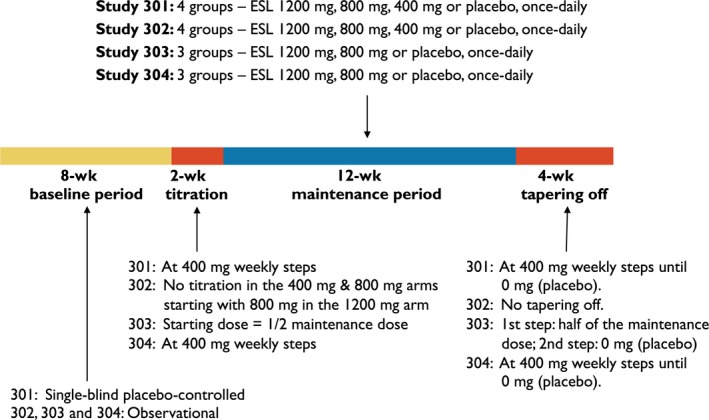
Data from 1703 patients enrolled in four phase III double-blind, randomized, placebo-controlled studies were pooled and analyzed. Following a 2 week titration period, ESL was administered at 400 mg, 800 mg, and 1200 mg once-daily doses for 12 weeks (maintenance period). Pooled efficacy variable was standardized (/4 weeks) seizure frequency (SSF) analyzed over the maintenance period as reduction in absolute and relative SSF and proportion of responders (≥50% reduction in SSF). Pooled safety was analyzed by means of adverse events and clinical laboratory assessments.
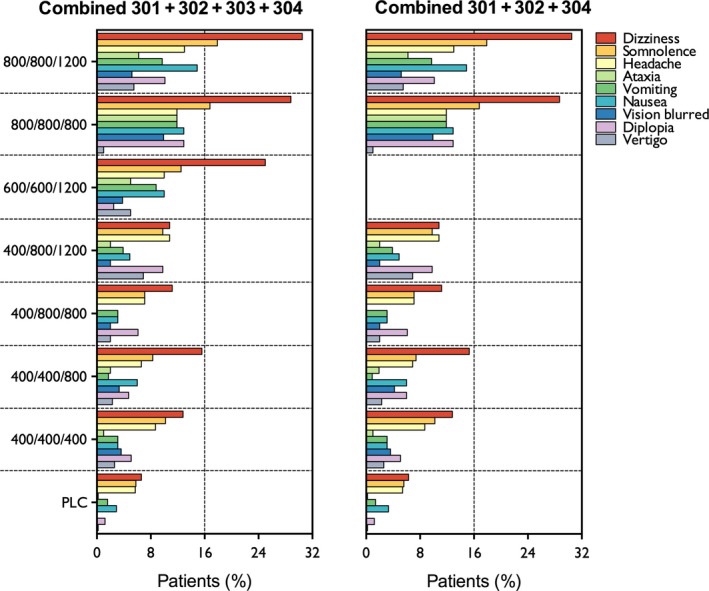
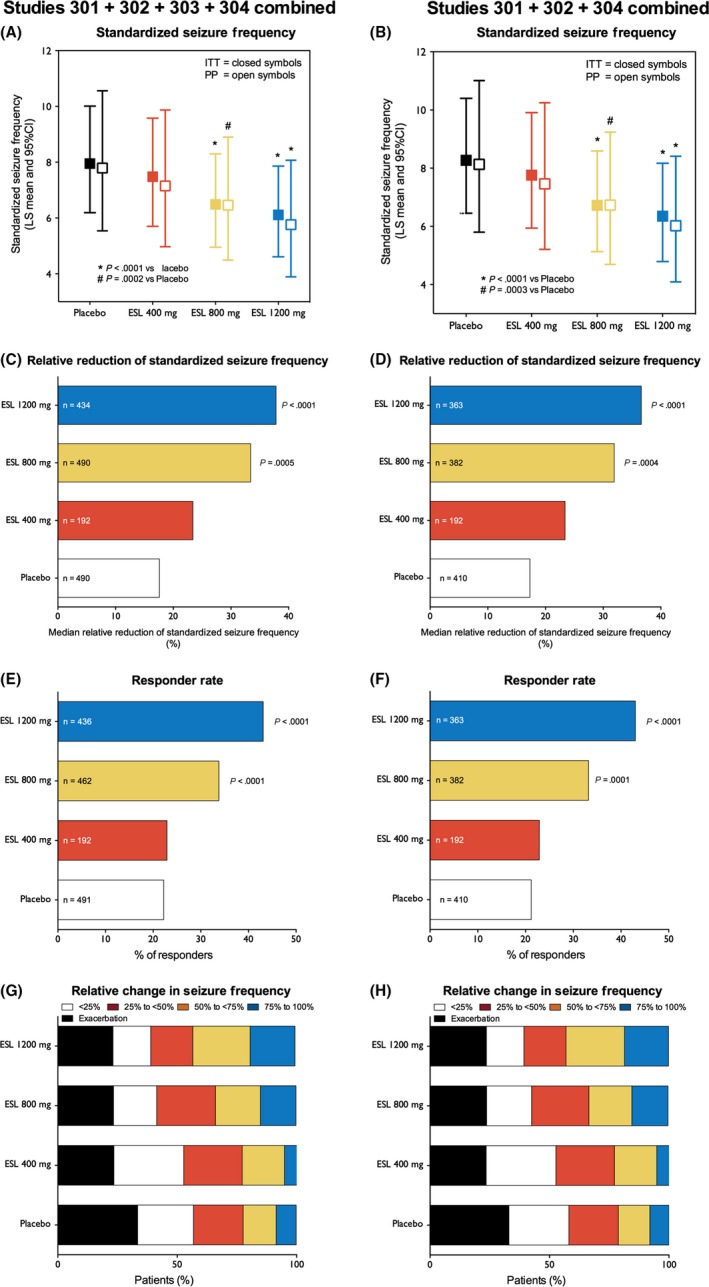
SSF was significantly reduced with ESL 800 mg (P < 0.0001) and 1200 mg (P < 0.0001) compared to placebo. Median relative reduction in SSF was 33.4% for ESL 800 mg and 37.8% for 1200 mg (placebo: 17.6%), and responder rate was 33.8% and 43.1% (placebo: 22.2%). ESL was more efficacious than placebo regardless of gender, geographical region, epilepsy duration, age at time of diagnosis, seizure type, and type of concomitant antiepileptic drugs (AED). Incidence of adverse events (AEs) and AEs leading to discontinuation was dose dependent. Most common AEs (>10% patients) were dizziness, somnolence, and nausea. The incidence of treatment-emergent AEs (dizziness, somnolence, ataxia, vomiting, and nausea) was lower in patients who began taking ESL 400 mg (followed by 400 mg increments to 800 or 1200 mg) than in those who began taking ESL 600 mg or 800 mg.
Once-daily ESL 800 mg and 1200 mg showed consistent results across all efficacy and safety endpoints, independent of study population characteristics and type of concomitant AEDs. Treatment initiated with ESL 400 mg followed by 400 mg increments to 800 or 1200 mg provides optimal balance of efficacy and tolerability.
汇总评估添加依佐加滨治疗成人局灶性发作癫痫患者的关键疗效和安全性概况。
汇总分析了 1703 名参与四项 III 期双盲、随机、安慰剂对照研究患者的数据。经过 2 周的滴定期后,依佐加滨以 400mg、800mg 和 1200mg 每日一次剂量治疗 12 周(维持期)。汇总的疗效变量为标准化(每 4 周)发作频率(SSF),分析维持期内绝对和相对 SSF的减少以及反应者的比例(SSF减少≥50%)。通过不良事件和临床实验室评估分析汇总安全性。
与安慰剂相比,依佐加滨 800mg(P<0.0001)和 1200mg(P<0.0001)显著降低 SSF。依佐加滨 800mg 的相对 SSF中位数降低 33.4%,1200mg 降低 37.8%(安慰剂降低 17.6%),反应者率分别为 33.8%和 43.1%(安慰剂为 22.2%)。无论性别、地理区域、癫痫持续时间、诊断时年龄、发作类型和伴随抗癫痫药物(AED)类型如何,依佐加滨均比安慰剂更有效。不良事件(AE)的发生率和导致停药的 AE 均与剂量有关。最常见的 AE(>10%患者)为头晕、嗜睡和恶心。在开始服用依佐加滨 400mg(随后增加 400mg 至 800mg 或 1200mg)的患者中,治疗中出现的 AE(头晕、嗜睡、共济失调、呕吐和恶心)发生率低于开始服用依佐加滨 600mg 或 800mg 的患者。
依佐加滨每日一次 800mg 和 1200mg 在所有疗效和安全性终点均表现一致,独立于研究人群特征和伴随 AED 类型。起始剂量为 400mg,随后增加至 800mg 或 1200mg 的依佐加滨治疗方案可提供最佳疗效和耐受性平衡。