Zhang Yanqing, Xiao Zhengtao, Zou Qin, Fang Jianhuo, Wang Qifan, Yang Xuerui, Gao Ning
MOE Key Laboratory of Protein Sciences, Beijing Advanced Innovation Center for Structural Biology, Tsinghua-Peking Center for Life Sciences, School of Life Sciences, Tsinghua University, Beijing 100084, China.
MOE Key Laboratory of Bioinformatics, Tsinghua-Peking Joint Center for Life Sciences, Center for Synthetic and Systems Biology, School of Life Sciences, Tsinghua University, Beijing 100084, China.
Genomics Proteomics Bioinformatics. 2017 Oct;15(5):324-330. doi: 10.1016/j.gpb.2017.04.005. Epub 2017 Oct 12.
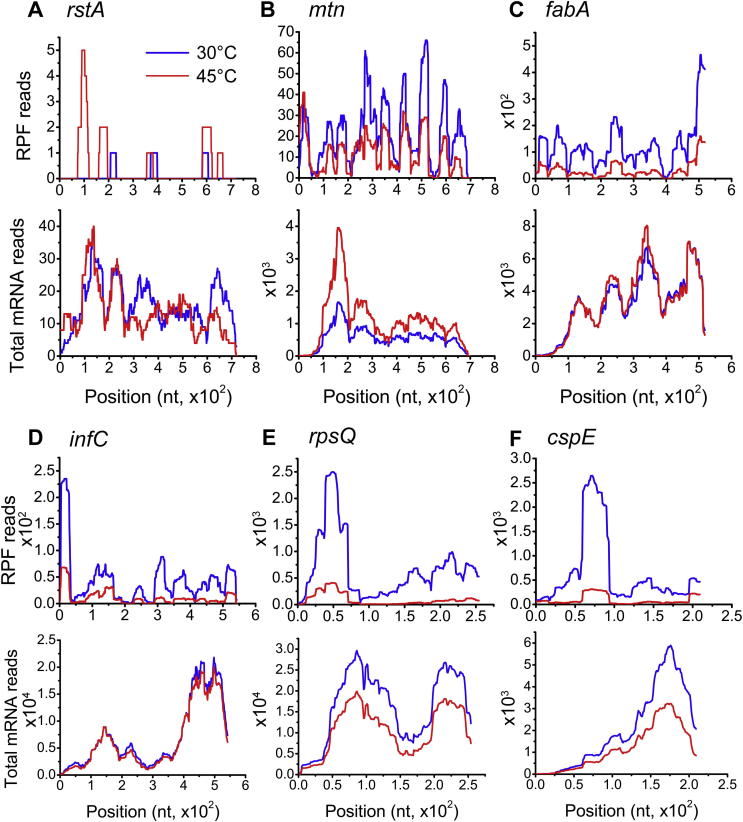
Heat shock response is a classical stress-induced regulatory system in bacteria, characterized by extensive transcriptional reprogramming. To compare the impact of heat stress on the transcriptome and translatome in Escherichia coli, we conducted ribosome profiling in parallel with RNA-Seq to investigate the alterations in transcription and translation efficiency when E. coli cells were exposed to a mild heat stress (from 30 °C to 45 °C). While general changes in ribosome footprints correlate with the changes of mRNA transcripts upon heat stress, a number of genes show differential changes at the transcription and translation levels. Translation efficiency of a few genes that are related to environment stimulus response is up-regulated, and in contrast, some genes functioning in mRNA translation and amino acid biosynthesis are down-regulated at the translation level in response to heat stress. Moreover, our ribosome occupancy data suggest that in general ribosomes accumulate remarkably in the starting regions of ORFs upon heat stress. This study provides additional insights into bacterial gene expression in response to heat stress, and suggests the presence of stress-induced but yet-to-be characterized cellular regulatory mechanisms of gene expression at translation level.
热休克反应是细菌中一种经典的应激诱导调节系统,其特征是广泛的转录重编程。为了比较热应激对大肠杆菌转录组和翻译组的影响,我们同时进行了核糖体谱分析和RNA测序,以研究大肠杆菌细胞暴露于轻度热应激(从30°C到45°C)时转录和翻译效率的变化。虽然热应激时核糖体足迹的总体变化与mRNA转录本的变化相关,但一些基因在转录和翻译水平上表现出差异变化。一些与环境刺激反应相关的基因的翻译效率上调,相反,一些在mRNA翻译和氨基酸生物合成中起作用 的基因在热应激下的翻译水平下调。此外,我们的核糖体占据数据表明,一般来说,热应激时核糖体在开放阅读框的起始区域显著积累。这项研究为细菌对热应激的基因表达提供了更多见解,并表明存在应激诱导但尚未表征的翻译水平基因表达的细胞调节机制。