
马铃薯在干旱和热胁迫下通过全基因组核糖体分析揭示的动态翻译景观
Dynamic Translational Landscape Revealed by Genome-Wide Ribosome Profiling under Drought and Heat Stress in Potato.
作者信息
Jian Hongju, Wen Shiqi, Liu Rongrong, Zhang Wenzhe, Li Ziyan, Chen Weixi, Zhou Yonghong, Khassanov Vadim, Mahmoud Ahmed M A, Wang Jichun, Lyu Dianqiu
机构信息
College of Agronomy and Biotechnology, Southwest University, Chongqing 400715, China.
State Cultivation Base of Crop Stress Biology for Southern Mountainous Land of Southwest University, Chongqing 400715, China.
出版信息
Plants (Basel). 2023 Jun 6;12(12):2232. doi: 10.3390/plants12122232.
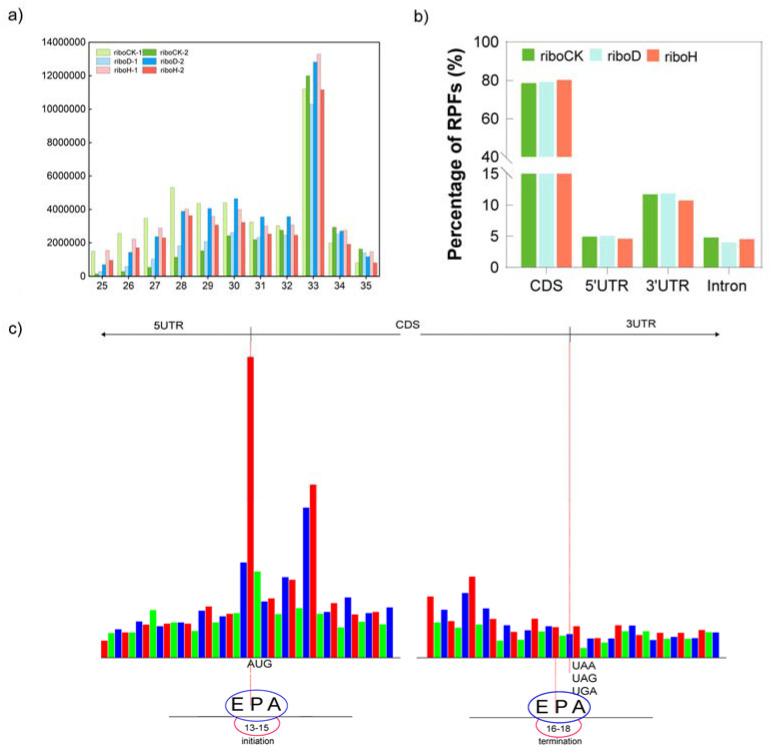
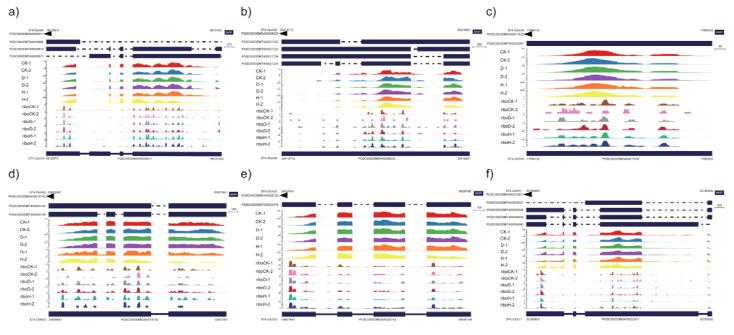
The yield and quality of potatoes, an important staple crop, are seriously threatened by high temperature and drought stress. In order to deal with this adverse environment, plants have evolved a series of response mechanisms. However, the molecular mechanism of potato's response to environmental changes at the translational level is still unclear. In this study, we performed transcriptome- and ribosome-profiling assays with potato seedlings growing under normal, drought, and high-temperature conditions to reveal the dynamic translational landscapes for the first time. The translational efficiency was significantly affected by drought and heat stress in potato. A relatively high correlation (0.88 and 0.82 for drought and heat stress, respectively) of the fold changes of gene expression was observed between the transcriptional level and translational level globally based on the ribosome-profiling and RNA-seq data. However, only 41.58% and 27.69% of the different expressed genes were shared by transcription and translation in drought and heat stress, respectively, suggesting that the transcription or translation process can be changed independently. In total, the translational efficiency of 151 (83 and 68 for drought and heat, respectively) genes was significantly changed. In addition, sequence features, including GC content, sequence length, and normalized minimal free energy, significantly affected the translational efficiencies of genes. In addition, 28,490 upstream open reading frames (uORFs) were detected on 6463 genes, with an average of 4.4 uORFs per gene and a median length of 100 bp. These uORFs significantly affected the translational efficiency of downstream major open reading frames (mORFs). These results provide new information and directions for analyzing the molecular regulatory network of potato seedlings in response to drought and heat stress.
土豆作为一种重要的主粮作物,其产量和品质受到高温和干旱胁迫的严重威胁。为应对这种不利环境,植物进化出了一系列响应机制。然而,土豆在翻译水平上对环境变化的响应分子机制仍不清楚。在本研究中,我们对在正常、干旱和高温条件下生长的土豆幼苗进行了转录组和核糖体谱分析,首次揭示了动态翻译图谱。干旱和热胁迫显著影响了土豆的翻译效率。基于核糖体谱和RNA测序数据,在转录水平和翻译水平之间全局观察到基因表达倍数变化具有相对较高的相关性(干旱和热胁迫分别为0.88和0.82)。然而,在干旱和热胁迫下,转录和翻译分别仅共享41.58%和27.69%的差异表达基因,这表明转录或翻译过程可以独立改变。总共151个基因(干旱和热胁迫分别为83个和68个)的翻译效率发生了显著变化。此外,包括GC含量、序列长度和标准化最小自由能在内的序列特征显著影响了基因的翻译效率。此外,在6463个基因上检测到28490个上游开放阅读框(uORF),每个基因平均有4.4个uORF,中位数长度为100 bp。这些uORF显著影响了下游主要开放阅读框(mORF)的翻译效率。这些结果为分析土豆幼苗响应干旱和热胁迫的分子调控网络提供了新的信息和方向。





 Zotero 插件