Bjerrum Jacob Tveiten, Steenholdt Casper, Ainsworth Mark, Nielsen Ole Haagen, Reed Michelle Ac, Atkins Karen, Günther Ulrich Leonhard, Hao Fuhua, Wang Yulan
Department of Gastroenterology, Medical Section, Herlev Hospital, University of Copenhagen, Herlev Ringvej 75, DK-2730, Herlev, Denmark.
HWB-NMR, Institute of Cancer and Genomic Sciences, University of Birmingham, Edgbaston, Birmingham, UK.
BMC Med. 2017 Oct 16;15(1):184. doi: 10.1186/s12916-017-0949-7.
One-third of inflammatory bowel disease (IBD) patients show no response to infliximab (IFX) induction therapy, and approximately half of patients responding become unresponsive over time. Thus, identification of potential treatment response biomarkers are of great clinical significance. This study employs spectroscopy-based metabolic profiling of serum from patients with IBD treated with IFX and healthy subjects (1) to substantiate the use of spectroscopy as a semi-invasive diagnostic tool, (2) to identify potential biomarkers of treatment response and (3) to characterise the metabolic changes during management of patients with tumour necrosis factor-α inhibitors.
Successive serum samples collected during IFX induction treatment (weeks 0, 2, 6 and 14) from 87 IBD patients and 37 controls were analysed by H nuclear magnetic resonance (NMR) spectroscopy. Data were analysed with principal components analysis and orthogonal projection to latent structures discriminant analysis using SIMCA-P+ v12 and MATLAB.
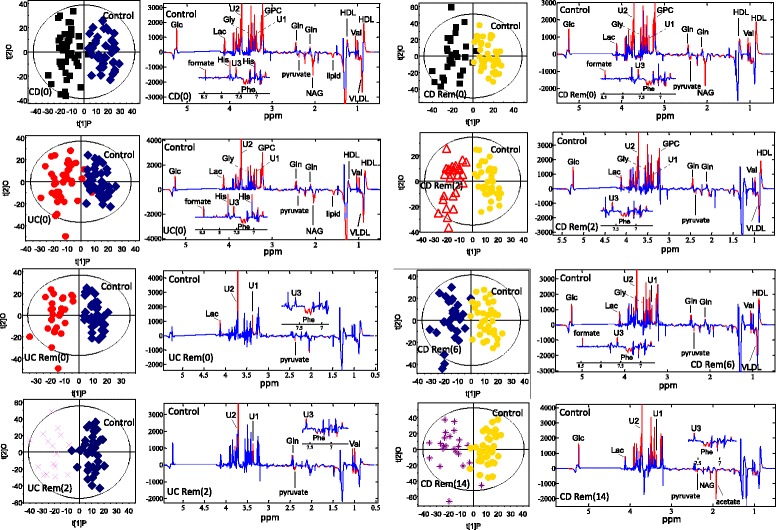
Metabolic profiles were significantly different between active ulcerative colitis and controls, active Crohn's disease and controls, and quiescent Crohn's disease and controls. Metabolites holding differential power belonged primarily to lipids and phospholipids with proatherogenic characteristics and metabolites in the pyruvate metabolism, suggestive of an intense inflammation-driven energy demand. IBD patients not responding to IFX were identified as a potentially distinct group based on their metabolic profile, although no applicable response biomarkers could be singled out in the current setting.
H NMR spectroscopy of serum samples is a powerful semi-invasive diagnostic tool in flaring IBD. With its use, we provide unique insights into the metabolic changes taking place during induction treatment with IFX. Of distinct clinical relevance is the identification of a reversible proatherogenic lipid profile in IBD patients with active disease, which partially explains the increased risk of cardiovascular disease associated with IBD.
三分之一的炎症性肠病(IBD)患者对英夫利昔单抗(IFX)诱导治疗无反应,且随着时间推移,约一半有反应的患者会变得无反应。因此,识别潜在的治疗反应生物标志物具有重大临床意义。本研究采用基于光谱的代谢谱分析方法,对接受IFX治疗的IBD患者和健康受试者的血清进行分析,以(1)证实光谱作为一种半侵入性诊断工具的用途,(2)识别潜在的治疗反应生物标志物,以及(3)描述肿瘤坏死因子-α抑制剂治疗患者过程中的代谢变化。
采用氢核磁共振(NMR)光谱分析,对87例IBD患者和37例对照在IFX诱导治疗期间(第0、2、6和14周)采集的连续血清样本进行分析。使用SIMCA-P + v12和MATLAB软件,通过主成分分析和正交投影到潜在结构判别分析对数据进行分析。
活动期溃疡性结肠炎与对照、活动期克罗恩病与对照、静止期克罗恩病与对照之间的代谢谱存在显著差异。具有鉴别能力的代谢物主要属于具有促动脉粥样硬化特征的脂质和磷脂,以及丙酮酸代谢中的代谢物,提示炎症驱动的能量需求强烈。尽管在当前情况下未能筛选出适用的反应生物标志物,但基于代谢谱,未对IFX产生反应的IBD患者被确定为一个潜在的独特群体。
血清样本的氢核磁共振光谱是活动期IBD的一种强大的半侵入性诊断工具。通过使用该工具,我们对IFX诱导治疗期间发生的代谢变化有了独特的见解。具有明显临床相关性的是,在患有活动性疾病的IBD患者中识别出一种可逆的促动脉粥样硬化脂质谱,这部分解释了与IBD相关的心血管疾病风险增加的原因。