Department of Epidemiology and Public Health, University College London, London, United Kingdom; Department of Gerontology, Federal University of São Carlos, São Carlos, Brazil.
Department of Epidemiology and Public Health, University College London, London, United Kingdom.
Clin Nutr. 2018 Dec;37(6 Pt A):2045-2053. doi: 10.1016/j.clnu.2017.09.018. Epub 2017 Oct 2.
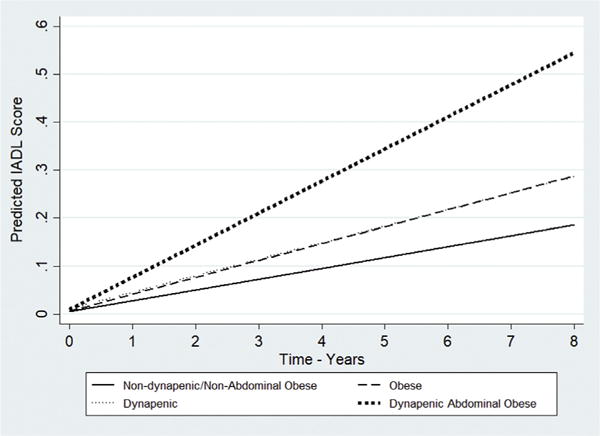
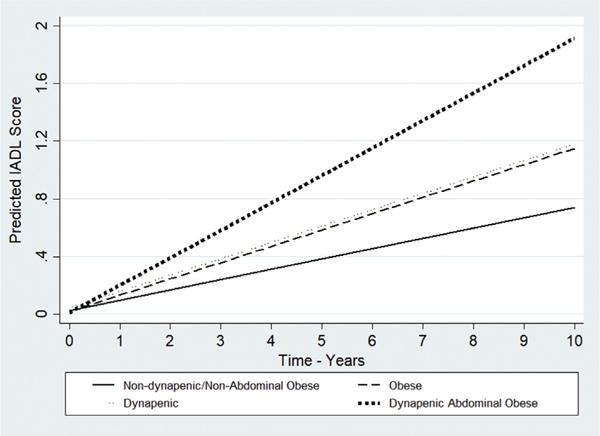
BACKGROUND/OBJECTIVES: The concept of dynapenic obesity has been gaining great attention recently. However, there is little epidemiological evidence demonstrating that dynapenic abdominal obese individuals have worse trajectories of disability than those with dynapenia and abdominal obesity alone. Our aim was to investigate whether dynapenia combined with abdominal obesity can result in worse trajectories of instrumental activities of daily living (IADL) among English and Brazilian older adults over eight and ten years of follow-up, respectively.
We used longitudinal data from 3374 participants from the English Longitudinal Study of Ageing (ELSA) and 1040 participants from the Brazilian Health, Well-being and Aging Study (SABE) who were free from disability as assessed by IADL at baseline. IADL disability was defined herein as a difficulty to perform the following: preparing meals, managing money, using transportation, shopping, using the telephone, house cleaning, washing clothes, and taking medications according to the Lawton IADL modified scale. The study population in each country was categorized into non-dynapenic/non-abdominal obese (reference group), abdominal obese, dynapenic and dynapenic abdominal obese according to their handgrip strength (<26 kg for men and <16 kg for women) and waist circumference (>102 cm for men and >88 cm for women). We used generalized linear mixed models with IADL as the outcome.
The estimated change over time in IADL disability was significantly higher for participants with dynapenic abdominal obesity compared to those with neither condition in both cohorts (ELSA: +0.023, 95% CI = 0.012-0.034, p < 0.001; SABE: +0.065, 95% CI = 0.038-0.091, p < 0.001). Abdominal obesity was also associated with changes over time in IADL disability (ELSA: +0.009, 95% CI = 0.002-0.015, p < 0.05; SABE: +0.021, 95% CI = 0.002-0.041, p < 0.05), which was not observed for dynapenia.
Abdominal obesity is an important risk factor for IADL decline but participants with dynapenic abdominal obesity had the highest rates of IADL decline over time among English and Brazilian older adults.
背景/目的:动力衰弱性肥胖的概念最近受到了广泛关注。然而,很少有流行病学证据表明动力衰弱性腹型肥胖者的残疾轨迹比单纯动力衰弱或单纯腹型肥胖者更差。我们的目的是研究在分别进行八年和十年的随访后,英国和巴西的老年人中,动力衰弱合并腹型肥胖是否会导致工具性日常生活活动(IADL)轨迹更差。
我们使用了来自英国老龄化纵向研究(ELSA)的 3374 名参与者和巴西健康、福利和老龄化研究(SABE)的 1040 名参与者的纵向数据,这些参与者在基线时均未被 IADL 评估为残疾。此处,IADL 残疾定义为:根据 Lawton 改良 IADL 量表,难以完成以下活动:做饭、管理钱财、使用交通工具、购物、使用电话、房屋清洁、洗衣服和服药。根据他们的握力(男性<26kg,女性<16kg)和腰围(男性>102cm,女性>88cm),每个国家的研究人群分为非动力衰弱/非腹型肥胖(参照组)、腹型肥胖、动力衰弱和动力衰弱性腹型肥胖。我们使用广义线性混合模型,将 IADL 作为因变量。
与既无动力衰弱也无腹型肥胖的参与者相比,两个队列中均为动力衰弱性腹型肥胖的参与者的 IADL 残疾估计随时间的变化明显更高(ELSA:+0.023,95%CI=0.012-0.034,p<0.001;SABE:+0.065,95%CI=0.038-0.091,p<0.001)。腹型肥胖也与 IADL 残疾的随时间变化有关(ELSA:+0.009,95%CI=0.002-0.015,p<0.05;SABE:+0.021,95%CI=0.002-0.041,p<0.05),而动力衰弱则没有观察到这种情况。
腹型肥胖是 IADL 下降的一个重要危险因素,但在英国和巴西的老年人中,动力衰弱性腹型肥胖者的 IADL 下降速度最快。