Chang Boksoon, Park Myung Jae, Choi Sue In, In Kwang Ho, Kim Chul Hwan, Lee Seung Hyeun
Division of Pulmonary and Critical Care Medicine, Department of Internal Medicine, Kyung Hee University School of Medicine.
Division of Respiratory and Critical Care Medicine, Department of Internal Medicine.
Onco Targets Ther. 2017 Sep 19;10:4625-4633. doi: 10.2147/OTT.S144895. eCollection 2017.
NANOG is a master transcription factor that regulates stem cell pluripotency and cellular reprograming. Increased NANOG expression has been associated with poor survival in several human malignancies. However, the clinical significance of NANOG overexpression in lung cancer has been scarcely evaluated. The aim of this study was to investigate whether NANOG levels are associated with clinical outcomes of patients with non-small cell lung cancer (NSCLC) who were treated with platinum-based chemotherapy.
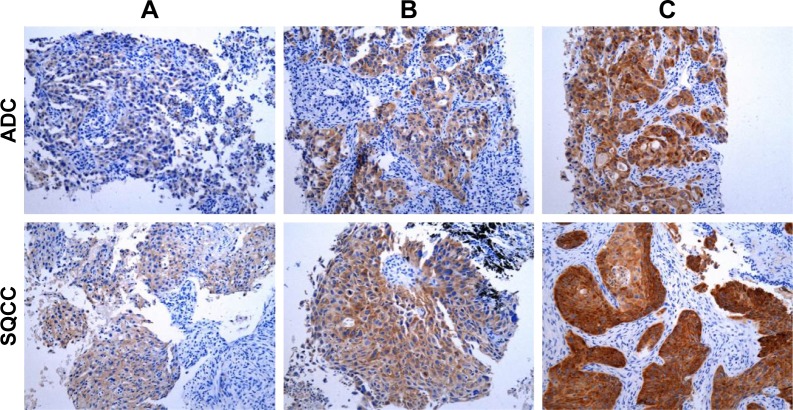
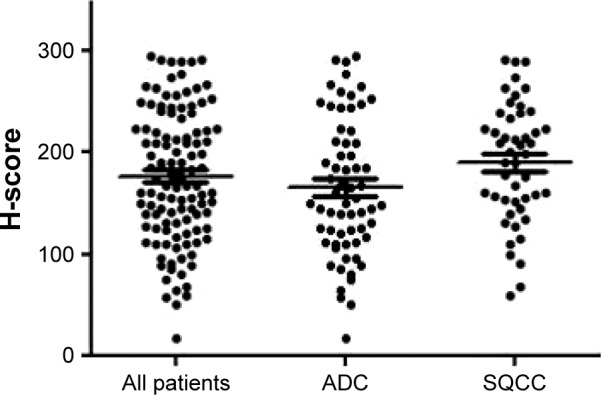
NANOG levels were evaluated immunohistochemically using the histologic score (H-score) in tumor tissues from patients with advanced NSCLC who received platinum-based doublet treatment. We performed survival analyses according to the NANOG levels and evaluated the association between clinicopathological parameters and levels of NANOG.
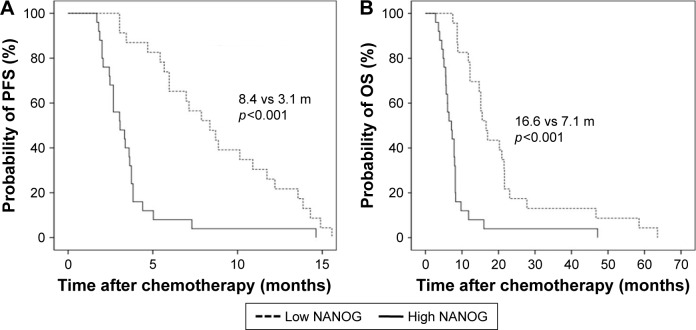
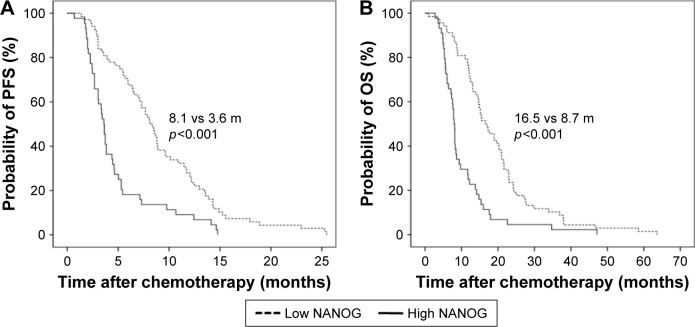
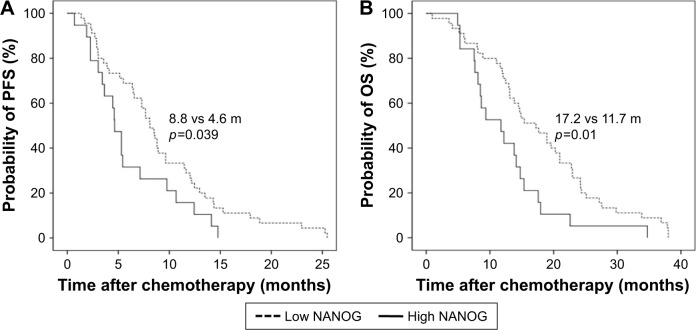
Multivariate analyses using 112 tumor specimens showed that high NANOG levels were independently associated with short progression-free survival (hazard ratio [HR] =3.09, 95% confidence interval [CI]: 2.01-4.76) and with short overall survival (HR =3.00, 95% CI: 1.98-4.54). Similar results were shown in the subgroup analyses for patients with adenocarcinoma and squamous cell carcinoma. NANOG expression was not associated with any clinicopathological parameter such as age, gender, smoking status, stage, differentiation, or histological subtypes.
NANOG overexpression was associated with poor response and short overall survival in patients with advanced NSCLC who were treated with platinum-based chemotherapy, suggesting that NANOG could be a potential adverse predictive marker in this setting.
NANOG是一种调控干细胞多能性和细胞重编程的主要转录因子。在几种人类恶性肿瘤中,NANOG表达增加与生存率低相关。然而,NANOG过表达在肺癌中的临床意义鲜有评估。本研究旨在调查NANOG水平是否与接受铂类化疗的非小细胞肺癌(NSCLC)患者的临床结局相关。
使用组织学评分(H评分)对接受铂类双药治疗的晚期NSCLC患者肿瘤组织中的NANOG水平进行免疫组化评估。我们根据NANOG水平进行生存分析,并评估临床病理参数与NANOG水平之间的关联。
对112个肿瘤标本进行多变量分析显示,高NANOG水平与无进展生存期短独立相关(风险比[HR]=3.09,95%置信区间[CI]:2.01-4.76),与总生存期短也独立相关(HR=3.00,95%CI:1.98-4.54)。腺癌和鳞状细胞癌患者的亚组分析显示了类似结果。NANOG表达与任何临床病理参数均无关联,如年龄、性别、吸烟状态、分期、分化程度或组织学亚型。
NANOG过表达与接受铂类化疗的晚期NSCLC患者反应差和总生存期短相关,提示NANOG可能是这种情况下潜在的不良预测标志物。