Murakami Hidetomo, Nohara Tetsuhito, Uchiyama Masanobu, Owan Yoshiyuki, Futamura Akinori, Shiromaru Azusa, Tsukada Setsuro, Saito Yu, Kuroda Takeshi, Yano Satoshi, Ishigaki Seiichiro, Katoh Hirotaka, Munechika Jiro, Ohgiya Yoshimitsu, Gokan Takehiko, Ono Kenjiro
Department of Neurology, School of Medicine, Showa University, Tokyo, Japan.
Department of Neurology, Showa University Northern Yokohama Hospital, Yokohama, Japan.
Front Aging Neurosci. 2017 Sep 29;9:321. doi: 10.3389/fnagi.2017.00321. eCollection 2017.
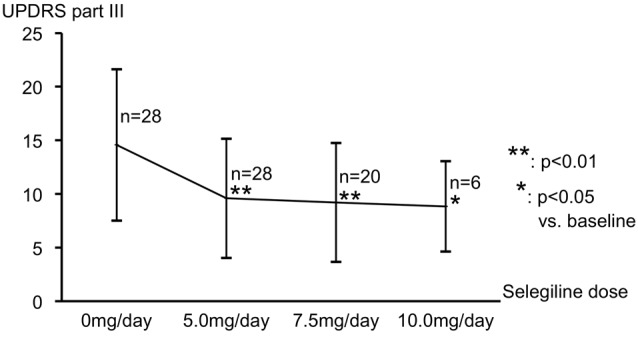
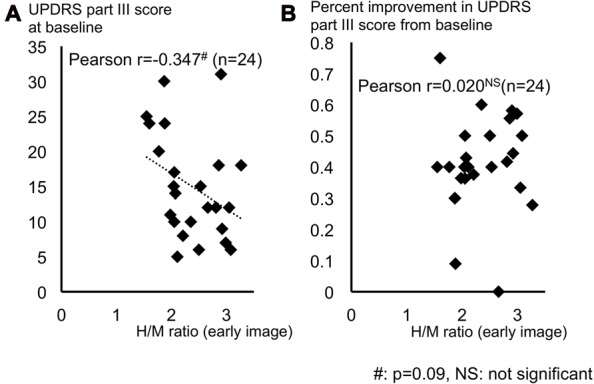
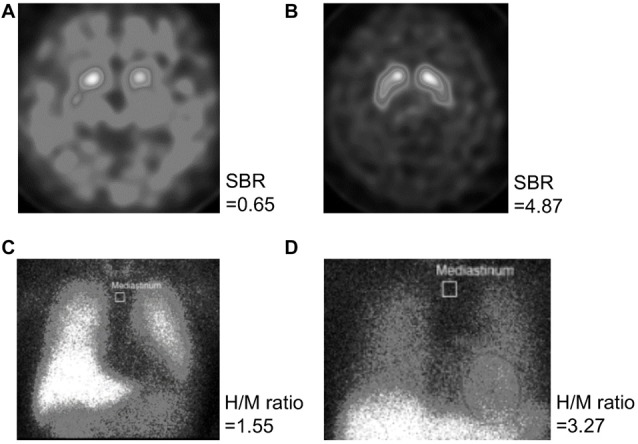
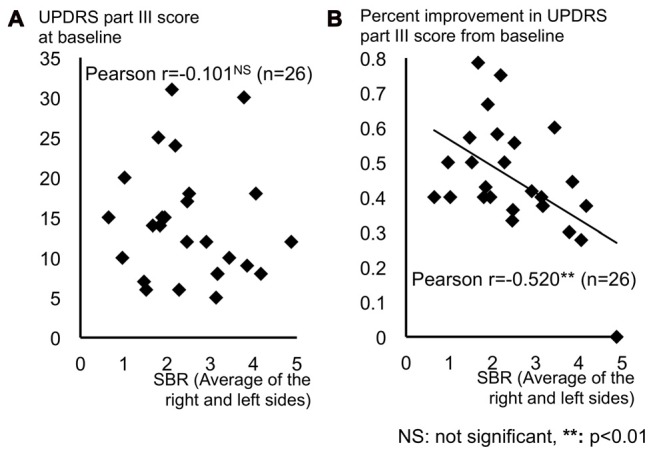
: Selegiline enhances the patient's endogenous dopamine by inhibiting dopamine metabolism. The efficacy of selegiline monotherapy for drug-naïve Parkinson's disease (PD) patients may depend on the degree of dopaminergic neuronal degeneration. I-Ioflupane single photon emission computed tomography (SPECT) and I-meta-iodobenzylguanidine (MIBG) myocardial scintigraphy are diagnostic methods to assess the pharmacological and pathological changes in PD. : We examined the utility of these imaging methods to predict the efficacy of selegiline monotherapy for motor symptoms in drug-naïve PD patients. : We observed the efficacy of selegiline monotherapy in 28 drug-naïve PD patients and compared the improvement in motor function and the imaging findings. These patients received selegiline monotherapy, and the amount was increased to the optimal dose in clinical practice. Motor function was assessed using the Unified Parkinson's Rating Scale (UPDRS) at baseline and at the stable dose. Imaging was performed before treatment, and the striatal Specific Binding Ratio (SBR) of the I-Ioflupane SPECT and the Heart-to-Mediastinum (H/M) ratio of the I-MIBG myocardial scintigraphy were calculated. Both ratios were compared with improvements in scores for motor assessment using Pearson's correlation coefficient. : The mean UPDRS part III score significantly improved with at least 5.0 mg/day of selegiline. Further dose escalation did not improve the mean motor score. The percent improvement in the motor score from baseline showed a significant negative correlation with the SBR of average of the right and left striatum, but not with the H/M ratio. Multiple regression analysis using patient's background factors showed that percent improvement in the UPDRS part III score directly correlate with the SBR ( = 0.04), but not with the age ( = 0.72), disease duration ( = 0.31), baseline UPDRS part III ( = 0.77) and the drug dose ( = 0.26). : PD patients with a lower accumulation of I-Ioflupane in the striatum can have greater improvement with selegiline monotherapy.
司来吉兰通过抑制多巴胺代谢来增强患者体内的内源性多巴胺。司来吉兰单药治疗初治帕金森病(PD)患者的疗效可能取决于多巴胺能神经元变性的程度。18F-氟代左旋多巴单光子发射计算机断层扫描(SPECT)和123I-间碘苄胍(MIBG)心肌闪烁显像术是评估PD药理和病理变化的诊断方法。我们研究了这些成像方法预测司来吉兰单药治疗初治PD患者运动症状疗效的实用性。我们观察了28例初治PD患者司来吉兰单药治疗的疗效,并比较了运动功能改善情况和成像结果。这些患者接受司来吉兰单药治疗,剂量在临床实践中增加至最佳剂量。在基线和稳定剂量时使用统一帕金森病评定量表(UPDRS)评估运动功能。在治疗前进行成像,计算18F-氟代左旋多巴SPECT的纹状体特异性结合率(SBR)和123I-MIBG心肌闪烁显像术的心脏与纵隔(H/M)比值。使用Pearson相关系数将这两个比值与运动评估得分的改善情况进行比较。司来吉兰每日至少5.0mg时,UPDRS第三部分的平均得分显著改善。进一步增加剂量并未改善平均运动得分。运动得分相对于基线的改善百分比与左右纹状体平均值的SBR呈显著负相关,但与H/M比值无关。使用患者背景因素进行的多元回归分析表明,UPDRS第三部分得分的改善百分比与SBR直接相关(P = 0.04),但与年龄(P = 0.72)、病程(P = 0.31)、基线UPDRS第三部分(P = 0.77)和药物剂量(P = 0.26)无关。纹状体中18F-氟代左旋多巴蓄积较低的PD患者接受司来吉兰单药治疗时改善可能更大。