Grenga Lucia, Chandra Govind, Saalbach Gerhard, Galmozzi Carla V, Kramer Günter, Malone Jacob G
Department of Molecular Microbiology, John Innes CentreNorwich, United Kingdom.
School of Biological Sciences, University of East AngliaNorwich, United Kingdom.
Front Microbiol. 2017 Sep 20;8:1784. doi: 10.3389/fmicb.2017.01784. eCollection 2017.
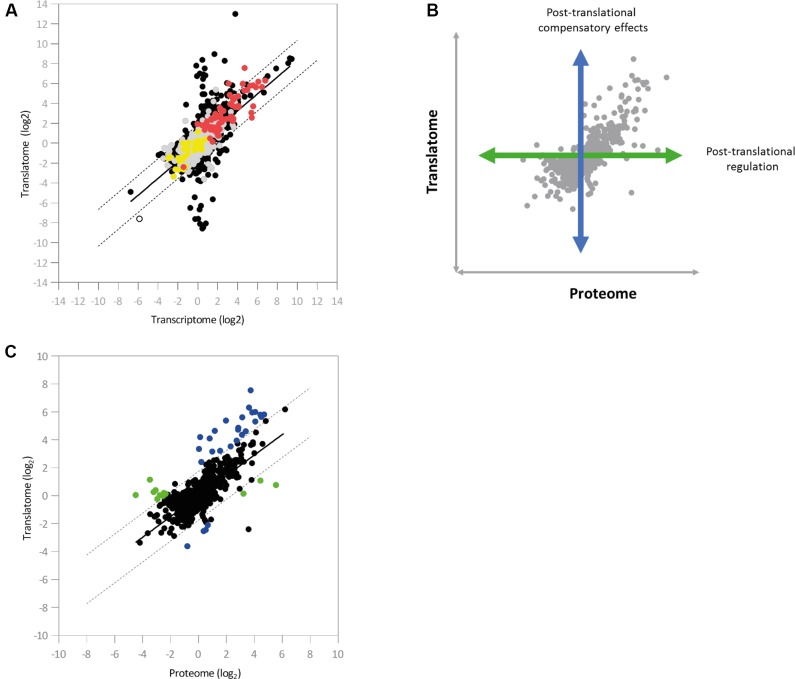
The ability of bacteria to respond to environmental change is based on the ability to coordinate, redirect and fine-tune their genetic repertoire as and when required. While we can learn a great deal from reductive analysis of individual pathways and global approaches to gene regulation, a deeper understanding of these complex signaling networks requires the simultaneous consideration of several regulatory layers at the genome scale. To highlight the power of this approach we analyzed the Hfq transcriptional/translational regulatory network in the model bacterium . We first used extensive 'omics' analyses to assess how deletion affects mRNA abundance, mRNA translation and protein abundance. The subsequent, multi-level integration of these datasets allows us to highlight the discrete contributions by Hfq to gene regulation at different levels. The integrative approach to regulatory analysis we describe here has significant potential, for both dissecting individual signaling pathways and understanding the strategies bacteria use to cope with external challenges.
细菌对环境变化作出反应的能力基于其在需要时协调、重新定向和微调其基因库的能力。虽然我们可以从对单个途径的简化分析和基因调控的全局方法中学到很多东西,但要更深入地理解这些复杂的信号网络,需要在基因组规模上同时考虑多个调控层面。为了突出这种方法的强大之处,我们分析了模式细菌中的Hfq转录/翻译调控网络。我们首先使用广泛的“组学”分析来评估缺失如何影响mRNA丰度、mRNA翻译和蛋白质丰度。随后对这些数据集进行的多层次整合,使我们能够突出Hfq在不同水平上对基因调控的离散贡献。我们在此描述的调控分析的综合方法具有巨大潜力,既可以剖析单个信号通路,又可以理解细菌应对外部挑战所采用的策略。