Kirkham-King Mandy, Brusseau Timothy A, Hannon James C, Castelli Darla M, Hilton Kristy, Burns Ryan D
Department of Health, Kinesiology, and Recreation, University of Utah, Salt Lake City, UT, USA.
College of Physical Activity and Sports Sciences, West Virginia University, Morgantown, WV, USA.
Prev Med Rep. 2017 Sep 28;8:135-139. doi: 10.1016/j.pmedr.2017.09.007. eCollection 2017 Dec.
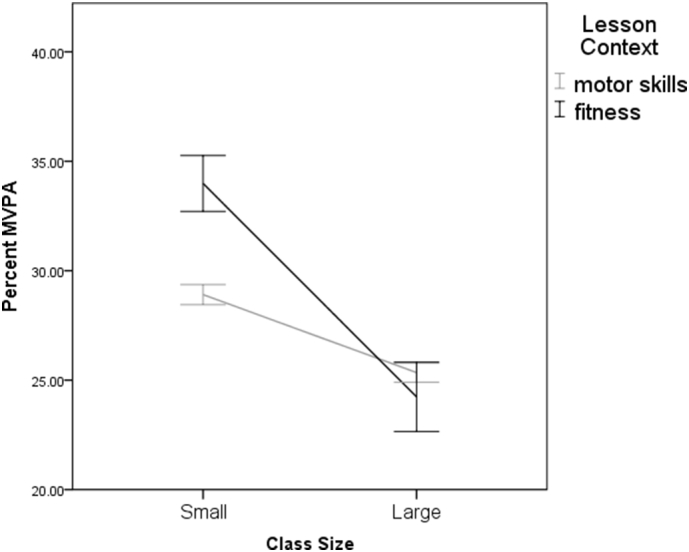
Optimizing physical activity during physical education is necessary for children to achieve daily physical activity recommendations. The purpose of this study was to examine the relationship among various contextual factors with accelerometer measured physical activity during elementary physical education. Data were collected during 2015-2016 from 281 students (1st-5th grade, 137 males, 144 females) from a private school located in a metropolitan area of Utah in the U.S. Students wore accelerometers for 12 consecutive weeks at an accelerometer wear frequency of 3 days per week during physical education. A multi-level general linear mixed effects model was employed to examine the relationship among various physical education contextual factors and percent of wear time in moderate-to-vigorous physical activity (%MVPA), accounting for clustering of observations within students and the clustering of students within classrooms. Explored contextual factors included grade level, lesson context, sex, and class size. Main effects and interactions among the factors were explored in the multi-level models. A two-way interaction of lesson context and class size on %MVPA was shown to be statistically significant. The greatest differences were found to be between fitness lessons using small class sizes compared to motor skill lessons using larger class sizes (β = 14.8%, 95% C.I. 5.7%-23.9% < 0.001). Lessons that included a focus on fitness activities with class sizes that were < 25 students associated with significantly higher %MVPA during elementary physical education.
优化体育课期间的身体活动对于儿童达到每日身体活动建议量是必要的。本研究的目的是探讨小学体育课期间各种情境因素与通过加速度计测量的身体活动之间的关系。2015年至2016年期间,从美国犹他州大都市地区一所私立学校的281名学生(1至5年级,137名男生,144名女生)收集数据。学生在体育课期间以每周3天的加速度计佩戴频率连续佩戴加速度计12周。采用多层次一般线性混合效应模型来研究各种体育课情境因素与中度至剧烈身体活动(%MVPA)的佩戴时间百分比之间的关系,同时考虑学生内部观察值的聚类以及教室内学生的聚类情况。探索的情境因素包括年级、课程情境、性别和班级规模。在多层次模型中探索了各因素的主效应和相互作用。结果显示,课程情境和班级规模对%MVPA的双向交互作用具有统计学意义。发现差异最大的是小班的健身课与大班的运动技能课相比(β = 14.8%,95%置信区间5.7% - 23.9% < 0.001)。在小学体育课期间,专注于健身活动且班级规模小于25名学生的课程与显著更高的%MVPA相关。