Nandakumar Pravanya, Mansouri Alireza, Das Sunit
Division of Neurosurgery, St. Michael's Hospital, University of Toronto, Toronto, ON, Canada.
Center for Cancer Research, Neuro-Oncology Branch, National Cancer Institute, National Institutes of Health, Bethesda, MD, United States.
Front Oncol. 2017 Sep 29;7:236. doi: 10.3389/fonc.2017.00236. eCollection 2017.
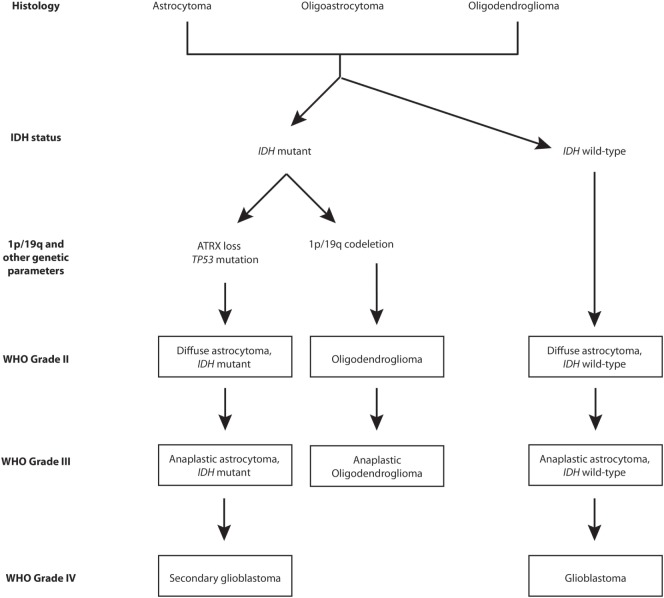
The current World Health Organization classification of CNS tumors has made a tremendous leap from past editions by incorporating molecular criteria in addition to the pre-existing histological parameters. The revised version has had a particular impact on the classification of diffuse low-grade gliomas and their high-grade variants. The ATRX status is one of the critical markers that define the molecular classification of gliomas. In this review, we will first provide an overview of the role of ATRX in regular cell biology. Furthermore, the role of ATRX in tumorigenesis, specifically gliomas, is comprehensively elucidated. The possible correlation of ATRX status with other genetic/epigenetic modifications is also presented. We conclude by discussing some of the challenges associated with incorporating ATRX status assessment into routine clinical practice while also exploring opportunities for future diagnostics/therapeutics in gliomas based on ATRX status.
世界卫生组织当前的中枢神经系统肿瘤分类在以往版本的基础上实现了巨大飞跃,除了原有的组织学参数外,还纳入了分子标准。修订版对弥漫性低级别胶质瘤及其高级别变体的分类产生了特别影响。ATRX状态是定义胶质瘤分子分类的关键标志物之一。在本综述中,我们首先将概述ATRX在正常细胞生物学中的作用。此外,还将全面阐明ATRX在肿瘤发生,特别是胶质瘤发生中的作用。同时也将介绍ATRX状态与其他基因/表观遗传修饰之间可能存在的相关性。我们在结尾处讨论了将ATRX状态评估纳入常规临床实践所面临的一些挑战,同时也探索了基于ATRX状态在胶质瘤未来诊断/治疗方面的机会。