Rezazadeh Fahimeh, Hajian Khadijeh, Shahidi Shoaleh, Piroozi Soraya
Dept. of Oral & Maxillofacial Medicine, School of Dentistry, Shiraz University of Medical Sciences, Shiraz, Iran.
Dept. of Oral & Maxillofacial Medicine, School of Dentistry, Shahid Sadoughi University of Medical Sciences, Yazd, Iran.
J Dent (Shiraz). 2017 Sep;18(3):187-192.
Temporomandibular disorder (TMD) is a clinical term used for clinical signs and symptoms that affect the temporomandibular joints, masticatory muscles, and associated structures. Surgical and non-surgical treatments can be used for management of TMD. Non-surgical route is the main part of the treatment, since clinicians prefer non-aggressive treatment for TMD such as pharmacological and physical therapy. Low-level laser therapy (LLLT) and transcutaneous electrical nerve stimulation (TENS) are the main procedures in physical therapy.
The aim of this study was to evaluate the effectiveness of TENS and LLLT in treatment of TMD patients who did not respond to pharmacological therapy.
This clinical trial was performed on 45 patients who randomly received either TENS or LLLT for 8 sessions. LLLT was applied with diode laser (Ga-Al-As, 980nm, dose 5j/cm) and TENS by using two carbon electrodes with 75 Hz frequency (0.75 msec pulse width). Helkimo index and visual analogue scale (VAS) were measured during the treatment period and throughout the follow-up sessions.
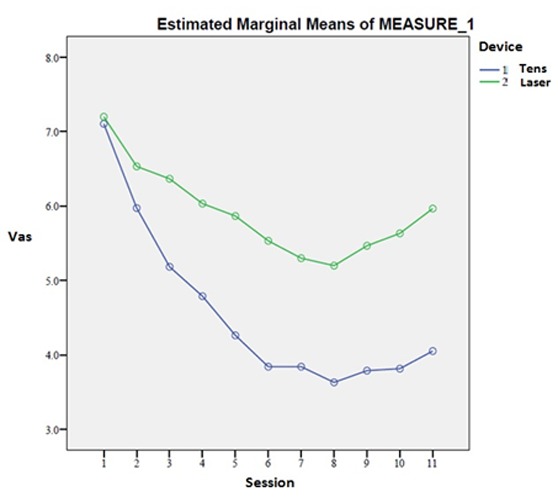
Significant reduction in the VAS and Helkimo index was observed in both TENS and LLLT group. There was no significant difference between the two methods during the treatment; however, TENS was more effective in pain reduction in follow-ups.
This study justified the use of TENS therapy as well as LLLT in drug-resistant TMD. Both were useful in relieving the pain and muscles tenderness, although, TENS was more effective than LLLT.
颞下颌关节紊乱病(TMD)是一个临床术语,用于描述影响颞下颌关节、咀嚼肌及相关结构的临床体征和症状。TMD的治疗可采用手术和非手术方法。非手术途径是治疗的主要部分,因为临床医生倾向于对TMD采用非侵入性治疗,如药物治疗和物理治疗。低强度激光疗法(LLLT)和经皮电刺激神经疗法(TENS)是物理治疗中的主要方法。
本研究的目的是评估TENS和LLLT对药物治疗无效的TMD患者的治疗效果。
本临床试验对45例患者进行,这些患者被随机分为两组,分别接受8次TENS或LLLT治疗。LLLT使用二极管激光(Ga-Al-As,980nm,剂量5j/cm),TENS使用两个碳电极,频率为75Hz(脉冲宽度0.75毫秒)。在治疗期间和整个随访过程中测量赫尔基莫指数(Helkimo index)和视觉模拟量表(VAS)。
TENS组和LLLT组的VAS和赫尔基莫指数均显著降低。治疗期间两种方法之间无显著差异;然而,在随访中TENS在减轻疼痛方面更有效。
本研究证明了TENS疗法和LLLT在耐药性TMD治疗中的应用价值。两者都有助于缓解疼痛和肌肉压痛,尽管TENS比LLLT更有效。