Lee Yu-Lin, Lin Kuan-Yin, Cheng Chien-Yu, Li Chia-Wen, Yang Chia-Jui, Tsai Mao-Song, Tang Hung-Jen, Lin Te-Yu, Wang Ning-Chi, Lee Yi-Chien, Lin Shih-Ping, Huang Yu-Shan, Sun Hsin-Yun, Zhang Jun-Yu, Ko Wen-Chien, Cheng Shu-Hsing, Lee Yuan-Ti, Liu Chun-Eng, Hung Chien-Ching
Department of Internal Medicine, Changhua Christian Hospital, Changhua, Taiwan.
Department of Medicine, National Taiwan University Hospital Jin-Shan Branch, New Taipei City, Taiwan.
PLoS One. 2017 Oct 16;12(10):e0186338. doi: 10.1371/journal.pone.0186338. eCollection 2017.
The study aimed to describe the seroprevalence of hepatitis A virus (HAV) in HIV-positive adult patients in Taiwan between 2012 and 2016 and to examine the evolution of HAV seroprevalence between 2004-2007 and 2012-2016.
Clinical information and data of anti-HAV antibody results were collected from 2,860 antiretroviral-naïve HIV-positive Taiwanese aged 18 years or older who initiated combination antiretroviral therapy at 11 hospitals around Taiwan between 2012 and 2016 (2012-2016 cohort). A multivariate logistic regression model was applied to identify independent variables associated with HAV seropositivity. Comparisons of HAV seroprevalences and associated clinical characteristics were made between this 2012-2016 cohort and a previous cohort of 1580 HIV-positive patients in 2004-2007 (2004-2007 cohort).
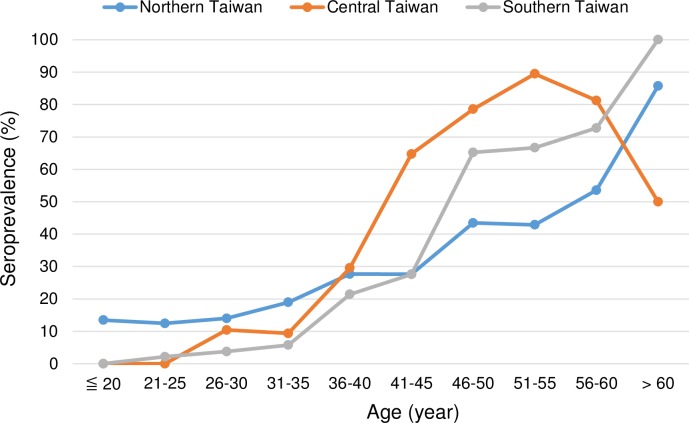
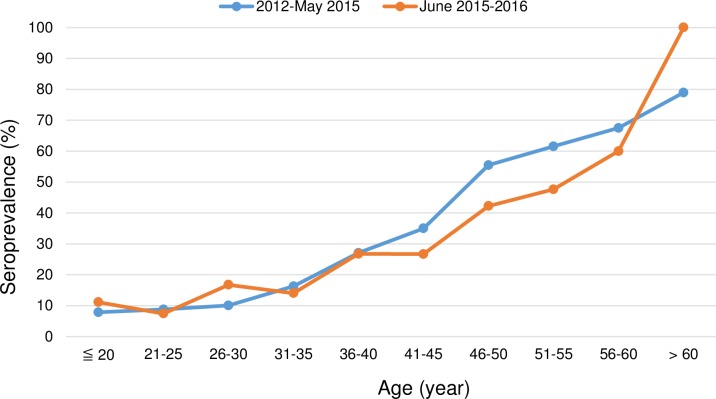
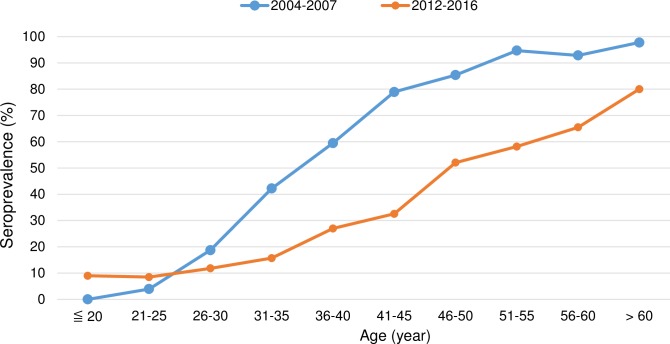
Of the 2,860 HIV-positive patients between 2012 and 2016, the overall HAV seropositivity rate was 21.2% (605/2860), which was independently associated with an older age (adjusted odds ratio [AOR], per 1-year increase, 1.13; 95% confidence interval [95% CI], 1.11-1.15) and co-infection with hepatitis B virus (AOR 1.44; 95% CI, 1.08-1.93). Residence in southern Taiwan (AOR 0.49; 95% CI, 0.34-0.72) was inversely associated with HAV seropositivity. The overall HAV seroprevalence in the 2012-2016 cohort was significantly lower than that in the 2004-2007 cohort (21.2% vs 60.9%, p<0.01). The decreases of HAV seropositivity rate were observed in nearly every age-matched group, which suggested the cohort effect on HAV seroepidemiology. However, among individuals aged 25 years or younger, the HAV seropositivity rate increased from 3.8% (2/52) in the 2004-2007 cohort to 8.5% (50/587) in the 2012-2016 cohort, with 95.4% (560/587) being MSM in this age group of the latter cohort.
HAV seroprevalence has decreased with time among HIV-positive adults in Taiwan. The cohort effect has increased the number of young HIV-positive patients that are susceptible to HAV infection in a country without nationwide childhood vaccination program against HAV.
本研究旨在描述2012年至2016年台湾地区HIV阳性成年患者中甲型肝炎病毒(HAV)的血清流行率,并探讨2004 - 2007年和2012 - 2016年期间HAV血清流行率的变化。
收集了2860例18岁及以上未接受过抗逆转录病毒治疗的HIV阳性台湾患者的临床信息和抗HAV抗体检测结果数据,这些患者于2012年至2016年在台湾各地的11家医院开始接受联合抗逆转录病毒治疗(2012 - 2016队列)。应用多因素逻辑回归模型来确定与HAV血清阳性相关的独立变量。对该2012 - 2016队列与2004 - 2007年的1580例HIV阳性患者的前一个队列(2004 - 2007队列)之间的HAV血清流行率及相关临床特征进行了比较。
在2012年至2016年的2860例HIV阳性患者中,总体HAV血清阳性率为21.2%(605/2860),其与年龄较大(调整后的优势比[AOR],每增加1岁,为1.13;95%置信区间[95%CI],1.11 - 1.15)以及与乙型肝炎病毒合并感染(AOR 1.44;95%CI,1.08 - 1.93)独立相关。居住在台湾南部(AOR 0.49;95%CI,0.34 - 0.72)与HAV血清阳性呈负相关。2012 - 2016队列中的总体HAV血清流行率显著低于2004 - 2007队列(21.2%对60.9%,p<0.01)。几乎在每个年龄匹配组中均观察到HAV血清阳性率的下降,这表明队列效应影响了HAV血清流行病学。然而,在25岁及以下的个体中,HAV血清阳性率从2004 - 2007队列中的3.8%(2/52)增加到2012 - 2016队列中的8.5%(50/587),在后一个队列的该年龄组中95.4%(560/587)为男男性行为者。
台湾地区HIV阳性成年人中HAV血清流行率随时间下降。在一个没有全国性针对HAV的儿童疫苗接种计划的国家,队列效应增加了易感染HAV的年轻HIV阳性患者的数量。