Physiopathology of Inflammatory Bone Diseases, University of the Littoral Opal Coast, F-62327, Boulogne sur Mer, France.
Electrochemical Signaling in Development and Disease, Max Delbrück Center for Molecular Medicine in the Helmholtz Association, D-13125, Berlin, Germany.
J Biomed Sci. 2017 Oct 16;24(1):78. doi: 10.1186/s12929-017-0385-1.
Improving the neuronal yield from in vitro cultivated neural progenitor cells (NPCs) is an essential challenge in transplantation therapy in neurological disorders. In this regard, Ascorbic acid (AA) is widely used to expand neurogenesis from NPCs in cultures although the mechanisms of its action remain unclear. Neurogenesis from NPCs is regulated by the redox-sensitive WNT/β-catenin signaling pathway. We therefore aimed to investigate how AA interacts with this pathway and potentiates neurogenesis.
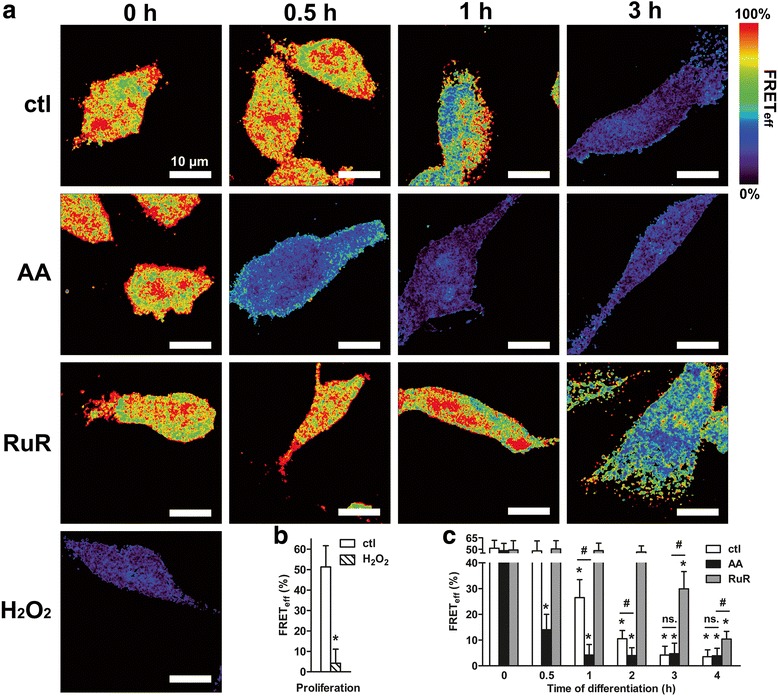
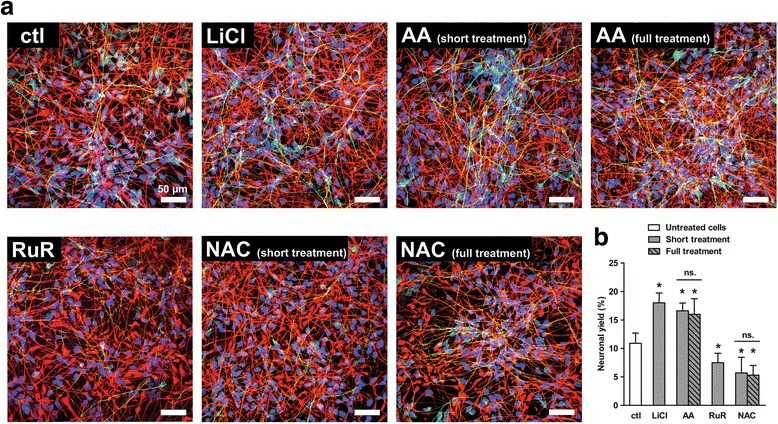
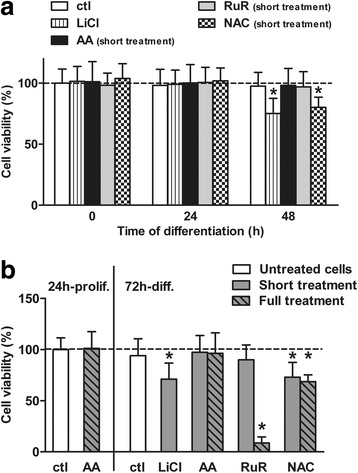
Effects of 200 μM AA were compared with the pro-neurogenic reagent and WNT/β-catenin signaling agonist lithium chloride (LiCl), and molecules with antioxidant activities i.e. N-acetyl-L-cysteine (NAC) and ruthenium red (RuR), in differentiating neural progenitor ReNcell VM cells. Cells were supplemented with reagents for two periods of treatment: a full period encompassing the whole differentiation process versus an early short period that is restricted to the cell fate commitment stage. Intracellular redox balance and reactive oxygen species (ROS) metabolism were examined by flow cytometry using redox and ROS sensors. Confocal microscopy was performed to assess cell viability, neuronal yield, and levels of two proteins: Nucleoredoxin (NXN) and the WNT/β-catenin signaling component Dishevelled 2 (DVL2). TUBB3 and MYC gene responses were evaluated by quantitative real-time PCR. DVL2-NXN complex dissociation was measured by fluorescence resonance energy transfer (FRET).
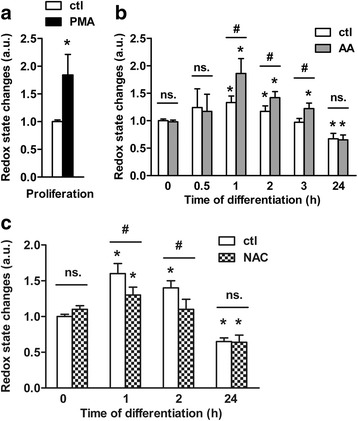
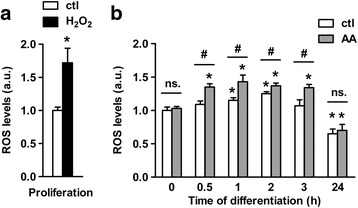
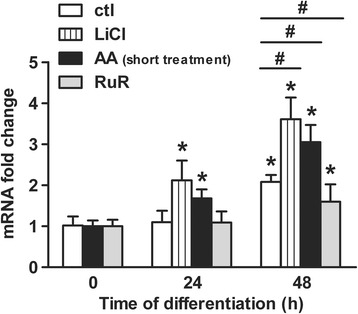
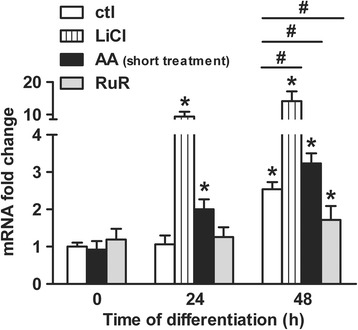
In contrast to NAC which predictably exhibited an antioxidant effect, AA treatment enhanced ROS metabolism with no cytotoxic induction. Both drugs altered ROS levels only at the early stage of the differentiation as no changes were held beyond the neuronal fate commitment stage. FRET studies showed that AA treatment accelerated the redox-dependent release of the initial pool of DVL2 from its sequestration by NXN, while RuR treatment hampered the dissociation of the two proteins. Accordingly, AA increased WNT/β-catenin signaling output i.e. MYC mRNA level, whereas RuR attenuated it. Moreover, AA improved neurogenesis as much as LiCl as both TUBB3-positive cell yield and TUBB3 mRNA level increased, while NAC or RuR attenuated neurogenesis. Markedly, the neurogenesis outputs between the short and the full treatment with either NAC or AA were found unchanged, supporting our model that neuronal yield is altered by events taking place at the early phase of differentiation.
Our findings demonstrate that AA treatment elevates ROS metabolism in a non-lethal manner prior to the NPCs commitment to their neuronal fate. Such effect stimulates the redox-sensitive DVL2 activation and WNT/β-catenin signaling response that would enhance the ensuing neuronal cell differentiation.
提高体外培养神经祖细胞(NPCs)的神经元产量是神经紊乱移植治疗中的一个重要挑战。在这方面,抗坏血酸(AA)被广泛用于扩大 NPC 培养物中的神经发生,尽管其作用机制尚不清楚。NPC 中的神经发生受到氧化还原敏感的 WNT/β-catenin 信号通路的调节。因此,我们旨在研究 AA 如何与该途径相互作用并增强神经发生。
比较 200μM AA 与促神经生成试剂和 WNT/β-catenin 信号激动剂氯化锂(LiCl)以及具有抗氧化活性的分子(即 N-乙酰-L-半胱氨酸(NAC)和钌红(RuR))在分化神经祖细胞 ReNcell VM 细胞中的作用。用试剂处理细胞两个时期:一个完整的周期,涵盖整个分化过程,另一个是早期的短周期,仅限于细胞命运决定阶段。使用氧化还原和 ROS 传感器通过流式细胞术检查细胞内氧化还原平衡和活性氧(ROS)代谢。通过共聚焦显微镜评估细胞活力、神经元产量以及两种蛋白质的水平:核还原酶(NXN)和 WNT/β-catenin 信号成分 Dishevelled 2(DVL2)。通过定量实时 PCR 评估 TUBB3 和 MYC 基因反应。通过荧光共振能量转移(FRET)测量 DVL2-NXN 复合物解离。
与可预测地表现出抗氧化作用的 NAC 相反,AA 处理增强了 ROS 代谢,而没有诱导细胞毒性。两种药物仅在分化的早期阶段改变 ROS 水平,因为在神经元命运决定阶段之后没有变化。FRET 研究表明,AA 处理加速了初始 DVL2 池从 NXN 隔离的氧化还原依赖性释放,而 RuR 处理阻碍了两种蛋白质的解离。因此,AA 增加了 WNT/β-catenin 信号输出,即 MYC mRNA 水平,而 RuR 则减弱了它。此外,AA 改善了神经发生,就像 LiCl 一样,因为 TUBB3 阳性细胞产量和 TUBB3 mRNA 水平都增加了,而 NAC 或 RuR 则减弱了神经发生。值得注意的是,在使用 NAC 或 AA 进行短期和完整治疗之间,神经发生输出保持不变,这支持了我们的模型,即神经元产量是通过分化早期发生的事件改变的。
我们的发现表明,AA 处理在 NPC 决定其神经元命运之前以非致死的方式提高 ROS 代谢。这种作用刺激了氧化还原敏感的 DVL2 激活和 WNT/β-catenin 信号反应,从而增强随后的神经元细胞分化。