Oncology Department, Chinese PLA General Hospital, Beijing, China.
Sci Rep. 2017 Oct 16;7(1):13208. doi: 10.1038/s41598-017-13192-8.
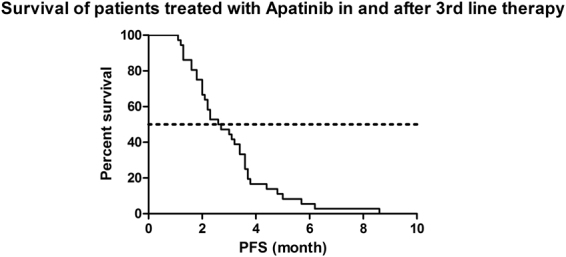
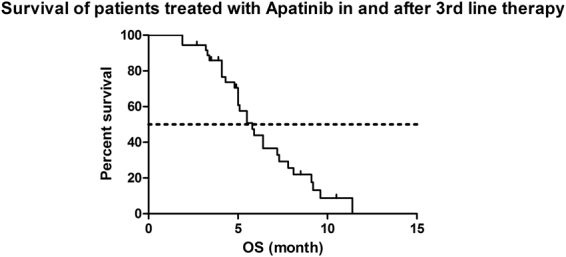
Apatinib has been proved to be effective and safe among patients in gastric cancer in Phase II and III Trials. We aimed to evaluate its efficacy and safety in real world practice, and to explore factors associated with efficacy. Between January 2015 and February 2017, totally 36 patients with advanced gastric adenocarcinoma or adenocarcinoma of gastroesophageal junction (GEJ) were enrolled and followed up retrospectively after failing at least two lines of systemic therapy. The mPFS was 2.65 months (95%CI 1.66-3.54), and mOS was 5.8 months (95%CI 4.77-6.83). Two patients achieved partial response, and nineteen achieved stable disease. The disease control rate (DCR) was 58.3%, and objective response rate (ORR) was 5.6%. Common grade adverse events were hypertension (38.9%), proteinuria (36.1%), and neutropenia (33.3%). And the most common adverse events over grade 3 were hand-foot syndrome (8.3%), anemia (5.6%), and diarrhea (5.6%). No treatment-related death was documented during the drug administration. Exploratory analyses indicated patients treated with antiangiogenic therapy previously were more likely to benefit from apatinib.
阿帕替尼已被证明在 II 期和 III 期试验中对胃癌患者有效且安全。我们旨在评估其在真实世界实践中的疗效和安全性,并探索与疗效相关的因素。2015 年 1 月至 2017 年 2 月,共纳入 36 例晚期胃腺癌或胃食管结合部腺癌患者,这些患者在至少两种系统治疗失败后进行了回顾性随访。mPFS 为 2.65 个月(95%CI 1.66-3.54),mOS 为 5.8 个月(95%CI 4.77-6.83)。2 例患者部分缓解,19 例患者病情稳定。疾病控制率(DCR)为 58.3%,客观缓解率(ORR)为 5.6%。常见的 1-2 级不良反应有高血压(38.9%)、蛋白尿(36.1%)和中性粒细胞减少(33.3%)。最常见的 3 级以上不良反应是手足综合征(8.3%)、贫血(5.6%)和腹泻(5.6%)。在药物治疗期间,未发生与治疗相关的死亡。探索性分析表明,先前接受过抗血管生成治疗的患者更有可能从阿帕替尼中获益。