Cloitre Marylene, Garvert Donn W, Weiss Brandon J
National Center for PTSD, Veterans Affairs Palo Alto Health Care System, Palo Alto, CA, USA.
Department of Psychiatry and Behavioral Sciences, Stanford University School of Medicine, Palo Alto, CA, USA.
Eur J Psychotraumatol. 2017 Oct 10;8(1):1377028. doi: 10.1080/20008198.2017.1377028. eCollection 2017.
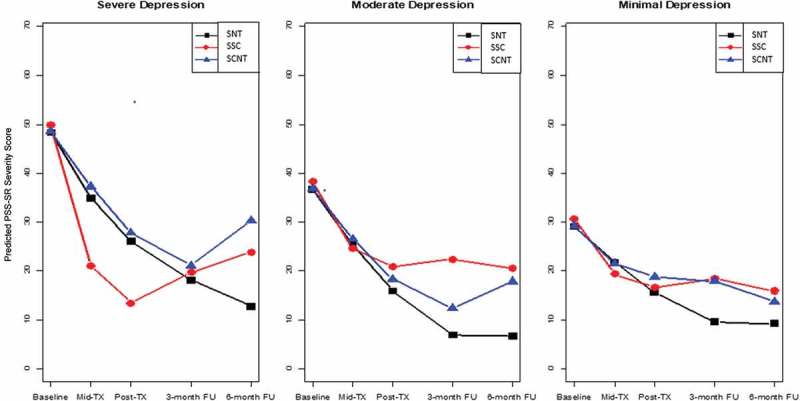
: Depression among those who have experienced childhood abuse is associated with earlier onset, more persistent and severe symptoms, more frequent relapse, and poorer treatment outcomes across a variety of psychiatric disorders. In addition, individuals with a history of childhood abuse are more likely to develop post-traumatic stress disorder (PTSD) co-occurring with depression. : This study evaluated whether severity of depression moderated the outcome in a PTSD treatment for childhood abuse survivors. Specifically, we assessed whether individuals with significant depression obtained better outcomes when provided with a two-module treatment which included a skills training component with behavioral activation interventions, Skills Training in Affective and Interpersonal Regulation (STAIR) followed by a trauma-focused component, Narrative Therapy, as compared to two control conditions where one component (STAIR or Narrative Therapy) was replaced with Supportive Counseling. : Participants were 104 women with PTSD related to childhood abuse. Participants were randomized into three conditions: (1) STAIR plus Narrative Therapy (SNT), (2) STAIR plus Supportive Counseling (SSC), and (3) Supportive Counseling plus Narrative Therapy (SCNT). Clinician-Administered PTSD Scale for DSM-IV (CAPS-IV) PTSD symptom severity was assessed at pre-treatment, post-treatment, and 3 and 6 month follow-up. : Participants with severe depression showed superior PTSD symptom reduction following SNT, while those in the other two conditions experienced a loss of improvement after treatment ended. A similar finding was obtained among those with moderate depression, while among those with low levels of depression, outcomes did not differ across the three treatment conditions. : Childhood abuse survivors with severe depression obtained superior outcomes in a treatment that combined skills training with trauma-focused work. Skills packages which contain behavioral activation interventions in combination with trauma-focused work may be particularly beneficial for patients with childhood abuse and severe depression.
在经历过童年期虐待的人群中,抑郁症与多种精神障碍的发病更早、症状更持久且严重、复发更频繁以及治疗效果更差有关。此外,有童年期虐待史的个体更有可能患上与抑郁症共病的创伤后应激障碍(PTSD)。本研究评估了抑郁严重程度是否会调节针对童年期虐待幸存者的PTSD治疗的结果。具体而言,我们评估了与两种对照情况相比,当为有明显抑郁症状的个体提供一种两模块治疗时,他们是否能获得更好的治疗效果。该两模块治疗包括一个带有行为激活干预的技能训练部分,即情感与人际调节技能训练(STAIR),随后是一个以创伤为重点的部分,即叙事疗法,而在两种对照情况中,一个部分(STAIR或叙事疗法)被支持性咨询所取代。参与者为104名与童年期虐待相关的PTSD女性。参与者被随机分为三种情况:(1)STAIR加叙事疗法(SNT),(2)STAIR加支持性咨询(SSC),以及(3)支持性咨询加叙事疗法(SCNT)。在治疗前、治疗后以及3个月和6个月随访时,使用临床医生管理的DSM-IV创伤后应激障碍量表(CAPS-IV)评估PTSD症状严重程度。重度抑郁的参与者在接受SNT治疗后PTSD症状减轻更显著,而在其他两种情况中的参与者在治疗结束后改善情况出现倒退。中度抑郁的参与者也有类似发现,而在轻度抑郁的参与者中,三种治疗情况的结果没有差异。有重度抑郁的童年期虐待幸存者在一种将技能训练与以创伤为重点的治疗相结合的治疗中获得了更好的治疗效果。包含行为激活干预并结合以创伤为重点治疗的技能包可能对有童年期虐待和重度抑郁的患者特别有益。