Yang Hyun Seung, Kim June-Gone, Cha Jae Bong, Yun Young In, Park Jong Hoon, Woo Jong Eun
Department of Ophthalmology, Seoul Shinsegae Eye Center, Eui Jung Bu, Gyeonggi-do, South Korea.
Department of Ophthalmology, University of Ulsan, College of Medicine, Asan Medical Center, Seoul, South Korea.
PLoS One. 2017 Oct 17;12(10):e0186229. doi: 10.1371/journal.pone.0186229. eCollection 2017.
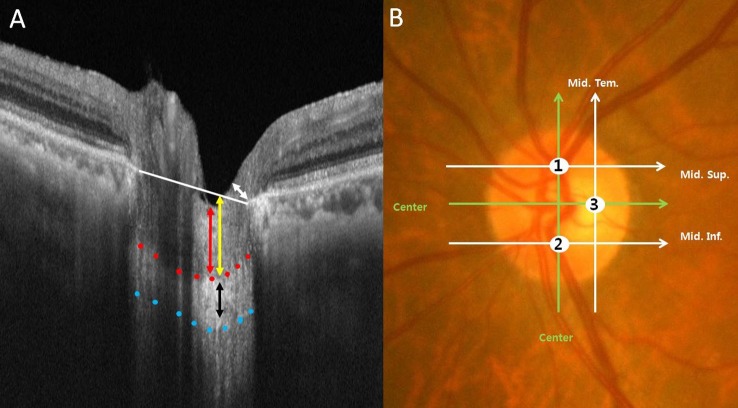
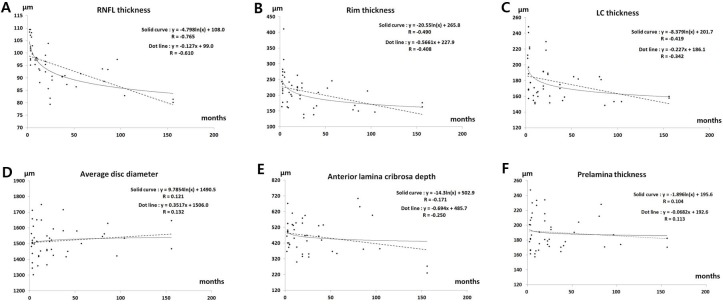
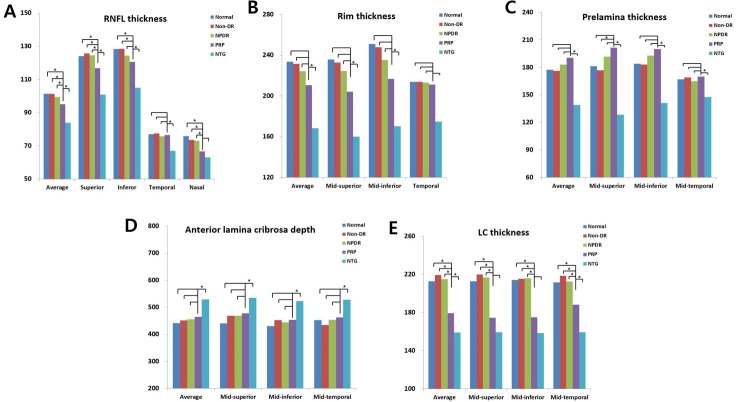
In this retrospective cross-sectional study, we quantitatively analyzed the tomographic features in the neural tissues around the optic disc in patients with diabetic retinopathy with and without panretinal photocoagulation. We analyzed 206 eyes, comprising 33 normal eyes in subjects without diabetes (group I), 30 eyes without diabetic retinopathy (group II), 66 eyes with non-proliferative diabetic retinopathy (group III), 45 eyes with panretinal photocoagulation (group IV), and 32 eyes with normal tension glaucoma (group V). Sequential images acquired using swept-source optical coherence tomography in three-dimensional mode were used to measure peripapillary retinal nerve fiber layer thickness, neuro-retinal rim thickness, anterior lamina cribrosa depth, prelaminar thickness, and thickness of the lamina cribrosa. The peripapillary retinal nerve fiber layer thickness and lamina cribrosa thickness were significantly thinner in group IV than in group III (p = 0.019 and p < 0.001). However, there was no significant difference in rim thickness, anterior lamina cribrosa depth, or prelaminar thickness between groups III and IV (p = 0.307, p = 0.877, and p = 0.212). Multivariate analysis revealed that time since panretinal photocoagulation and thickness of the lamina cribrosa had a significant effect on peripapillary retinal nerve fiber layer thickness (p < 0.001 and p = 0.014). In group IV, there was a negative correlation between time elapsed since panretinal photocoagulation and peripapillary retinal nerve fiber layer thickness, rim thickness, and thickness of the lamina cribrosa (r = -0.765, r = -0.490, and r = -0.419), but no correlation with prelaminar thickness or anterior lamina cribrosa depth (r = 0.104 and r = -0.171). Panretinal photocoagulation may be related to thinning of the peripapillary retinal nerve fiber layer, rim thickness, and lamina cribrosa, but not prelaminar thickness or anterior lamina cribrosa depth. These features are different from the peripapillary features of eyes with typical normal tension glaucoma.
在这项回顾性横断面研究中,我们定量分析了接受全视网膜光凝和未接受全视网膜光凝的糖尿病视网膜病变患者视盘周围神经组织的断层特征。我们分析了206只眼睛,包括无糖尿病受试者的33只正常眼睛(I组)、30只无糖尿病视网膜病变的眼睛(II组)、66只非增殖性糖尿病视网膜病变的眼睛(III组)、45只接受全视网膜光凝的眼睛(IV组)以及32只正常眼压性青光眼的眼睛(V组)。使用扫频源光学相干断层扫描以三维模式获取的序列图像用于测量视乳头周围视网膜神经纤维层厚度、神经视网膜边缘厚度、筛板前深度、板前厚度和筛板厚度。IV组的视乳头周围视网膜神经纤维层厚度和筛板厚度明显薄于III组(p = 0.019和p < 0.001)。然而,III组和IV组之间的边缘厚度、筛板前深度或板前厚度没有显著差异(p = 0.307、p = 0.877和p = 0.212)。多变量分析显示,全视网膜光凝后的时间和筛板厚度对视乳头周围视网膜神经纤维层厚度有显著影响(p < 0.001和p = 0.014)。在IV组中,全视网膜光凝后的时间与视乳头周围视网膜神经纤维层厚度、边缘厚度和筛板厚度呈负相关(r = -0.765、r = -0.490和r = -0.419),但与板前厚度或筛板前深度无相关性(r = 0.104和r = -0.171)。全视网膜光凝可能与视乳头周围视网膜神经纤维层、边缘厚度和筛板变薄有关,但与板前厚度或筛板前深度无关。这些特征与典型正常眼压性青光眼眼睛的视乳头周围特征不同。