Valiani Vincenzo, Sourdet Sandrine, Schoeller Dale A, Mackey Dawn C, Bauer Douglas C, Glynn Nancy W, Yamada Yosuke, Harris Tamara B, Manini Todd M
Department of Aging and Geriatric Research, University of Florida, Gainesville, Forida, United States of America.
Dipartimento Interdisciplinare di Medicina, Clinica Medica Cesare Frugoni, University of Bari Aldo Moro, Bari, Italy.
PLoS One. 2017 Oct 17;12(10):e0186289. doi: 10.1371/journal.pone.0186289. eCollection 2017.
Total daily energy expenditure (TEE) is composed of resting metabolic rate (RMR), post-prandial thermogenesis and activity energy expenditure (AEE). Higher AEE is strongly associated with lower mortality and physical limitations among older adults, but factors that predict changes in AEE in septu and octogenarians are not clearly understood.
To identify factors associated with late-life longitudinal change in AEE.
Energy expenditure was re-assessed in 83 participants (average age at baseline, 74.4±3.2 years)-an average of 7.5±0.54 years since the baseline measure. RMR was measured using indirect calorimetry and the thermic effect of meals was estimated at 10% of TEE. AEE was calculated as: TEE(0.9)-RMR. Participants were categorized into two groups according to the estimated day-to-day precision of the doubly-labeled water technique. Those who were within 10% or increased relative to their initial AEE measurement were categorized as having preserved AEE. Participants who declined greater than 10% of their initial measurement were categorized as having reduced AEE. A variety of socio-demographic, functional and mental factors, body composition, community and personal behaviors, blood measurements and health conditions were evaluated between groups at baseline and changes during follow-up.
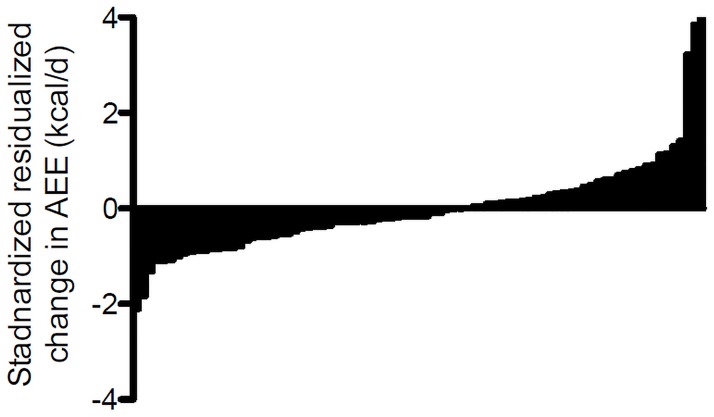
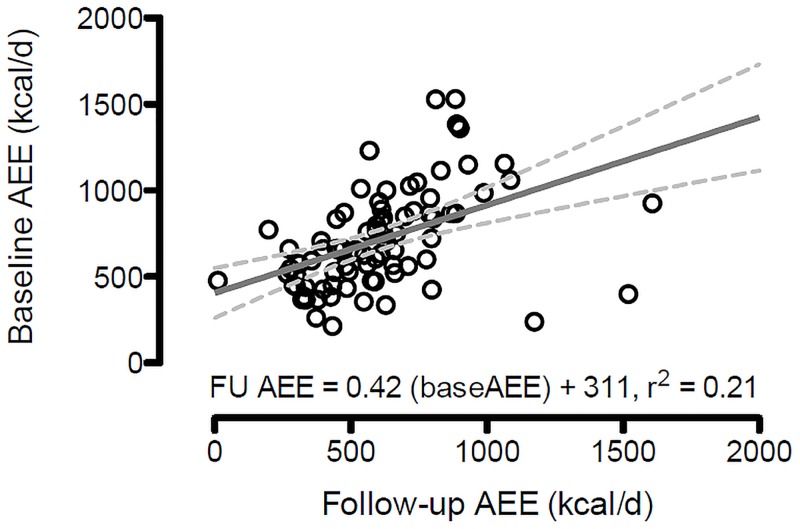
Daily AEE declined 106.61±293.25 kcal, which equated to a 14.63±40.57 kcal/d decrease per year. Fifty-nine percent (n = 49) preserved their AEE and 41% (n = 34) declined. Those who demonstrated a decline in AEE were older, had lower walking speed at baseline and showed a higher lean mass loss during follow up. Otherwise, groups were similar for socio-demographic characteristics, body composition, mental and physical function, health conditions and community and personal behaviors at baseline and change in these factors during follow-up.
This study demonstrates that AEE declines through the 8th decade of life and is associated with age, lower walking speed at baseline and lean mass loss. Additionally, there are a significant number of individuals who appear to be resilient to these declines despite having health events that are expected to have a negative impact on their physical activity.
每日总能量消耗(TEE)由静息代谢率(RMR)、餐后产热和活动能量消耗(AEE)组成。较高的AEE与老年人较低的死亡率和身体机能受限密切相关,但预测七旬和八旬老人AEE变化的因素尚不清楚。
确定与晚年AEE纵向变化相关的因素。
对83名参与者(基线时平均年龄74.4±3.2岁)的能量消耗进行重新评估,自基线测量以来平均为7.5±0.54年。使用间接测热法测量RMR,膳食热效应估计为TEE的10%。AEE的计算方法为:TEE(0.9)-RMR。根据双标记水技术估计的日常精度,将参与者分为两组。相对于初始AEE测量值,在10%以内或增加的参与者被归类为AEE保持不变。初始测量值下降超过10%的参与者被归类为AEE降低。在基线时评估了两组之间的各种社会人口统计学、功能和心理因素、身体成分、社区和个人行为、血液测量和健康状况以及随访期间的变化。
每日AEE下降106.61±293.25千卡,相当于每年下降14.63±40.57千卡/天。59%(n = 49)的人保持了他们的AEE,41%(n = 34)的人下降了。AEE下降的人年龄较大,基线时步行速度较低,随访期间瘦体重下降较高。否则,两组在基线时的社会人口统计学特征、身体成分、心理和身体功能、健康状况以及社区和个人行为以及随访期间这些因素的变化方面相似。
本研究表明,AEE在生命的第八个十年中下降,并且与年龄、基线时较低的步行速度和瘦体重下降有关。此外,尽管有预期会对其身体活动产生负面影响的健康事件,但仍有相当数量的个体似乎对这些下降具有抵抗力。