Academic Department of Rheumatology, Centre for Inflammation Biology and Cancer Immunology, Faculty of Life Sciences and Medicine, King's College London, London, United Kingdom.
Department of Immunobiology, Centre for Inflammation Biology and Cancer Immunology, Faculty of Life Sciences and Medicine, King's College London, London, United Kingdom.
PLoS One. 2017 Oct 17;12(10):e0186625. doi: 10.1371/journal.pone.0186625. eCollection 2017.
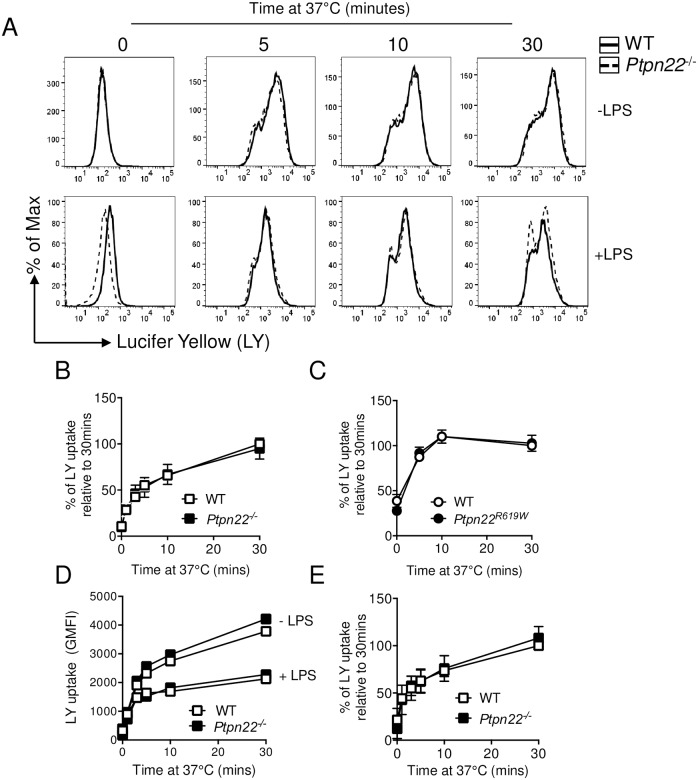
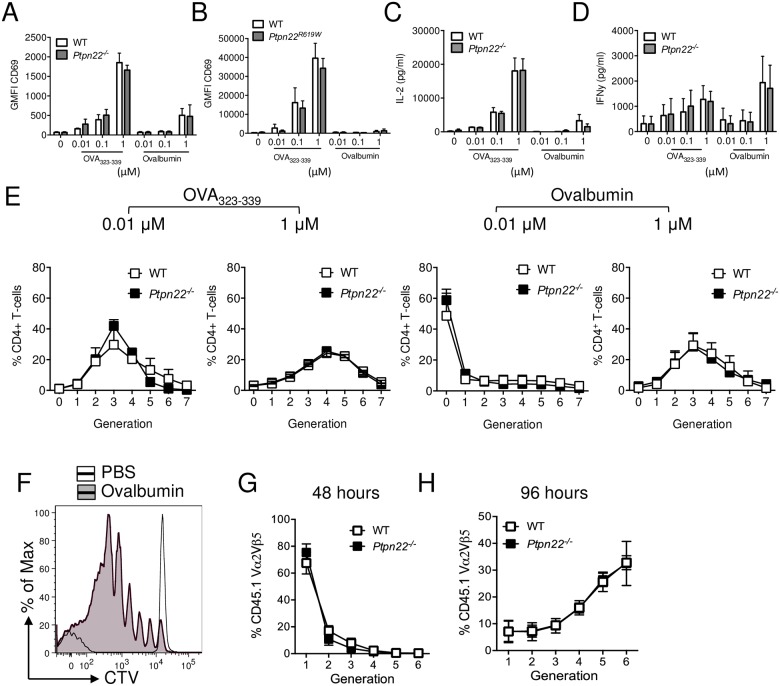
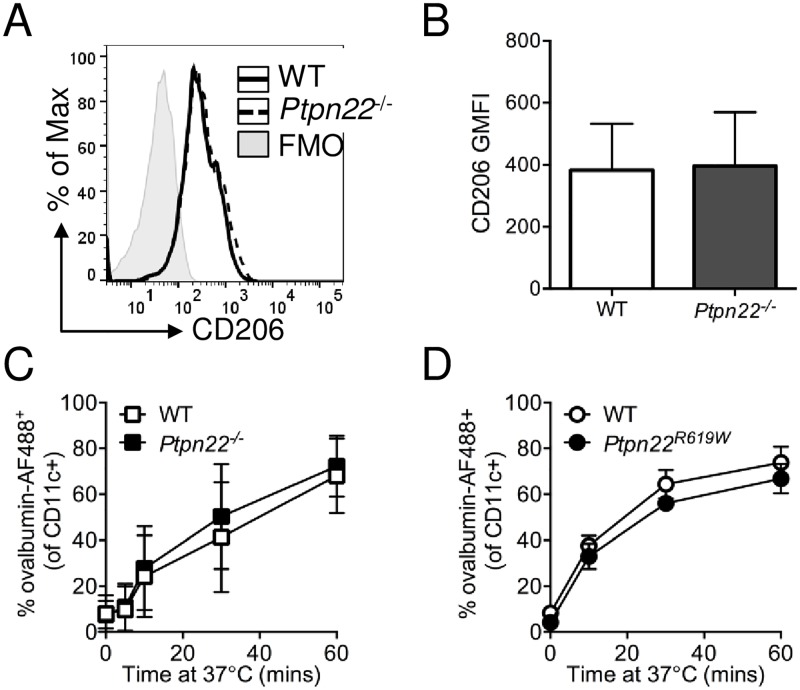
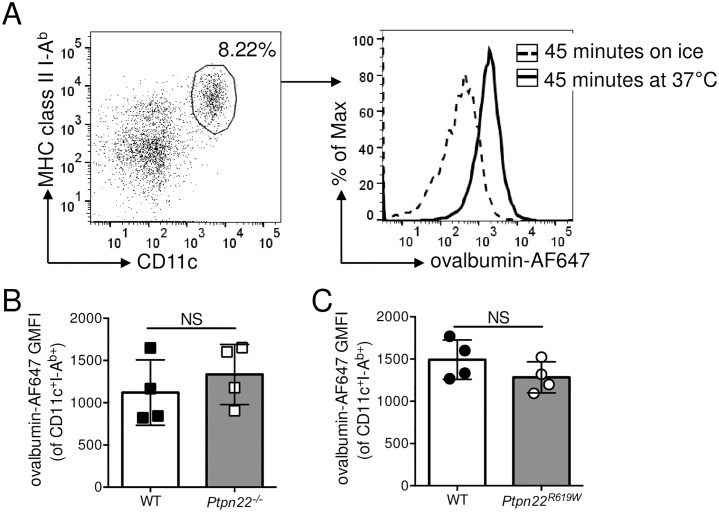
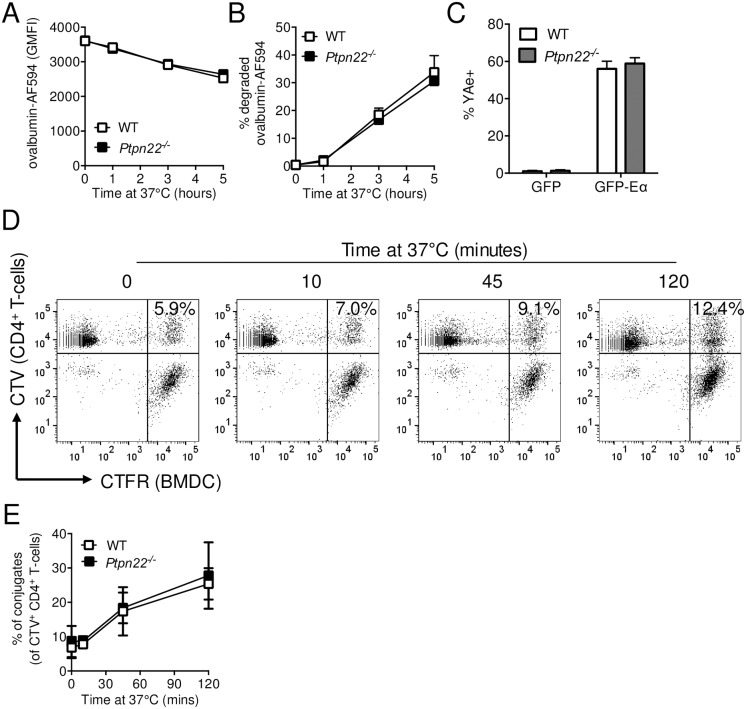
The PTPN22R620W single nucleotide polymorphism increases the risk of developing multiple autoimmune diseases including type 1 diabetes, rheumatoid arthritis and lupus. PTPN22 is highly expressed in antigen presenting cells (APCs) where the expression of the murine disease associated variant orthologue (Ptpn22R619W) is reported to dysregulate pattern recognition receptor signalling in dendritic cells (DCs) and promote T-cell proliferation. Because T-cell activation is dependent on DC antigen uptake, degradation and presentation, we analysed the efficiency of these functions in splenic and GM-CSF bone marrow derived DC from wild type (WT), Ptpn22-/- or Ptpn22R619W mutant mice. Results indicated no differential ability of DCs to uptake antigen via macropinocytosis or receptor-mediated endocytosis. Antigen degradation and presentation was also equal as was WT T-cell conjugate formation and subsequent T-cell proliferation. Despite the likely presence of multiple phosphatase-regulated pathways in the antigen uptake, processing and presentation pathways that we investigated, we observed that Ptpn22 and the R619W autoimmune associated variant were dispensable. These important findings indicate that under non-inflammatory conditions there is no requirement for Ptpn22 in DC dependent antigen uptake and T-cell activation. Our findings reveal that perturbations in antigen uptake and processing, a fundamental pathway determining adaptive immune responses, are unlikely to provide a mechanism for the risk associated with the Ptpn22 autoimmune associated polymorphism.
PTPN22R620W 单核苷酸多态性增加了多种自身免疫性疾病的发病风险,包括 1 型糖尿病、类风湿关节炎和狼疮。PTPN22 在抗原呈递细胞 (APC) 中高度表达,据报道,鼠源疾病相关变异体同源物 (Ptpn22R619W) 的表达会使树突状细胞 (DC) 中的模式识别受体信号失调,并促进 T 细胞增殖。由于 T 细胞的激活依赖于 DC 的抗原摄取、降解和呈递,我们分析了来自野生型 (WT)、Ptpn22-/-或 Ptpn22R619W 突变小鼠的脾和 GM-CSF 骨髓来源 DC 的这些功能的效率。结果表明,DC 通过巨胞饮作用或受体介导的内吞作用摄取抗原的能力没有差异。抗原降解和呈递也相同,WT T 细胞结合形成和随后的 T 细胞增殖也是如此。尽管我们研究的抗原摄取、加工和呈递途径中可能存在多种磷酸酶调节途径,但我们观察到 Ptpn22 和与自身免疫相关的 R619W 变体是可有可无的。这些重要发现表明,在非炎症条件下,Ptpn22 并不需要参与 DC 依赖性抗原摄取和 T 细胞激活。我们的研究结果表明,决定适应性免疫反应的抗原摄取和加工途径的扰动不太可能为 PTPN22 与自身免疫相关的多态性相关的风险提供机制。