Pathology, University of Chicago Biological Sciences Division, Chicago, Illinois, USA.
Pathology, Department of Medicine, University of Chicago, Chicago, Illinois, USA.
J Immunother Cancer. 2024 Oct 26;12(10):e009588. doi: 10.1136/jitc-2024-009588.
Individuals with a loss-of-function single-nucleotide polymorphism in the gene encoding PTPN22 have an increased risk for autoimmune diseases, and patients with cancer with such alleles may respond better to checkpoint blockade immunotherapy. Studies in PTPN22 knockout (KO) mice have established it as a negative regulator of T cell responses in cancer models. However, the role of PTPN22 in distinct immune cell compartments, such as dendritic cells (DCs), remains undefined.
We developed a novel PTPN22 conditional KO (cKO) mouse model that enables specific deletion in CD11c DCs by crossing to CD11c-Cre transgenic mice. Antitumor immunity was characterized using the B16.SIY and MC38.SIY cancer models and immune profiles of relevant tissues were evaluated by spectral flow cytometry. Antigen uptake, processing, and presentation, as well as DC proliferation to Flt3L, were characterized ex vivo.
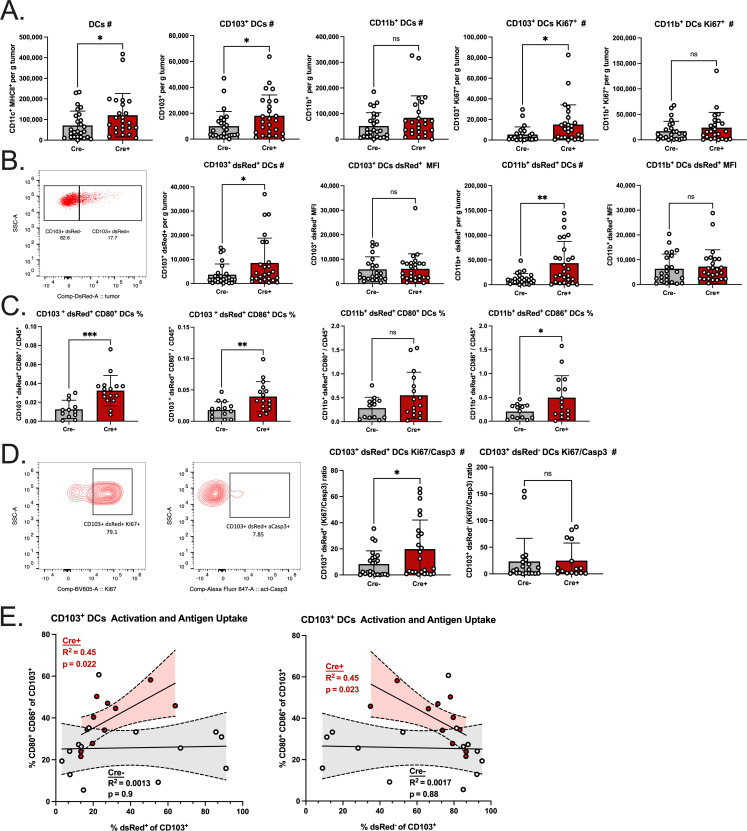
Deletion of PTPN22 in DCs resulted in augmented antitumor immunity in multiple syngeneic tumor models. Tumor antigen-specific CD8 T cells were increased in the tumor microenvironment (TME) of PTPN22 cKO mice and improved tumor control was CD8 T cell-dependent. Augmented T cell priming was also detected at early time points in the draining lymph nodes, and these effects were correlated with an increased number of proliferating CD103 DCs, also seen in the TME. In vitro studies revealed increased DC proliferation in response to Flt3L, as well as increased antigen processing and presentation. PTPN22 cKO mice bearing MC38 parental tumors showed combinatorial benefit with anti-PD-L1 therapy.
Deletion of PTPN22 in DCs is sufficient to drive an augmented tumor antigen-specific T cell response, resulting in enhanced tumor control. PTPN22 negatively regulates DC proliferation and antigen processing and presentation. Our work argues that PTPN22 is an attractive therapeutic target for cancer immunotherapy and highlights the potential to modulate antitumor immunity through the manipulation of DC signaling.
编码 PTPN22 的基因中存在功能丧失的单核苷酸多态性的个体患自身免疫性疾病的风险增加,并且具有这些等位基因的癌症患者可能对检查点阻断免疫疗法反应更好。在 PTPN22 敲除(KO)小鼠中的研究已经确定其为癌症模型中 T 细胞反应的负调节剂。然而,PTPN22 在树突状细胞(DC)等不同免疫细胞区室中的作用仍未定义。
我们开发了一种新型的 PTPN22 条件性 KO(cKO)小鼠模型,通过与 CD11c-Cre 转基因小鼠杂交,能够在 CD11c DC 中特异性缺失。使用 B16.SIY 和 MC38.SIY 癌症模型来表征抗肿瘤免疫,并通过光谱流式细胞术评估相关组织的免疫特征。体外表征抗原摄取、加工和呈递以及 DC 对 Flt3L 的增殖。
在多个同基因肿瘤模型中,DC 中 PTPN22 的缺失导致抗肿瘤免疫增强。肿瘤抗原特异性 CD8 T 细胞在 PTPN22 cKO 小鼠的肿瘤微环境(TME)中增加,并且改善的肿瘤控制是 CD8 T 细胞依赖性的。在引流淋巴结中的早期时间点也检测到增强的 T 细胞启动,并且这些效应与 TME 中增殖的 CD103 DC 的数量增加相关。体外研究表明,Flt3L 反应中 DC 的增殖增加,以及抗原加工和呈递增加。携带 MC38 亲本肿瘤的 PTPN22 cKO 小鼠与抗 PD-L1 治疗具有组合获益。
DC 中 PTPN22 的缺失足以驱动增强的肿瘤抗原特异性 T 细胞反应,从而增强肿瘤控制。PTPN22 负调节 DC 增殖和抗原加工和呈递。我们的工作表明 PTPN22 是癌症免疫治疗的有吸引力的治疗靶标,并强调通过操纵 DC 信号来调节抗肿瘤免疫的潜力。