Department of Physics, Bar-Ilan University, Ramat Gan 52900, Israel.
The Mina and Everard Goodman Faculty of Life Sciences, Bar-Ilan University, Ramat Gan 52900, Israel.
Sci Adv. 2017 Oct 13;3(10):e1701256. doi: 10.1126/sciadv.1701256. eCollection 2017 Oct.
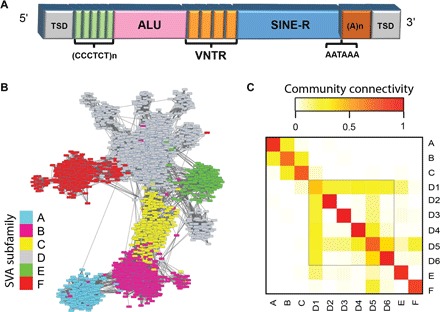
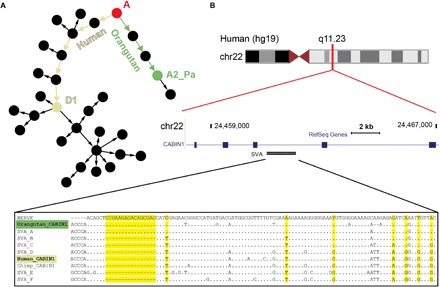
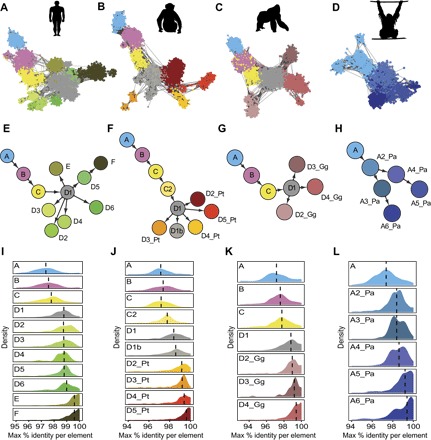
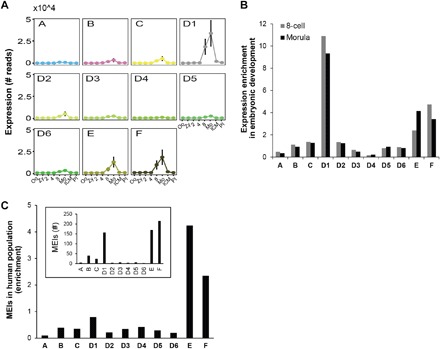
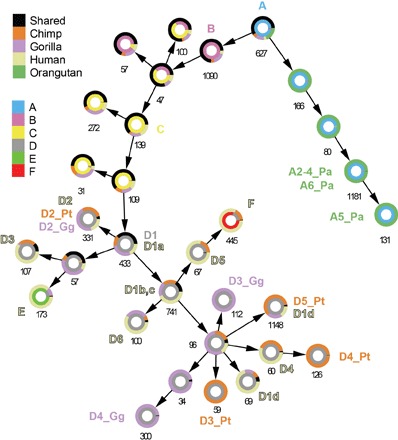
Retroelements (REs) are mobile DNA sequences that multiply and spread throughout genomes by a copy-and-paste mechanism. These parasitic elements are active in diverse genomes, from yeast to humans, where they promote diversity, cause disease, and accelerate evolution. Because of their high copy number and sequence similarity, studying their activity and tracking their proliferation dynamics is a challenge. It is particularly difficult to pinpoint the few REs in a genome that are still active in the haystack of degenerate and suppressed elements. We develop a computational framework based on network theory that tracks the path of RE proliferation throughout evolution. We analyze SVA (SINE-VNTR-Alu), the youngest RE family in human genomes, to understand RE dynamics across hominids. Integrating comparative genomics and network tools enables us to track the course of SVA proliferation, identify yet unknown active communities, and detect tentative "master REs" that played key roles in SVA propagation, providing strong support for the fundamental "master gene" model of RE proliferation. The method is generic and thus can be applied to REs of any of the thousands of available genomes to identify active RE communities and master REs that were pivotal in the evolution of their host genomes.
逆转录元件 (REs) 是一种可移动的 DNA 序列,通过复制粘贴机制在基因组中大量复制和传播。这些寄生元件在从酵母到人等多种基因组中活跃,促进多样性、引发疾病并加速进化。由于它们的高拷贝数和序列相似性,研究它们的活性和跟踪它们的增殖动力学是一项挑战。在退化和抑制元件的“干草堆”中精确定位基因组中仍活跃的少数 RE 尤其困难。我们开发了一种基于网络理论的计算框架,该框架可跟踪 RE 增殖在进化过程中的路径。我们分析了人类基因组中最年轻的 RE 家族 SVA(SINE-VNTR-Alu),以了解灵长类动物的 RE 动态。整合比较基因组学和网络工具使我们能够跟踪 SVA 增殖的过程,识别尚未发现的活跃社区,并检测到暂定的“主 RE”,它们在 SVA 传播中发挥了关键作用,为 RE 增殖的基本“主基因”模型提供了强有力的支持。该方法是通用的,因此可以应用于数千个可用基因组中的任何 RE,以识别活跃的 RE 社区和在其宿主基因组进化中起关键作用的主 RE。