Dietrich Camila, Cardoso Juliana Rezende, Vargas Fernanda, Sanchez Evelin Carneiro, Dutra Francine Hoffmann, Moreira Cátia, Bessel Marina, Robinson Caroline, Falavigna Maicon, Teixeira Cassiano
Pós-Graduação em Ciências da Reabilitação, Universidade Federal de Ciências da Saúde de Porto Alegre - Porto Alegre (RS), Brasil.
Hospital Moinhos de Vento - Porto Alegre (RS), Brasil.
Rev Bras Ter Intensiva. 2017 Jul-Sep;29(3):293-302. doi: 10.5935/0103-507X.20170055.
To compare the functional capacity of younger elderly individuals (60 to 79 years old) with that of older elderly individuals (≥ 80 years old) during the first 6 months after discharge from the intensive care unit.
A multicenter prospective cohort study was conducted, in which data on intensive care unit admission and outcomes after hospital discharge (immediate post-discharge, after 3 months and after 6 months) were collected. Muscle strength was evaluated through the protocol of the Medical Research Council and dynamometry (handgrip); the ability to perform activities of daily life and functional independence were assessed by the Barthel index and the usual level of physical activity (International Physical Activity Questionnaire); and quality of life was assessed by the 12-Item Short-Form Health Survey Version 2.
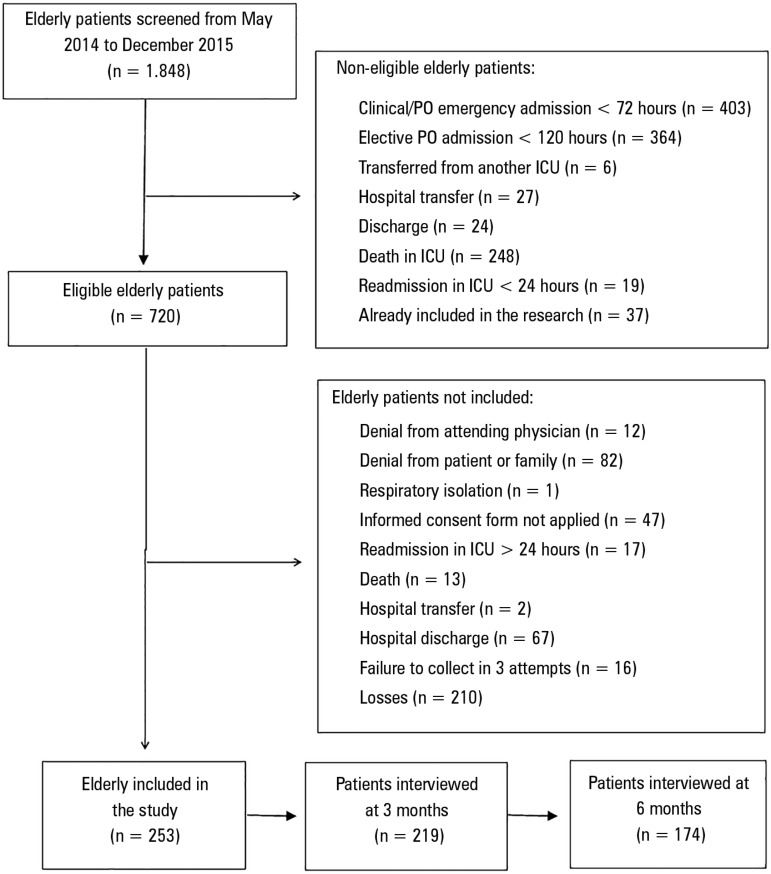
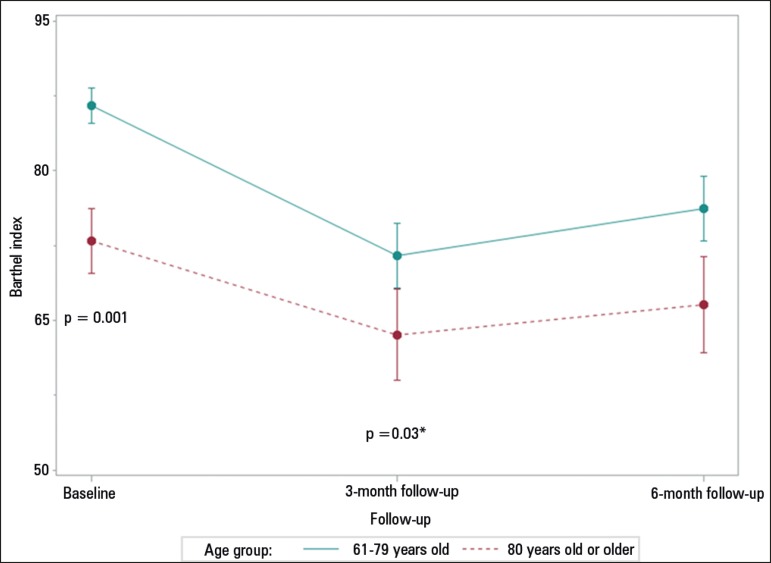
Among the 253 patients included, 167 were younger elderly (between 61 and 79 years old), and 86 were older elderly (≥ 80 years old). During the sixth month of evaluation, the older elderlies presented a higher need for a caregiver (69.0% versus 49, 5%, p = 0.002). Functional capacity prior to intensive care unit admission and in the third month after discharge was lower in older elderlies than in younger ones (Barthel prior to the intensive care unit: 73.0 ± 30.0 versus 86.5 ± 22.6; p <0.001, Barthel in the third month: 63.5 ± 34.0 versus 71.5 ± 35.5, p = 0.03), as was the usual level of physical activity (International Physical Activity Questionnaire in the third month: active/very active 3.4% versus 18.3%, no physical activity 64.4% versus 39.7%, p < 0.001, and International Physical Activity Questionnaire in the sixth month: active/very active 5.8% versus 20.8%, no physical activity 69.2% versus 43.4%, p = 0.005). Older elderlies had lower muscle strength when assessed according to handgrip in both the dominant (14.5 ± 7.7 versus 19.9 ± 9.6, p = 0.008) and non-dominant limb (13.1 ± 6.7 versus 17.5 ± 9.1, p = 0.02). There were no differences in functional capacity loss or reported quality of life between the age groups.
Although there were great functional capacity losses after discharge from the intensive care unit in both age groups, there was no difference in the magnitude of functional capacity loss between younger (60 to 79 years) and older elderly individuals (≥ 80 years old) during the first 6 months after discharge from the intensive care unit.
比较老年前期个体(60至79岁)与老年个体(≥80岁)在重症监护病房出院后的前6个月内的功能能力。
进行了一项多中心前瞻性队列研究,收集了重症监护病房入院数据以及出院后(出院后即刻、3个月后和6个月后)的结局数据。通过医学研究委员会的方案和握力测量法评估肌肉力量;通过Barthel指数和日常身体活动水平(国际身体活动问卷)评估日常生活活动能力和功能独立性;通过12项简短健康调查问卷第2版评估生活质量。
在纳入的253例患者中,167例为老年前期患者(61至79岁),86例为老年患者(≥80岁)。在评估的第六个月,老年患者对护理人员的需求更高(69.0%对49.5%,p = 0.002)。老年患者在重症监护病房入院前和出院后第三个月的功能能力低于老年前期患者(重症监护病房入院前的Barthel指数:73.0±30.0对86.5±22.6;p<0.001,第三个月的Barthel指数:63.5±34.0对71.5±35.5,p = 0.03),日常身体活动水平也是如此(第三个月的国际身体活动问卷:活跃/非常活跃3.4%对18.3%,无身体活动64.4%对39.7%,p<0.001,第六个月的国际身体活动问卷:活跃/非常活跃5.8%对20.8%,无身体活动69.2%对43.4%,p = 0.005)。根据握力评估,老年患者在优势肢体(14.5±7.7对19.9±9.6,p = 0.008)和非优势肢体(13.1±6.7对17.5±9.1,p = 0.02)的肌肉力量均较低。不同年龄组之间在功能能力丧失或报告的生活质量方面没有差异。
尽管两个年龄组在重症监护病房出院后功能能力均有很大丧失,但在重症监护病房出院后的前6个月内,老年前期(60至79岁)和老年个体(≥80岁)在功能能力丧失程度上没有差异。