The Alistair Reid Venom Research Unit, Parasitology Department, Liverpool School of Tropical Medicine, Liverpool, Merseyside, United Kingdom.
The Institute of Primate Research, National Museums of Kenya, Karen, Nairobi, Kenya.
PLoS Negl Trop Dis. 2017 Oct 18;11(10):e0005969. doi: 10.1371/journal.pntd.0005969. eCollection 2017 Oct.
Antivenom is the treatment of choice for snakebite, which annually kills an estimated 32,000 people in sub-Saharan Africa and leaves approximately 100,000 survivors with permanent physical disabilities that exert a considerable socioeconomic burden. Over the past two decades, the high costs of the most polyspecifically-effective antivenoms have sequentially reduced demand, commercial manufacturing incentives and production volumes that have combined to create a continent-wide vacuum of effective snakebite therapy. This was quickly filled with new, less expensive antivenoms, many of which are of untested efficacy. Some of these successfully marketed antivenoms for Africa are inappropriately manufactured with venoms from non-African snakes and are dangerously ineffective. The uncertain efficacy of available antivenoms exacerbates the complexity of designing intervention measures to reduce the burden of snakebite in sub-Saharan Africa. The objective of this study was to preclinically determine the ability of antivenoms available in Kenya to neutralise the lethal effects of venoms from the most medically important snakes in East Africa.
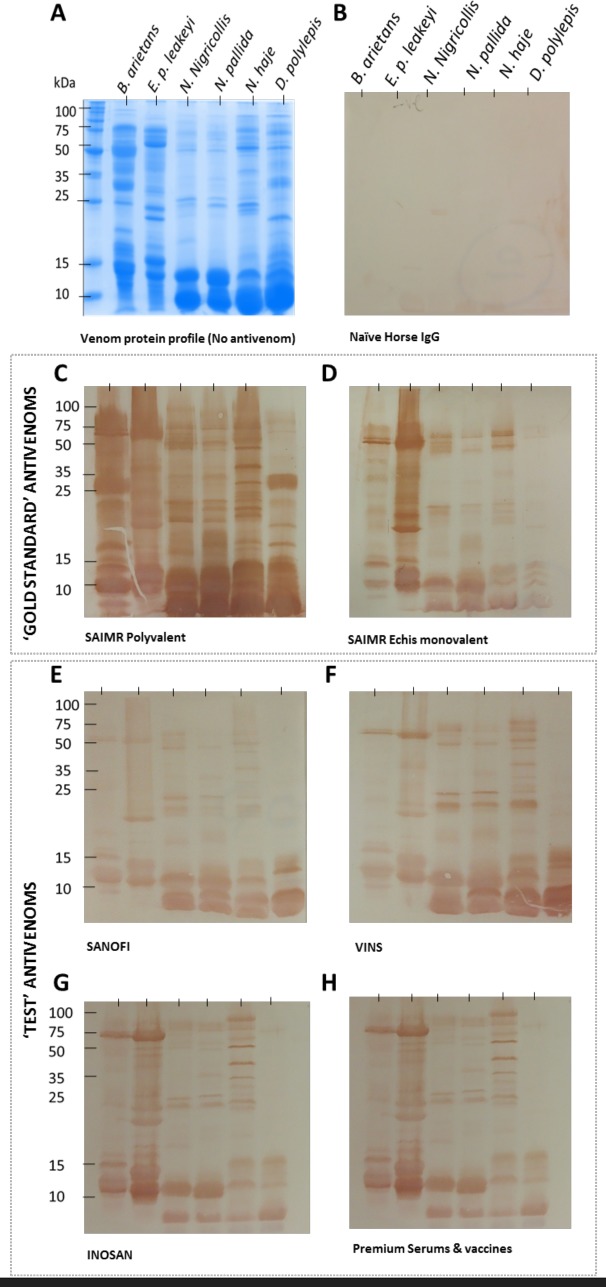
We collected venom samples from the most medically important snakes in East Africa and determined their toxicity in a mouse model. Using a 'gold standard' comparison protocol, we preclinically tested the comparative venom-neutralising efficacy of four antivenoms available in Kenya with two antivenoms of clinically-proven efficacy. To explain the variant efficacies of these antivenoms we tested the IgG-venom binding characteristics of each antivenom using in vitro IgG titre, avidity and venom-protein specificity assays. We also measured the IgG concentration of each antivenom.
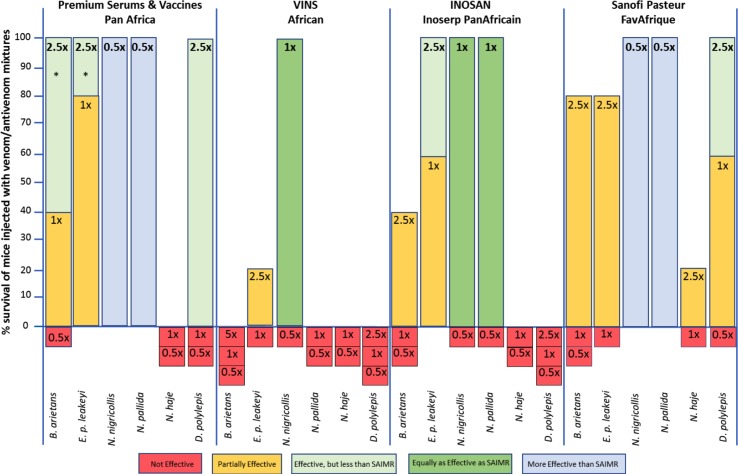
None of the six antivenoms are preclinically effective, at the doses tested, against all of the most medically important snakes of the region. The very limited snake polyspecific efficacy of two locally available antivenoms is of concern. In vitro assays of the abilities of 'test' antivenom IgGs to bind venom proteins were not substantially different from that of the 'gold standard' antivenoms. The least effective antivenoms had the lowest IgG content/vial.
Manufacture-stated preclinical efficacy statements guide decision making by physicians and antivenom purchasers in sub-Saharan Africa. This is because of the lack of both clinical data on the efficacy of most of the many antivenoms used to treat patients and independent preclinical assessment. Our preclinical efficacy assessment of antivenoms available in Kenya identifies important limitations for two of the most commonly-used antivenoms, and that no antivenom is preclinically effective against all the regionally important snakes. The potential implication to snakebite treatment is of serious concern in Kenya and elsewhere in sub-Saharan Africa, and underscores the dilemma physicians face, the need for clinical data on antivenom efficacy and the medical and societal value of establishing independent preclinical antivenom-efficacy testing facilities throughout the continent.
抗蛇毒血清是治疗蛇咬伤的首选方法,据估计,在撒哈拉以南非洲地区,每年有 32000 人因此死亡,约 10 万人因此永久残疾,给社会经济带来了巨大负担。在过去的二十年中,最具多效性的抗蛇毒血清成本高昂,导致需求下降,商业制造激励措施和生产数量减少,共同导致整个非洲大陆有效蛇伤治疗出现空白。这很快被新的、成本更低的抗蛇毒血清所填补,其中许多都未经证实的疗效。一些在非洲成功销售的抗蛇毒血清是用非非洲蛇的毒液不当制造的,并且非常无效。现有抗蛇毒血清疗效的不确定性加剧了设计干预措施以减轻撒哈拉以南非洲地区蛇伤负担的复杂性。本研究的目的是在临床前确定肯尼亚市售的抗蛇毒血清中和东非最重要的蛇类毒液的能力。
我们从东非最重要的蛇类中收集毒液样本,并在小鼠模型中确定其毒性。使用“金标准”比较方案,我们临床前测试了肯尼亚市售的四种抗蛇毒血清与两种临床疗效已证实的抗蛇毒血清的比较毒液中和功效。为了解释这些抗蛇毒血清的不同疗效,我们使用体外 IgG 效价、亲和力和毒液蛋白特异性测定法测试了每种抗蛇毒血清的 IgG-毒液结合特性。我们还测量了每种抗蛇毒血清的 IgG 浓度。
在所测试的剂量下,这六种抗蛇毒血清都没有临床前效果,不能中和该地区所有最重要的蛇类的毒液。两种当地可用的抗蛇毒血清的蛇类多效性非常有限,这令人担忧。“测试”抗蛇毒血清 IgG 结合毒液蛋白能力的体外检测与“金标准”抗蛇毒血清没有显著差异。效果最差的抗蛇毒血清每瓶 IgG 含量最低。
在撒哈拉以南非洲地区,医生和抗蛇毒血清购买者根据制造商声称的临床前疗效来做出决策。这是因为缺乏大多数用于治疗患者的抗蛇毒血清的临床疗效数据以及独立的临床前评估。我们对肯尼亚市售抗蛇毒血清的临床前疗效评估发现,两种最常用的抗蛇毒血清存在重要局限性,并且没有一种抗蛇毒血清对该地区所有重要的蛇类都具有临床前疗效。这对抗蛇毒血清治疗的潜在影响在肯尼亚乃至撒哈拉以南非洲其他地区都非常严重,这突显了医生所面临的困境,即需要关于抗蛇毒血清疗效的临床数据,以及在整个非洲大陆建立独立的临床前抗蛇毒血清疗效测试设施的医学和社会价值。