Edge Rebecca J, Marriott Amy E, Keen Molly, Xie Tiffany, Crittenden Edouard P, Dawson Charlotte A, Wilkinson Mark C, Wüster Wolfgang, Casewell Nicholas R, Ainsworth Stuart, Menzies Stefanie K
Centre for Snakebite Research and Interventions, Department of Tropical Disease Biology, Liverpool School of Tropical Medicine, Liverpool, United Kingdom.
Department of Infection Biology and Microbiomes, Institute of Infection, Veterinary and Ecological Sciences, University of Liverpool, Liverpool, United Kingdom.
PLoS Negl Trop Dis. 2025 Aug 4;19(8):e0013371. doi: 10.1371/journal.pntd.0013371. eCollection 2025 Aug.
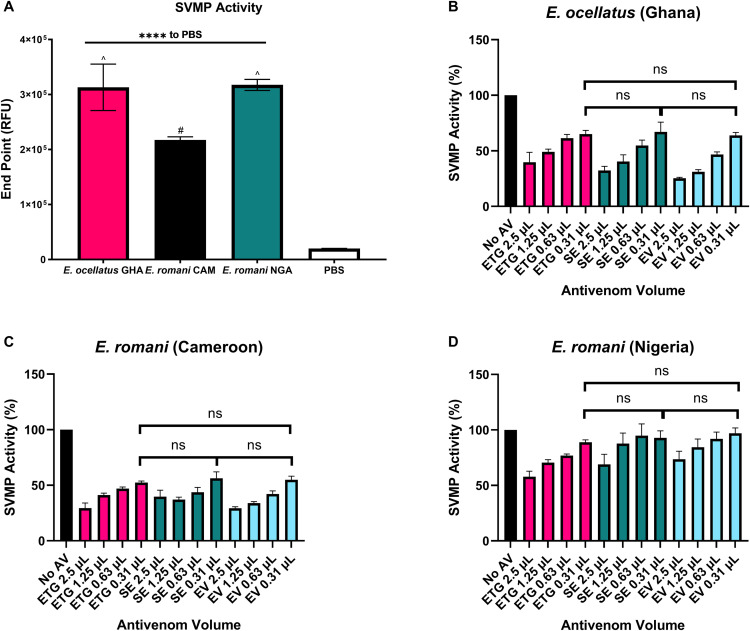
Snakebite is a significant public health concern in Africa, with the viperid species Echis ocellatus being responsible for the majority of snakebite deaths in West Africa. Recently E. ocellatus underwent taxonomic revision and was split into two species, E. ocellatus sensu stricto and E. romani, leading to questions regarding differences in venom bioactivities and the efficacy of antivenoms indicated for treatment of 'E. ocellatus' envenoming against the two redefined species. Using a range of in vitro assays we compared the toxin activities of the two species and the venom-neutralising efficacy of three antivenoms (EchiTAbG, SAIMR Echis and Echiven) raised against 'E. ocellatus'. We then used murine preclinical assays to compare the in vivo efficacy of these antivenoms against E. romani and E. ocellatus s. str venoms. Mitochondrial barcoding of snake skins and venom revealed that E. romani, and not E. ocellatus, is used in the manufacture of several antivenoms raised against 'E. ocellatus'. There were also a number of differences in specific toxin activity between the venoms of the two species in the three in vitro assays utilised in this study.; E. ocellatus (Ghana) had the strongest phospholipase A2 (PLA2) activity, followed by weak PLA2 activity for E. romani (Cameroon) and insignificant activity by E. romani (Nigeria). E. ocellatus (Ghana) and E. romani (Nigeria) demonstrated comparable snake venom metalloproteinase activity, whilst E. romani (Cameroon) had reduced, albeit still significant, activity in comparison. However no differences were observed in a plasma clotting assay measuring coagulopathy between the venoms and localities. Venoms from E. ocellatus (Ghana) and E. romani (Cameroon and Nigeria) were all recognised comparably by the three antivenoms, and there were only modest differences between antivenoms in neutralising the various in vitro toxin effects. In murine preclinical assays, each antivenom could neutralise the lethal effects of E. romani (Nigeria), but differences were seen in their comparative potency when the same antivenom doses were tested against E. romani (Cameroon) and E. ocellatus (Ghana). In these comparative potency assays, all three antivenoms were unable to confer 100% survival when tested against E. romani (Cameroon), but SAIMR Echis provided the best protection with 80% survival. When tested against E. ocellatus (Ghana), the comparative doses of SAIMR Echis and Echiven provided 100% protection whereas EchiTAbG failed to prevent lethality beyond three hours. This represents the first detailed analysis of differences between E. ocellatus and E. romani venom bioactivities and the efficacy of existing antivenoms against these two species. Our findings demonstrate that EchiTAbG, SAIMR Echis and Echiven antivenoms are preclinically efficacious against the lethal effects of E. ocellatus and E. romani venom across a number of localities.
蛇咬伤是非洲一个重大的公共卫生问题,在西非,锯鳞蝰属物种锯鳞蝰是导致大多数蛇咬伤死亡的原因。最近,锯鳞蝰经历了分类修订,被分为两个物种,狭义锯鳞蝰和罗氏锯鳞蝰,这引发了关于毒液生物活性差异以及针对“锯鳞蝰”咬伤所使用的抗蛇毒血清对这两个重新定义物种治疗效果的问题。我们使用一系列体外试验比较了这两个物种的毒素活性以及三种针对“锯鳞蝰”产生的抗蛇毒血清(EchiTAbG、南非医学研究所锯鳞蝰抗蛇毒血清和Echiven)的毒液中和效力。然后,我们使用小鼠临床前试验比较这些抗蛇毒血清对罗氏锯鳞蝰和狭义锯鳞蝰毒液的体内疗效。对蛇皮和毒液进行的线粒体条形码分析显示,罗氏锯鳞蝰,而非锯鳞蝰,被用于制造几种针对“锯鳞蝰”产生的抗蛇毒血清。在本研究使用的三种体外试验中,这两个物种的毒液在特定毒素活性方面也存在一些差异;狭义锯鳞蝰(加纳)具有最强的磷脂酶A2(PLA2)活性,其次是罗氏锯鳞蝰(喀麦隆)的较弱PLA2活性,而罗氏锯鳞蝰(尼日利亚)的活性不显著。狭义锯鳞蝰(加纳)和罗氏锯鳞蝰(尼日利亚)表现出相当的蛇毒金属蛋白酶活性,而罗氏锯鳞蝰(喀麦隆)的活性相对较低,尽管仍很显著。然而,在测量凝血障碍的血浆凝血试验中,未观察到毒液和产地之间存在差异。狭义锯鳞蝰(加纳)以及罗氏锯鳞蝰(喀麦隆和尼日利亚)的毒液被三种抗蛇毒血清识别的程度相当,并且在中和各种体外毒素效应方面,抗蛇毒血清之间只有适度差异。在小鼠临床前试验中,每种抗蛇毒血清都能中和罗氏锯鳞蝰(尼日利亚)的致死效应,但当用相同抗蛇毒血清剂量对罗氏锯鳞蝰(喀麦隆)和狭义锯鳞蝰(加纳)进行测试时,它们的相对效力存在差异。在这些相对效力试验中,当针对罗氏锯鳞蝰(喀麦隆)进行测试时,所有三种抗蛇毒血清都无法使100%的小鼠存活,但南非医学研究所锯鳞蝰抗蛇毒血清提供了最佳保护,存活率为80%。当针对狭义锯鳞蝰(加纳)进行测试时,南非医学研究所锯鳞蝰抗蛇毒血清和Echiven的相对剂量提供了100%的保护,而EchiTAbG在三小时后未能防止致死。这是对狭义锯鳞蝰和罗氏锯鳞蝰毒液生物活性差异以及现有抗蛇毒血清对这两个物种疗效的首次详细分析。我们的研究结果表明,EchiTAbG、南非医学研究所锯鳞蝰抗蛇毒血清和Echiven抗蛇毒血清在临床前对狭义锯鳞蝰和罗氏锯鳞蝰毒液在多个产地的致死效应有效。