Department of Pediatrics, Tufts University, Boston, MA, USA.
Heifer Nepal, Kathmandu, Nepal.
Int J Equity Health. 2017 Oct 18;16(1):183. doi: 10.1186/s12939-017-0681-0.
Many organizations seek to alleviate poverty in the developing world, often focusing their interventions on women. The role, status, and education of women are fundamentally important facets of development. Thus, understanding the interaction of women's educational level and the response to interventions is important. Therefore, we examined the impact of educational level of household adults on responses to a livestock-based community intervention.
Six pair-matched communities in 3 districts of Nepal (Chitwan/Nawalparasi/Nuwakot), were randomly assigned to receive community development activities via women's self-help groups at baseline or 1 year later. At 6 intervals over 48 months, a 125- item questionnaire addressing family demographics and child health/nutrition was completed in each household, plus child growth monitoring. Results were analyzed in relation to the highest education attained by any woman in the household, the child's mother, men, or any other adult in the household.
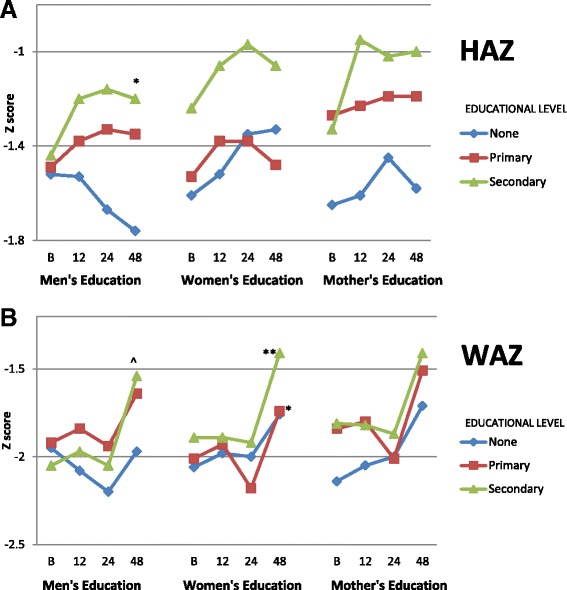
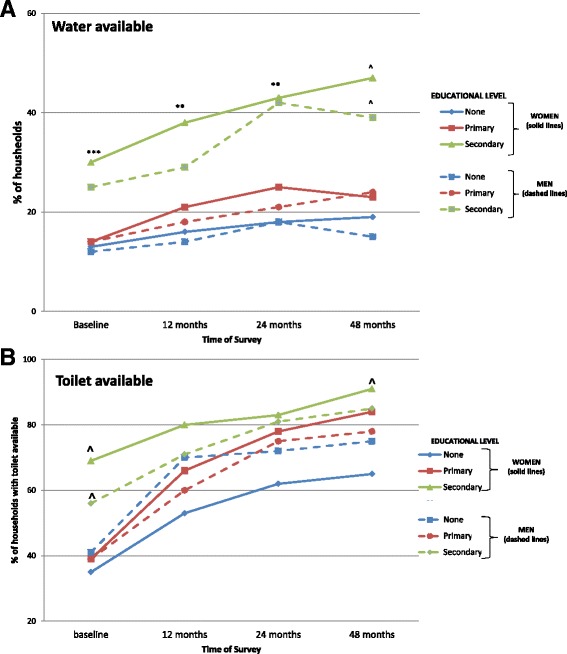
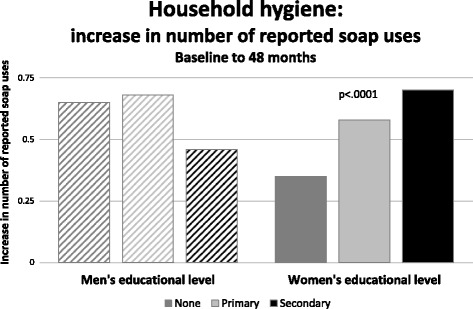
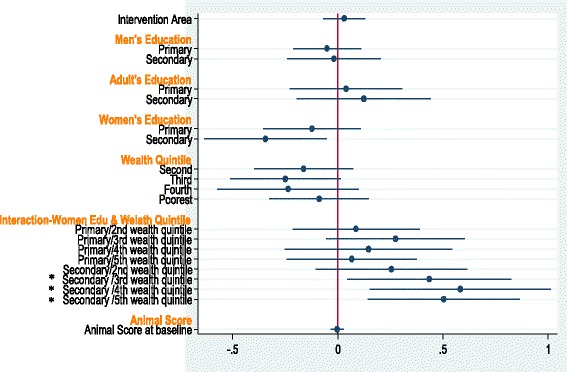
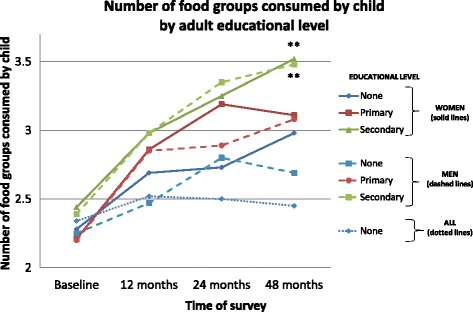
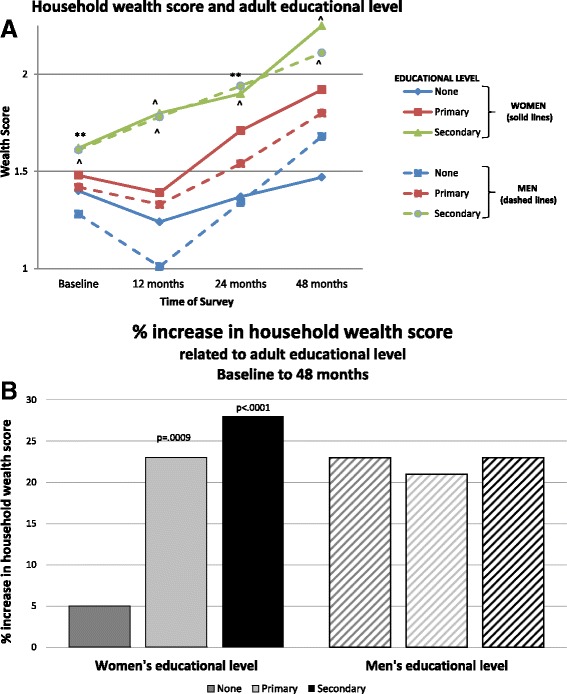
Outcomes (wealth, water/toilet availability, child diet diversity and growth) all significantly related to adult education. However, notable differences were found comparing the impact of men's and women's education. Percent change in wealth score was significant only in households where women had primary or secondary education (respectively, p = .0009 and p < .0001). Increased soap use related only to women's education (p < .0001). When adjusted for group assignment, baseline income, wealth, and animal scores, higher women's education was significantly associated with increased household wealth (p < .0001), better child height-for-age z scores (HAZ, p = .005), and improved child diet diversity (p = .01). Higher mother's education predicted better child HAZ (primary, p = .01, secondary, p = .03) and diet diversity (primary, p = .05, secondary, p < .0001). Higher men's education was significantly associated with household wealth (p = .02) and child diet diversity (p = .04), but not HAZ; higher education of any household member was associated only with household wealth (p < .0001). Moreover, households where the mother's education was better than the best-educated man also were significantly more likely to have children with better HAZ and dietary diversity (p = .03, p < .0001). Thus, the educational level of women and mothers had the broadest impact on child outcome variables.
Household characteristics vary among participants in most community development projects. Of these, adult education likely mediates response to the inputs provided by the intervention. Particularly in interventions directed towards women, better education may enhance the ability of households to put interventions into practice, thus improving wealth, hygiene, and child diet and growth indices.
许多组织都致力于减轻发展中国家的贫困问题,他们的干预措施通常都集中在女性身上。女性的角色、地位和受教育程度是发展的重要方面。因此,了解妇女教育水平与干预措施反应之间的相互作用非常重要。因此,我们研究了家庭中成年人的教育水平对基于牲畜的社区干预措施的反应的影响。
尼泊尔 3 个地区(奇特旺/纳瓦尔帕拉斯/努瓦科特)的 6 对配对社区在基线或 1 年后被随机分配接受妇女自助小组的社区发展活动。在 48 个月的 6 个时间间隔内,每个家庭都完成了一份包含家庭人口统计和儿童健康/营养的 125 项问题的问卷,以及儿童生长监测。结果与家庭中任何女性(孩子的母亲、男性或家庭中的任何其他成年人)所达到的最高教育程度相关联。
所有结果(财富、水/厕所的可用性、儿童饮食多样性和生长)都与成人教育显著相关。然而,在比较男性和女性教育的影响时,发现了显著的差异。只有在女性接受过小学或中学教育的家庭中,财富评分的变化百分比才有显著意义(分别为 p=0.0009 和 p<0.0001)。肥皂使用的增加仅与妇女教育有关(p<0.0001)。在调整了组分配、基线收入、财富和动物得分后,更高的女性教育与家庭财富的增加显著相关(p<0.0001)、儿童身高年龄 Z 分数(HAZ)的提高(p=0.005)和儿童饮食多样性的改善(p=0.01)。母亲教育程度越高,儿童 HAZ 越好(小学,p=0.01,中学,p=0.03)和饮食多样性越好(小学,p=0.05,中学,p<0.0001)。男性教育程度越高,与家庭财富(p=0.02)和儿童饮食多样性(p=0.04)显著相关,但与 HAZ 无关;家庭中任何成员的教育程度都与家庭财富(p<0.0001)显著相关。此外,母亲教育程度优于最佳受教育男性的家庭,其儿童 HAZ 和饮食多样性也显著更好(p=0.03,p<0.0001)。因此,妇女和母亲的教育水平对儿童结果变量的影响最广泛。
大多数社区发展项目的参与者之间存在家庭特征差异。在这些特征中,成人教育可能会影响干预措施提供的投入的反应。特别是在针对妇女的干预措施中,更好的教育可能会增强家庭实施干预措施的能力,从而提高家庭财富、卫生和儿童饮食和生长指数。