Prevention Research Center in St. Louis, Brown School, Washington University in St. Louis, One Brookings Drive, Campus Box 1196, St. Louis, MO, 63130, USA.
Department of Behavioral Science & Health Education, College for Public Health & Social Justice, Saint Louis University, St. Louis, USA.
Implement Sci. 2017 Oct 18;12(1):122. doi: 10.1186/s13012-017-0650-4.
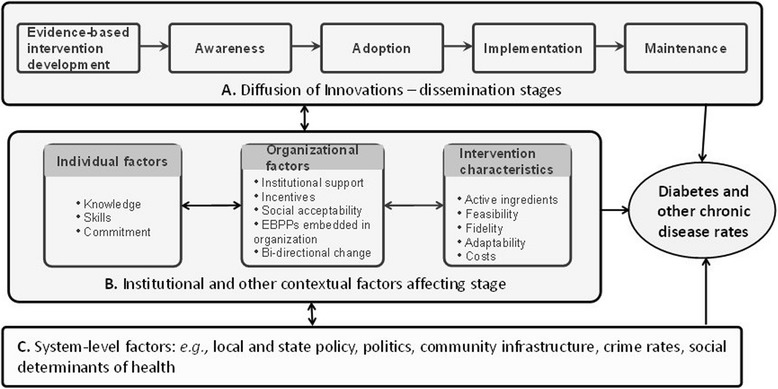
The rates of diabetes and prediabetes in the USA are growing, significantly impacting the quality and length of life of those diagnosed and financially burdening society. Premature death and disability can be prevented through implementation of evidence-based programs and policies (EBPPs). Local health departments (LHDs) are uniquely positioned to implement diabetes control EBPPs because of their knowledge of, and focus on, community-level needs, contexts, and resources. There is a significant gap, however, between known diabetes control EBPPs and actual diabetes control activities conducted by LHDs. The purpose of this study is to determine how best to support the use of evidence-based public health for diabetes (and related chronic diseases) control among local-level public health practitioners.
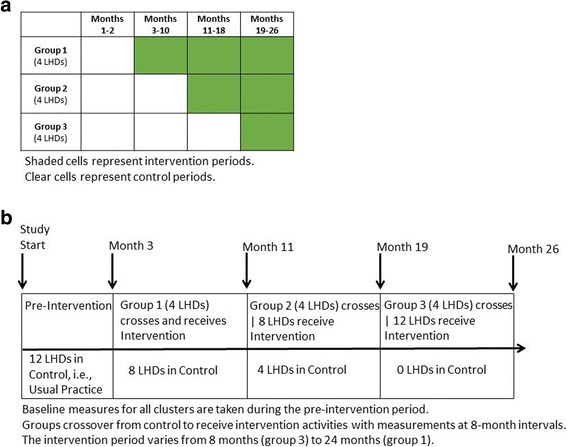
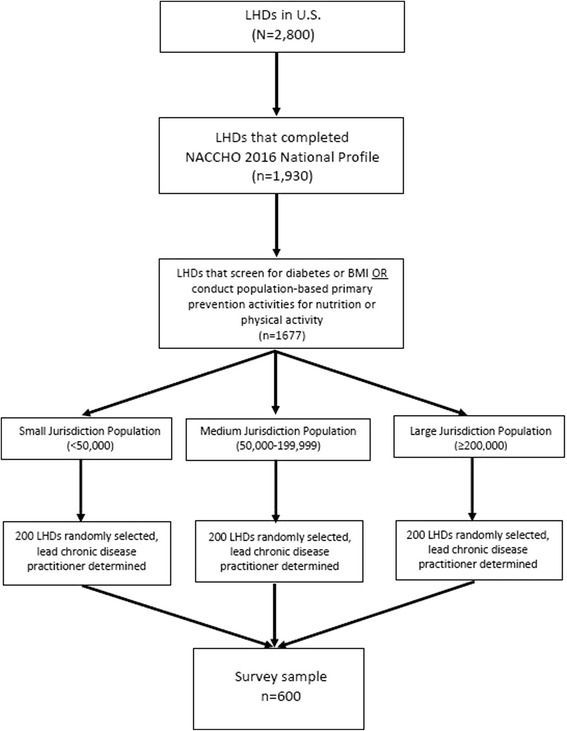
METHODS/DESIGN: This paper describes the methods for a two-phase study with a stepped-wedge cluster randomized trial that will evaluate dissemination strategies to increase the uptake of public health knowledge and EBPPs for diabetes control among LHDs. Phase 1 includes development of measures to assess practitioner views on and organizational supports for evidence-based public health, data collection using a national online survey of LHD chronic disease practitioners, and a needs assessment of factors influencing the uptake of diabetes control EBPPs among LHDs within one state in the USA. Phase 2 involves conducting a stepped-wedge cluster randomized trial to assess effectiveness of dissemination strategies with local-level practitioners at LHDs to enhance capacity and organizational support for evidence-based diabetes prevention and control. Twelve LHDs will be selected and randomly assigned to one of the three groups that cross over from usual practice to receive the intervention (dissemination) strategies at 8-month intervals; the intervention duration for groups ranges from 8 to 24 months. Intervention (dissemination) strategies may include multi-day in-person workshops, electronic information exchange methods, technical assistance through a knowledge broker, and organizational changes to support evidence-based public health approaches. Evaluation methods comprise surveys at baseline and the three crossover time points, abstraction of local-level diabetes and chronic disease control program plans and progress reports, and social network analysis to understand the relationships and contextual issues that influence EBPP adoption.
ClinicalTrial.gov, NCT03211832.
美国的糖尿病和糖尿病前期发病率不断上升,这显著影响了确诊患者的生活质量和预期寿命,同时也给社会带来了经济负担。通过实施基于证据的项目和政策(EBPP)可以预防过早死亡和残疾。由于地方卫生部门(LHD)了解并专注于社区层面的需求、背景和资源,因此他们在实施糖尿病控制 EBPP 方面具有独特的优势。然而,已知的糖尿病控制 EBPP 与 LHD 实际开展的糖尿病控制活动之间存在显著差距。本研究旨在确定如何最好地支持地方一级公共卫生从业人员使用基于证据的公共卫生来控制糖尿病(和相关慢性病)。
方法/设计:本文介绍了一项两阶段研究的方法,该研究采用阶梯式楔形集群随机试验,以评估传播策略,以增加地方卫生部门公共卫生知识和糖尿病控制 EBPP 的采用率。第一阶段包括开发评估从业者对基于证据的公共卫生的看法和组织支持的措施,使用全国性在线调查收集 LHD 慢性病从业者的数据,以及评估影响美国一个州内 LHD 采用糖尿病控制 EBPP 的因素的需求评估。第二阶段包括进行阶梯式楔形集群随机试验,以评估向地方卫生部门的基层从业者传播策略的有效性,以增强他们对基于证据的糖尿病预防和控制的能力和组织支持。将选择 12 个 LHD,并随机分配到三个组之一,这三个组将以 8 个月的间隔从常规实践交叉接受干预(传播)策略;组的干预持续时间从 8 个月到 24 个月不等。干预(传播)策略可能包括为期数天的面对面研讨会、电子信息交流方法、通过知识经纪人提供的技术援助,以及支持基于证据的公共卫生方法的组织变革。评估方法包括基线和三个交叉时间点的调查、地方一级糖尿病和慢性病控制计划和进展报告的提取,以及社会网络分析,以了解影响 EBPP 采用的关系和背景问题。
ClinicalTrials.gov,NCT03211832。