Cheng Ming, An Shoukuan, Li Junquan
Department of Cardiac Surgery, The Second Affiliated Hospital of Harbin Medical University, Nangang, Harbin, Heilongjiang, People's Republic of China.
Medicine (Baltimore). 2017 Oct;96(42):e7741. doi: 10.1097/MD.0000000000007741.
This study aimed to identify key genes associated with acute myocardial infarction (AMI) by reanalyzing microarray data.
Three gene expression profile datasets GSE66360, GSE34198, and GSE48060 were downloaded from GEO database. After data preprocessing, genes without heterogeneity across different platforms were subjected to differential expression analysis between the AMI group and the control group using metaDE package. P < .05 was used as the cutoff for a differentially expressed gene (DEG). The expression data matrices of DEGs were imported in ReactomeFIViz to construct a gene functional interaction (FI) network. Then, DEGs in each module were subjected to pathway enrichment analysis using DAVID. MiRNAs and transcription factors predicted to regulate target DEGs were identified. Quantitative real-time polymerase chain reaction (RT-PCR) was applied to verify the expression of genes.
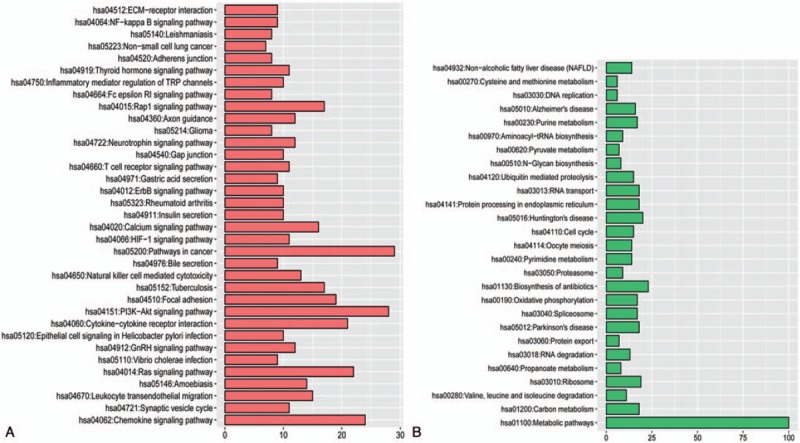
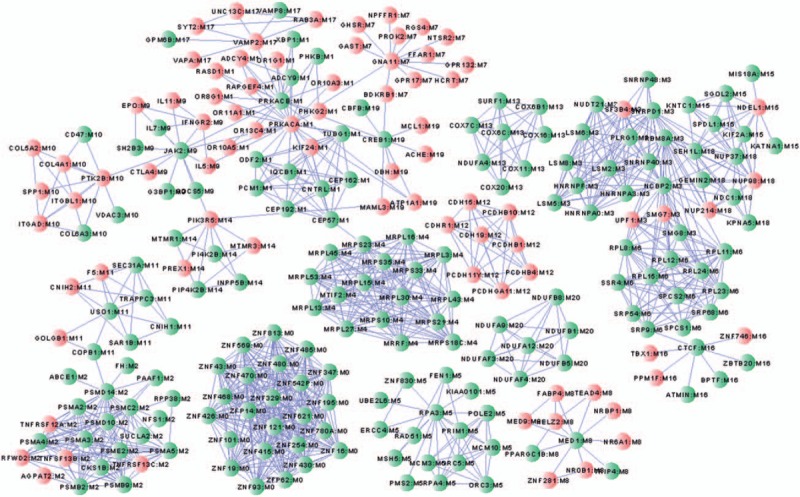
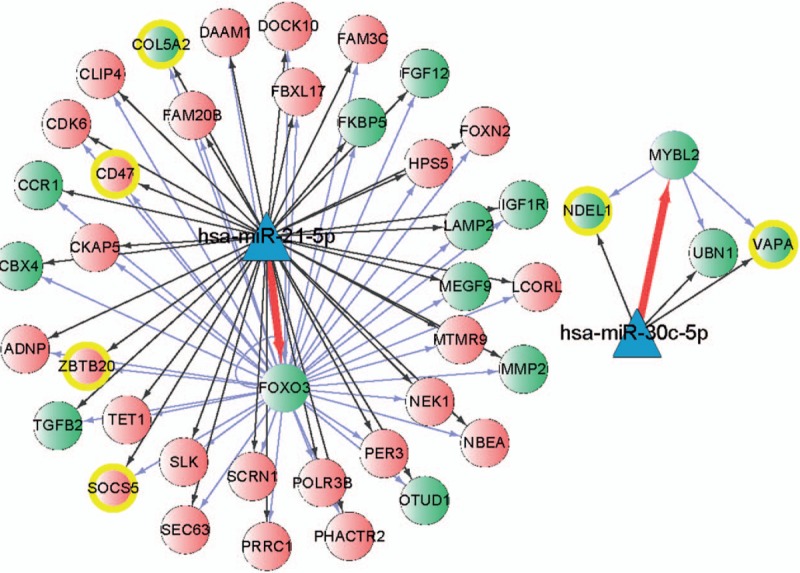
A total of 913 upregulated genes and 1060 downregulated genes were identified in the AMI group. A FI network consists of 21 modules and DEGs in 12 modules were significantly enriched in pathways. The transcription factor-miRNA-gene network contains 2 transcription factors FOXO3 and MYBL2, and 2 miRNAs hsa-miR-21-5p and hsa-miR-30c-5p. RT-PCR validations showed that expression levels of FOXO3 and MYBL2 were significantly increased in AMI, and expression levels of hsa-miR-21-5p and hsa-miR-30c-5p were obviously decreased in AMI.
A total of 41 DEGs, such as SOCS3, VAPA, and COL5A2, are speculated to have roles in the pathogenesis of AMI; 2 transcription factors FOXO3 and MYBL2, and 2 miRNAs hsa-miR-21-5p and hsa-miR-30c-5p may be involved in the regulation of the expression of these DEGs.
本研究旨在通过重新分析微阵列数据来鉴定与急性心肌梗死(AMI)相关的关键基因。
从基因表达综合数据库(GEO数据库)下载了三个基因表达谱数据集GSE66360、GSE34198和GSE48060。经过数据预处理后,使用metaDE软件包对不同平台间无异质性的基因进行AMI组与对照组之间的差异表达分析。以P<0.05作为差异表达基因(DEG)的截断值。将DEG的表达数据矩阵导入ReactomeFIViz以构建基因功能相互作用(FI)网络。然后,使用DAVID对每个模块中的DEG进行通路富集分析。鉴定出预测可调控靶标DEG的微小RNA(miRNA)和转录因子。应用定量实时聚合酶链反应(RT-PCR)验证基因的表达。
在AMI组中总共鉴定出913个上调基因和1060个下调基因。一个FI网络由21个模块组成,12个模块中的DEG在通路中显著富集。转录因子-miRNA-基因网络包含2个转录因子FOXO3和MYBL2,以及2个miRNA,即hsa-miR-21-5p和hsa-miR-30c-5p。RT-PCR验证表明,FOXO3和MYBL2的表达水平在AMI中显著升高,而hsa-miR-21-5p和hsa-miR-30c-5p的表达水平在AMI中明显降低。
推测共有41个DEG,如细胞因子信号转导抑制因子3(SOCS3)、囊泡相关膜蛋白A(VAPA)和Ⅴ型胶原α2链(COL5A2),在AMI的发病机制中起作用;2个转录因子FOXO3和MYBL2,以及2个miRNA,即hsa-miR-21-5p和hsa-miR-30c-5p可能参与这些DEG表达的调控。