Kwong P W H, Ng S S M, Chung R C K, Ng G Y F
Department of Rehabilitation Sciences, The Hong Kong Polytechnic University, Hong Kong, China.
PLoS One. 2017 Oct 19;12(10):e0185807. doi: 10.1371/journal.pone.0185807. eCollection 2017.
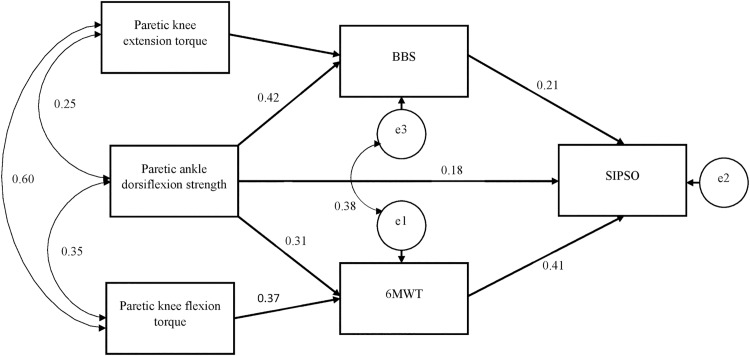
To use structural equation modelling (SEM) to determine (1) the direct and indirect associations of strength of paretic lower limb muscles with the level of community integration, and (2) the direct association of walking endurance and balance performance with the level of community integration in community-dwelling stroke survivors.
In this cross-sectional study of 105 stroke survivors, the Subjective Index of Physical and Social Outcome (SIPSO) was used to measure the level of community integration. Lower-limb strength measures included isometric paretic ankle strength and isokinetic paretic knee peak torque. The Berg Balance Scale (BBS) and the 6-minute walk test (6MWT) were used to evaluate balance performance and walking endurance, respectively.
SEM revealed that the distance walked on the 6MWT had the strongest direct association with the SIPSO score (β = 0.41, p <0.001). An increase of one standard deviation in the 6MWT distance resulted in an increase of 0.41 standard deviations in the SIPSO score. Moreover, dorsiflexion strength (β = 0.18, p = 0.044) and the BBS score (β = 0.21, p = 0.021) had direct associations with the SIPSO score.
The results of the proposed model suggest that rehabilitation training of community-dwelling stroke survivors could focus on walking endurance, balance performance and dorsiflexor muscle strengthening if the aim is to augment the level of community integration.
运用结构方程模型(SEM)来确定(1)偏瘫下肢肌肉力量与社区融入水平之间的直接和间接关联,以及(2)社区居住的中风幸存者的步行耐力和平衡能力与社区融入水平之间的直接关联。
在这项对105名中风幸存者的横断面研究中,使用身体和社会结果主观指数(SIPSO)来衡量社区融入水平。下肢力量测量包括等长偏瘫踝关节力量和等速偏瘫膝关节峰值扭矩。分别使用伯格平衡量表(BBS)和6分钟步行试验(6MWT)来评估平衡能力和步行耐力。
结构方程模型显示,6分钟步行试验中的步行距离与SIPSO评分的直接关联最强(β = 0.41,p <0.001)。6分钟步行试验距离增加一个标准差,SIPSO评分增加0.41个标准差。此外,背屈力量(β = 0.18,p = 0.044)和BBS评分(β = 0.21,p = 0.021)与SIPSO评分有直接关联。
所提出模型的结果表明,如果目标是提高社区融入水平,那么对社区居住的中风幸存者的康复训练可以侧重于步行耐力、平衡能力和背屈肌强化。