Lee Kyeongjin
Department of Physical Therapy, College of Health Science, Kyungdong University, Gangwon-do 24764, Korea.
Brain Sci. 2020 Feb 2;10(2):80. doi: 10.3390/brainsci10020080.
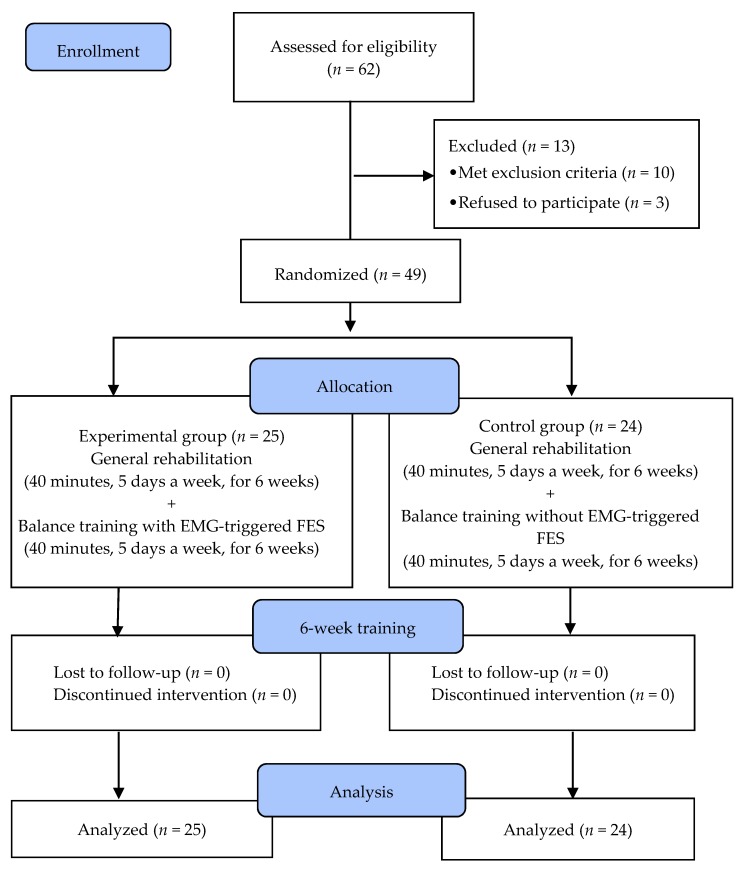
This study was conducted to investigate the effects of balance training with electromyogram-triggered functional electrical stimulation (EMG-triggered FES) to improve static balance, dynamic balance, and ankle muscle activation in stroke patients. Forty-nine participants (>6 months after stroke) were randomly assigned to the experimental group ( = 25) and the control group ( = 24). The experimental group underwent balance training with EMG-triggered FES for 40 min a day, 5 days a week, for a 6-week period in addition to general rehabilitation. The control group underwent balance training without EMG-triggered FES along with conventional therapy. Outcome measures included static balance ability, dynamic balance ability, and leg muscle activation. The static and dynamic balance abilities were significantly improved after intervention in both groups ( < 0.05), although the experimental group showed considerably greater improvement than the control group ( < 0.05). Leg muscle activation on the affected side resulted in significant improvements in the experimental group ( < 0.05) when compared with baseline but not in the control group. Balance training with EMG-triggered FES is an acceptable and effective intervention to improve the static balance, dynamic balance, and ankle muscle activation in stroke patients.
本研究旨在探讨肌电图触发功能性电刺激(EMG触发FES)平衡训练对改善脑卒中患者静态平衡、动态平衡及踝关节肌肉激活的效果。49名参与者(脑卒中后>6个月)被随机分为实验组(n = 25)和对照组(n = 24)。实验组除接受常规康复治疗外,还进行为期6周、每周5天、每天40分钟的EMG触发FES平衡训练。对照组在接受传统治疗的同时进行无EMG触发FES的平衡训练。结果指标包括静态平衡能力、动态平衡能力和腿部肌肉激活。两组干预后静态和动态平衡能力均有显著改善(P < 0.05),尽管实验组的改善程度明显大于对照组(P < 0.05)。与基线相比,实验组患侧腿部肌肉激活有显著改善(P < 0.05),而对照组无显著改善。EMG触发FES平衡训练是一种可接受且有效的干预措施,可改善脑卒中患者的静态平衡、动态平衡及踝关节肌肉激活。