Worthy Samantha J, Jiménez Paz Rosa A, Pérez Álvaro J, Reynolds Alex, Cruse-Sanders Jennifer, Valencia Renato, Barone John A, Burgess Kevin S
Department of Biology, Columbus State University, University System of Georgia, Columbus, GA 31907, USA.
Department of Biology, University of Maryland, College Park, MD 20742, USA.
Plants (Basel). 2019 Sep 5;8(9):326. doi: 10.3390/plants8090326.
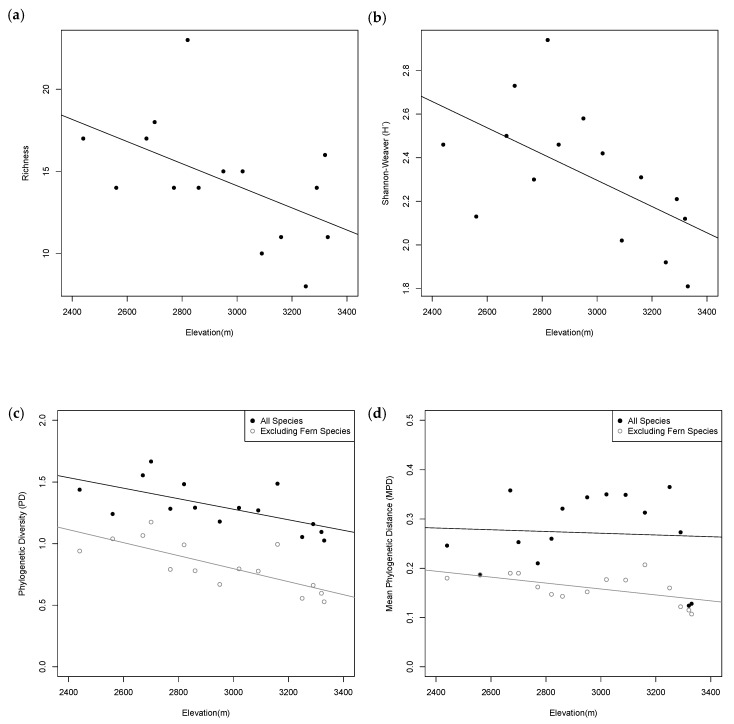
Highlighting patterns of distribution and assembly of plants involves the use of community phylogenetic analyses and complementary traditional taxonomic metrics. However, these patterns are often unknown or in dispute, particularly along elevational gradients, with studies finding different patterns based on elevation. We investigated how patterns of tree diversity and structure change along an elevation gradient using taxonomic and phylogenetic diversity metrics. We sampled 595 individuals (36 families; 53 genera; 88 species) across 15 plots along an elevational gradient (2440-3330 m) in Ecuador. Seventy species were sequenced for the and gene regions to generate a phylogeny. Species richness, Shannon-Weaver diversity, Simpson's Dominance, Simpson's Evenness, phylogenetic diversity (PD), mean pairwise distance (MPD), and mean nearest taxon distance (MNTD) were evaluated for each plot. Values were correlated with elevation and standardized effect sizes (SES) of MPD and MNTD were generated, including and excluding tree fern species, for comparisons across elevation. Taxonomic and phylogenetic metrics found that species diversity decreases with elevation. We also found that overall the community has a non-random phylogenetic structure, dependent on the presence of tree ferns, with stronger phylogenetic clustering at high elevations. Combined, this evidence supports the ideas that tree ferns have converged with angiosperms to occupy the same habitat and that an increased filtering of clades has led to more closely related angiosperm species at higher elevations.
突出植物的分布和组装模式涉及使用群落系统发育分析和补充性的传统分类学指标。然而,这些模式往往未知或存在争议,特别是在海拔梯度上,不同研究基于海拔发现了不同的模式。我们使用分类学和系统发育多样性指标,研究了树木多样性和结构模式如何沿海拔梯度变化。我们在厄瓜多尔沿海拔梯度(2440 - 3330米)的15个样地中对595个个体(36科;53属;88种)进行了采样。对70个物种的 和 基因区域进行了测序以构建系统发育树。对每个样地评估了物种丰富度、香农 - 韦弗多样性、辛普森优势度、辛普森均匀度、系统发育多样性(PD)、平均成对距离(MPD)和平均最近分类单元距离(MNTD)。将这些值与海拔进行关联,并生成了MPD和MNTD的标准化效应大小(SES),包括和排除树蕨物种,以便进行跨海拔比较。分类学和系统发育指标发现物种多样性随海拔降低。我们还发现总体而言,群落具有非随机的系统发育结构,这取决于树蕨的存在,在高海拔地区系统发育聚类更强。综合起来,这些证据支持了以下观点:树蕨与被子植物趋同占据相同栖息地,并且在高海拔地区对类群的过滤增加导致了亲缘关系更近的被子植物物种。