Joo Hyung Joon, Park Ji-Young, Hong Soon Jun, Kim Kyoung-Ah, Lee Seung Hoon, Cho Jae-Young, Park Jae Hyoung, Yu Cheol Woong, Lim Do-Sun
Department of Cardiology, Cardiovascular Center, Korea University Anam Hospital, Seoul, Korea.
Department of Clinical Pharmacology and Toxicology, Korea University Anam Hospital, Seoul, Korea.
Korean J Intern Med. 2018 May;33(3):522-531. doi: 10.3904/kjim.2016.228. Epub 2017 Oct 19.
BACKGROUND/AIMS: Although epigallocatechin-3-gallate (EGCG), which is found in high contents in the dried leaves of green tea, has been reported to have an anti-platelet effect, synergistic effects of EGCG in addition to current anti-platelet medications remains to be elucidated.
Blood samples were obtained from 40 participants who took aspirin (ASA, n = 10), clopidogrel (CPD, n = 10), ticagrelor (TCG, n = 10) and no anti-platelet medication (Control, n = 10). platelet aggregation and adhesion under various stimulators were analyzed by multiple electrode aggregometry (MEA) and Impact-R systems. PAC-1 and P-selectin expressions in human platelets were analyzed by flow cytometry.
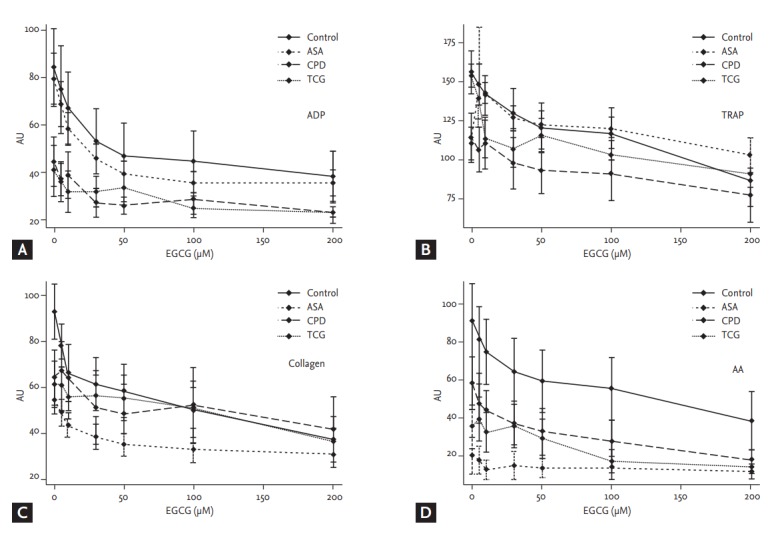
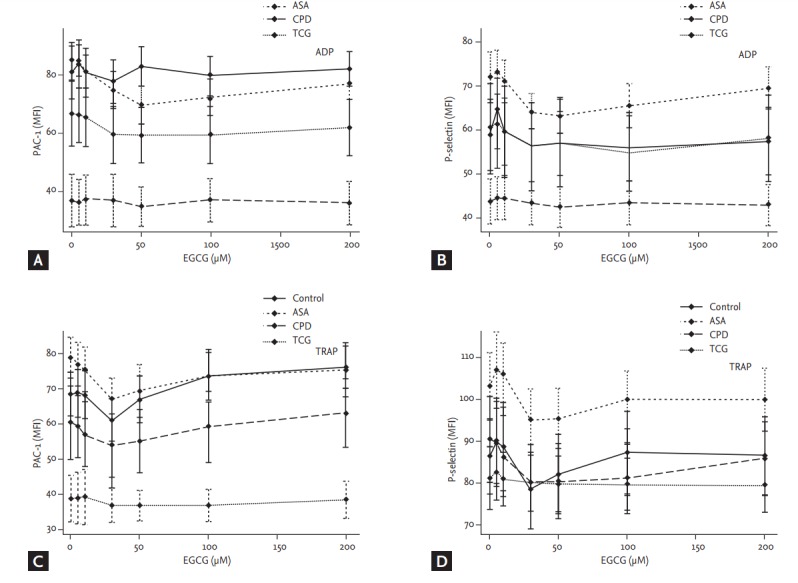
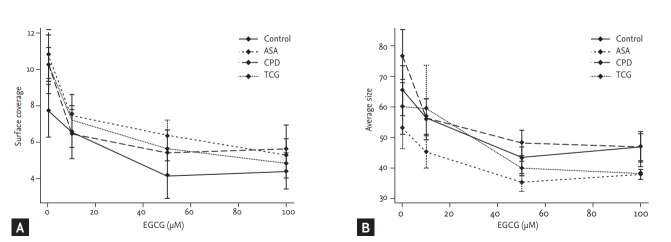
In MEA analysis, adenosine diphosphate (ADP) and thrombin receptor activating peptide (TRAP)-induced platelet aggregations were lower in the CPD and the TCG groups; arachidonic acid (AA)-induced platelet aggregation was lower in the ASA group, whereas collagen (COL)-induced platelet aggregations were comparable among four groups. EGCG significantly reduced ADP- and COL-induced platelet aggregation in dose-dependent manner (ADP, = 0.04; COL, < 0.01). There were no additional suppressions of platelet aggregation stimulated by AA in the ASA group, and by ADP in the CPD and TCG groups. Moreover, EGCG suppressed shear stress-induced platelet adhesion on Impact-R, and had no effect on P-selectin and PAC-1 expressions.
treatment of EGCG inhibited platelet adhesion and aggregation without changes in P-selectin and PAC-1 expression. There was no additional suppressions in platelet aggregation stimulated by AA in the ASA group and ADP in the CPD and TCG groups.
背景/目的:尽管绿茶干叶中含量丰富的表没食子儿茶素-3-没食子酸酯(EGCG)已被报道具有抗血小板作用,但EGCG与目前抗血小板药物联合使用的协同效应仍有待阐明。
从40名参与者中采集血样,这些参与者分别服用阿司匹林(ASA,n = 10)、氯吡格雷(CPD,n = 10)、替格瑞洛(TCG,n = 10)且未服用抗血小板药物(对照组,n = 10)。通过多电极聚集仪(MEA)和Impact-R系统分析不同刺激物作用下的血小板聚集和黏附情况。采用流式细胞术分析人血小板中PAC-1和P-选择素的表达。
在MEA分析中,CPD组和TCG组中,二磷酸腺苷(ADP)和凝血酶受体激活肽(TRAP)诱导的血小板聚集较低;ASA组中花生四烯酸(AA)诱导的血小板聚集较低,而四组中胶原(COL)诱导的血小板聚集相当。EGCG以剂量依赖方式显著降低ADP和COL诱导的血小板聚集(ADP,P = 0.04;COL,P < 0.01)。ASA组中AA刺激的血小板聚集,以及CPD组和TCG组中ADP刺激的血小板聚集均未因EGCG而进一步受到抑制。此外,EGCG抑制了Impact-R上剪切应力诱导的血小板黏附,且对P-选择素和PAC-1表达无影响。
EGCG治疗可抑制血小板黏附和聚集,而不改变P-选择素和PAC-1的表达。ASA组中AA刺激的血小板聚集,以及CPD组和TCG组中ADP刺激的血小板聚集均未因EGCG而进一步受到抑制。