Jensen Andrew R, Cha Peter S, Devana Sai K, Ishmael Chad, Di Pauli von Treuheim Theo, D'Oro Anthony, Wang Jeffrey C, McAllister David R, Petrigliano Frank A
Department of Orthopaedic Surgery, University of California Los Angeles, Los Angeles, California, USA.
Department of Orthopaedic Surgery, University of Southern California, Los Angeles, California, USA.
Orthop J Sports Med. 2017 Oct 12;5(10):2325967117731310. doi: 10.1177/2325967117731310. eCollection 2017 Oct.
Medicare insures the largest population of patients at risk for rotator cuff tears in the United States.
To evaluate the trends in incidence, concomitant procedures, and complications with open and arthroscopic rotator cuff repairs in Medicare patients.
Cohort study; Level of evidence, 3.
All Medicare patients who had undergone open or arthroscopic rotator cuff repair from 2005 through 2011 were identified with a claims database. Annual incidence, concomitant procedures, and postoperative complications were compared between these 2 groups.
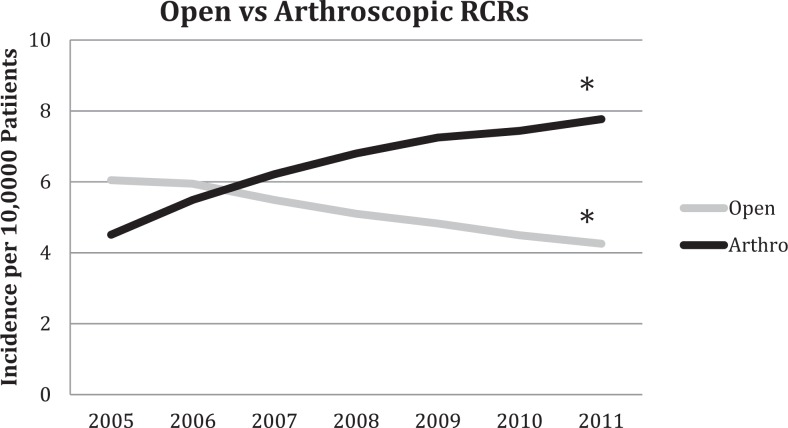
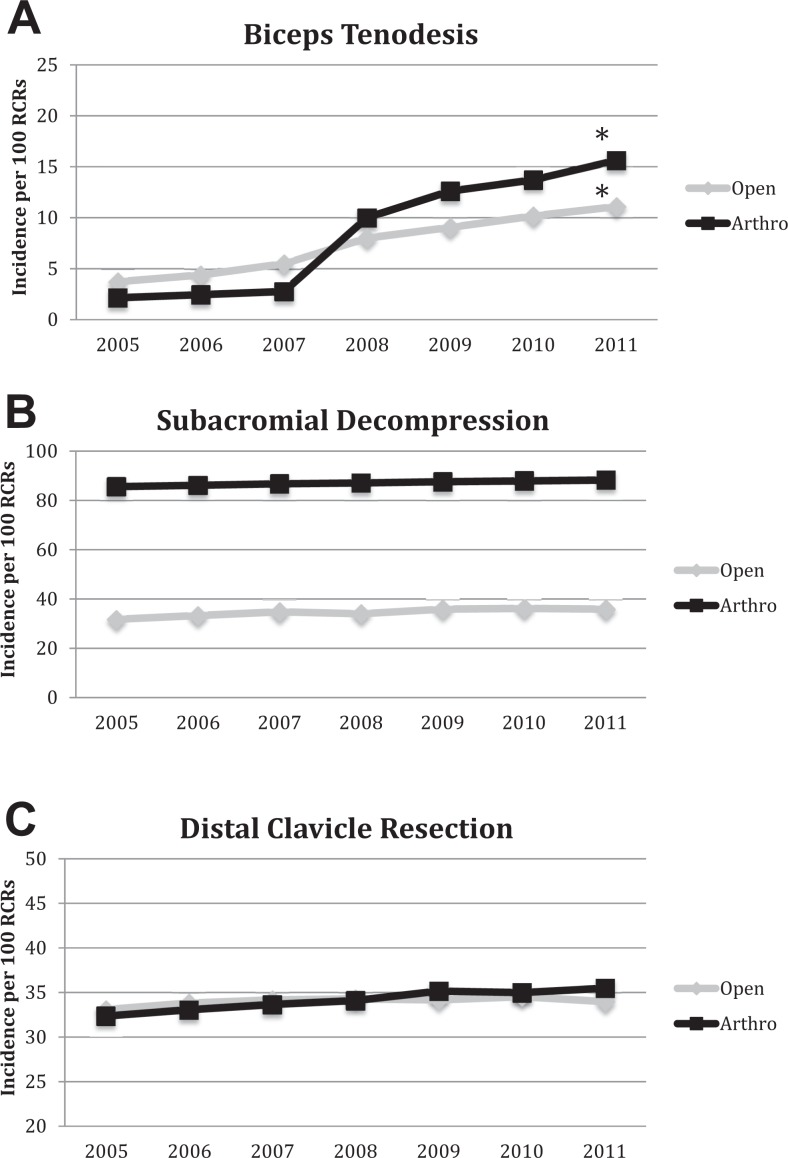
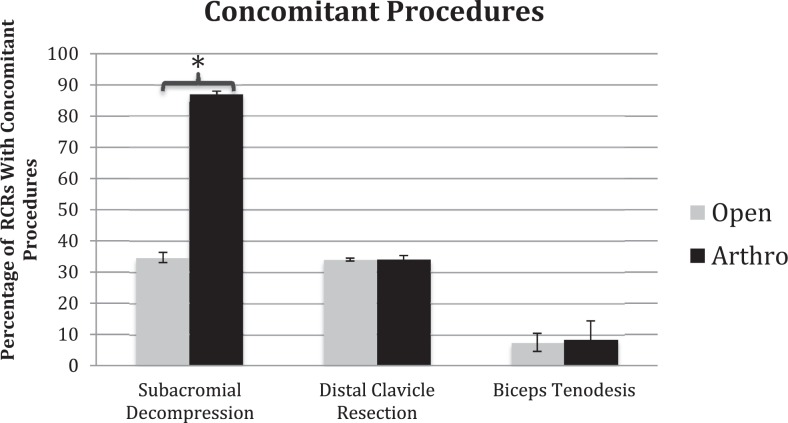
In total, 372,109 rotator cuff repairs were analyzed. The incidence of open repairs decreased (from 6.0 to 4.3 per 10,000 patients, < .001) while the incidence of arthroscopic repairs increased (from 4.5 to 7.8 per 10,000 patients, < .001) during the study period. Patients in the arthroscopic group were more likely to have undergone concomitant subacromial decompression than those in the open group (87% vs 35%, < .001), and the annual incidence of concomitant biceps tenodesis increased for both groups (from 3.8% to 11% for open and 2.2% to 16% for arthroscopic, < .001). While postoperative complications were infrequent, patients in the open group were more likely to be diagnosed with infection within 6 months (0.86% vs 0.37%, < .001) but no more likely to undergo operative debridement (0.43% vs 0.26%, = .08). Additionally, patients in the open group were more likely to undergo intervention for shoulder stiffness within 1 year (1.4% vs 1.1%, = .01).
In the Medicare population, arthroscopic rotator cuff repairs have increased in incidence and now represent the majority of rotator cuff repair surgery. Among concomitant procedures, subacromial decompression was most commonly performed despite evidence suggesting a lack of efficacy. Infections and stiffness were rare complications that were slightly but significantly more frequent in open rotator cuff repairs.
在美国,医疗保险覆盖了肩袖撕裂风险最高的最大患者群体。
评估医疗保险患者中开放性和关节镜下肩袖修复术在发病率、同期手术及并发症方面的趋势。
队列研究;证据等级,3级。
通过索赔数据库识别出2005年至2011年期间接受开放性或关节镜下肩袖修复术的所有医疗保险患者。对这两组患者的年发病率、同期手术及术后并发症进行比较。
共分析了372,109例肩袖修复术。在研究期间,开放性修复术的发病率下降(从每10,000例患者6.0例降至4.3例,P<0.001),而关节镜下修复术的发病率上升(从每10,000例患者4.5例升至7.8例,P<0.001)。关节镜组患者比开放组患者更有可能接受同期肩峰下减压术(87%对35%,P<0.001),两组同期肱二头肌固定术的年发病率均有所增加(开放组从3.8%升至11%,关节镜组从2.2%升至16%,P<0.001)。虽然术后并发症不常见,但开放组患者在6个月内更有可能被诊断为感染(0.86%对0.37%,P<0.001),但接受手术清创的可能性并无差异(0.43%对0.26%,P = 0.08)。此外,开放组患者在1年内更有可能因肩关节僵硬而接受干预(1.4%对1.1%,P = 0.01)。
在医疗保险人群中,关节镜下肩袖修复术的发病率有所增加,目前已占肩袖修复手术的大多数。在同期手术中,尽管有证据表明肩峰下减压术缺乏疗效,但该手术最为常用。感染和僵硬是罕见的并发症,在开放性肩袖修复术中略为常见,但差异有统计学意义。