Mozafari Javad, Masoumi Kambiz, Forouzan Arash, Motamed Hassan, Saki Malehi Amal, Dezham Marzieh
Department of Emergency Medicine, Ahvaz Jundishapur University of Medical Sciences, Ahvaz, Iran.
Department of Vital Statistics, Faculty of Health, Ahvaz Jundishapur University of Medical Sciences, Ahvaz, Iran.
Pain Ther. 2017 Dec;6(2):227-234. doi: 10.1007/s40122-017-0082-5. Epub 2017 Oct 20.
This study was designed to compare the analgesic efficacy of sublingual (SL) buprenorphine and intravenous (IV) ketorolac for renal colic pain relief.
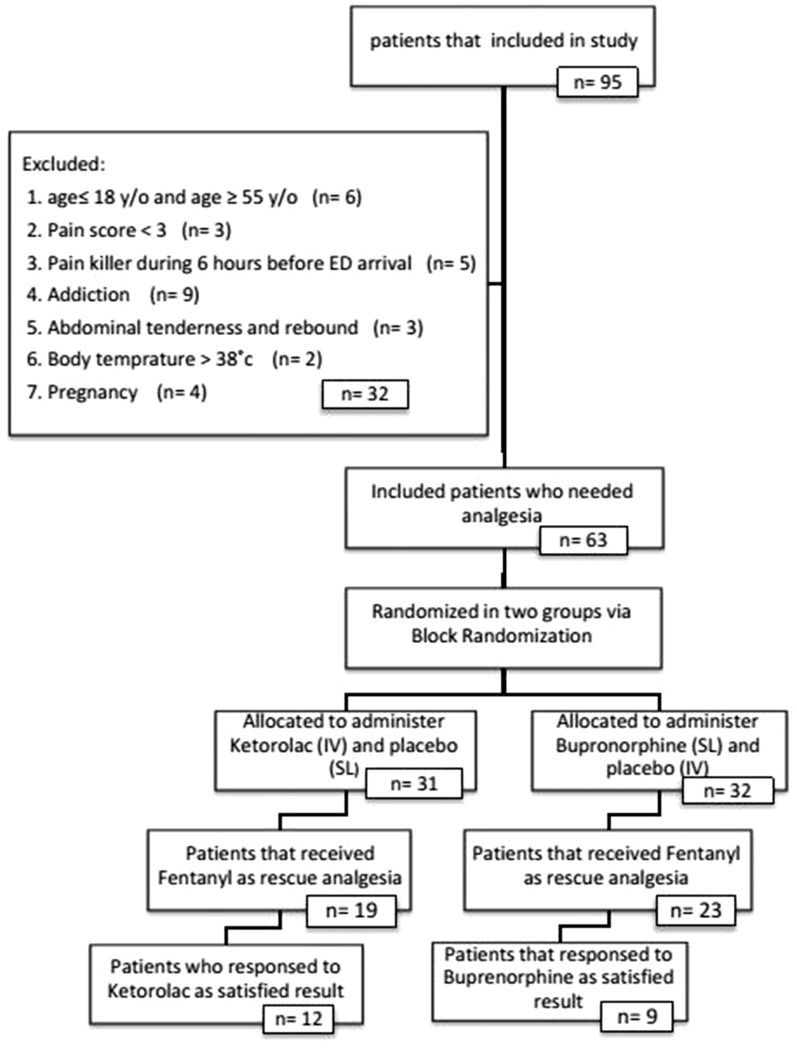
The present study was carried out as a double-blind, double-dummy randomized clinical trial in patients diagnosed with acute renal colic attending the emergency department. The study subjects were 63 patients with confirmed renal stones. The subjects were randomly divided into two groups. One group, which included 32 patients, received SL buprenorphine tablets (2 mg) with an IV placebo, and another group, including 31 patients, received ketorolac tromethamine (30 mg) with a SL placebo. After medication, the pain of subjects was measured by a standard visual pain analogous scale (VPAS) in minutes 0, 20, 40, and 60 of study. Also, probable adverse effects were recorded.
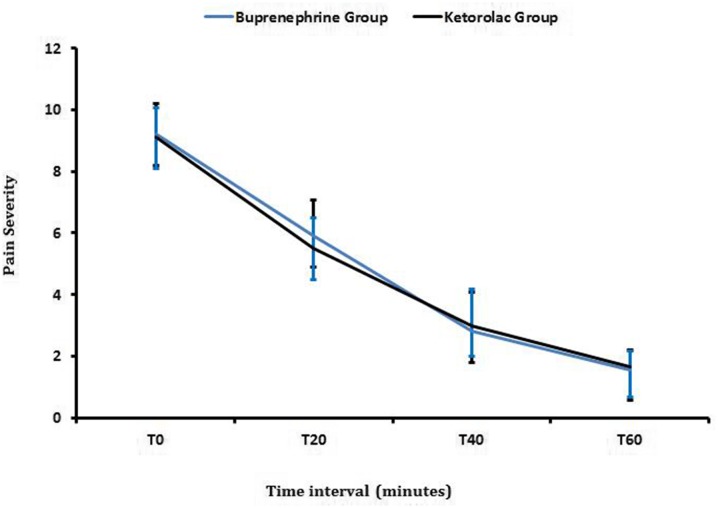
In 28.1% of patients in the buprenorphine group, the mean pain score decreased from 9.2 to 5.9, 2.8, and 1.5 after 20, 40, and 60 min, respectively, as determined by VPAS. Also, in 38.7% of patients in the ketorolac group, the mean pain score decreased from 9.1 to 5.5, 3.0, and 1.6 after 20, 40, and 60 min, respectively, as determined by VPAS. The two groups did not significantly differ for pain reduction at 20, 40, and 60 min (P value = 0.16, 0.34, and 0.3, respectively). No adverse effects were seen in the ketorolac group, but vomiting (18.8%), nausea (18.8%), and dizziness (21.9%) were detected in the buprenorphine group.
We found no difference between SL buprenorphine and intravenous ketorolac in renal colic pain relief but more adverse effects in the buprenorphine group. Trial Registration Iranian Registry of Clinical trials identifier, IRCT2015041421773N1.
本研究旨在比较舌下含服丁丙诺啡和静脉注射酮咯酸对肾绞痛的镇痛效果。
本研究为双盲、双模拟随机临床试验,研究对象为急诊科诊断为急性肾绞痛的患者。研究对象为63例确诊肾结石患者。将受试者随机分为两组。一组32例患者接受舌下含服丁丙诺啡片(2mg)加静脉注射安慰剂,另一组31例患者接受酮咯酸氨丁三醇(30mg)加舌下含服安慰剂。用药后,在研究的第0、20、40和60分钟,通过标准视觉模拟疼痛量表(VPAS)测量受试者的疼痛程度。同时,记录可能出现的不良反应。
根据VPAS测定,丁丙诺啡组28.1%的患者在用药20、40和60分钟后,平均疼痛评分分别从9.2降至5.9、2.8和1.5。同样,酮咯酸组38.7%的患者在用药20、40和60分钟后,平均疼痛评分分别从9.1降至5.5、3.0和1.6。两组在20、40和60分钟时疼痛减轻程度无显著差异(P值分别为0.16、0.34和0.3)。酮咯酸组未观察到不良反应,但丁丙诺啡组出现呕吐(18.8%)、恶心(18.8%)和头晕(21.9%)。
我们发现舌下含服丁丙诺啡和静脉注射酮咯酸在缓解肾绞痛方面无差异,但丁丙诺啡组不良反应更多。试验注册号:伊朗临床试验注册中心标识符,IRCT2015041421773N1。