Setién-Olarra A, Marichalar-Mendia X, Bediaga N G, Aguirre-Echebarria P, Aguirre-Urizar J M, Mosqueda-Taylor A
Oral Medicine and Pathology, Department of Stomatology II, University of the Basque Country (UPV/EHU), Leioa, Spain.
BIOMICs Research Group, Lascaray Research Center, University of the Basque Country (UPV/EHU), Miguel de Unamuno, Vitoria-Gazteiz, Spain.
PLoS One. 2017 Oct 20;12(10):e0186841. doi: 10.1371/journal.pone.0186841. eCollection 2017.
Odontogenic tumors (OT) represent a specific pathological category that includes some lesions with unpredictable biological behavior. Although most of these lesions are benign, some, such as the ameloblastoma, exhibit local aggressiveness and high recurrence rates. The most common types of ameloblastoma are the solid/multicystic (SA) and the unicystic ameloblastoma (UA); the latter considered a much less aggressive entity as compared to the SA. The microRNA system regulates the expression of many human genes while its deregulation has been associated with neoplastic development. The aim of the current study was to determine the expression profiles of microRNAs present in the two most common types of ameloblastomas.
MATERIAL & METHODS: MicroRNA expression profiles were assessed using TaqMan® Low Density Arrays (TLDAs) in 24 samples (8 SA, 8 UA and 8 control samples). The findings were validated using quantitative RTqPCR in an independent cohort of 19 SA, 8 UA and 19 dentigerous cysts as controls.
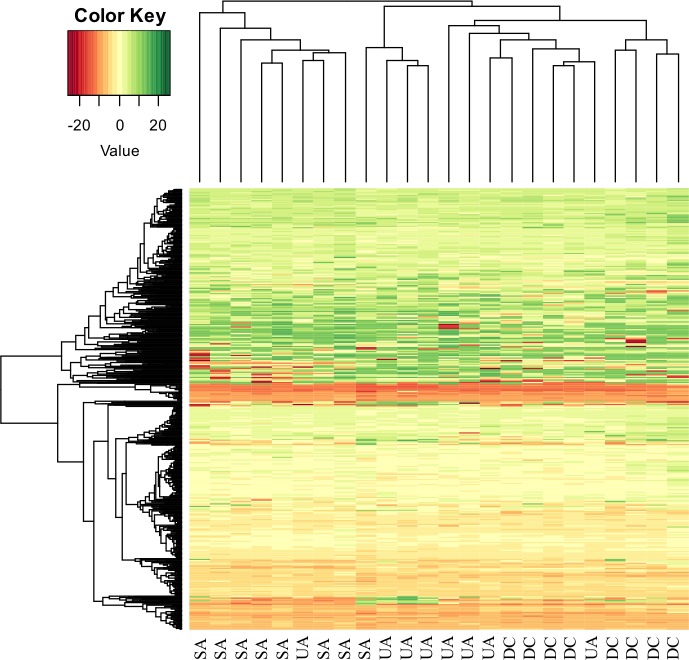
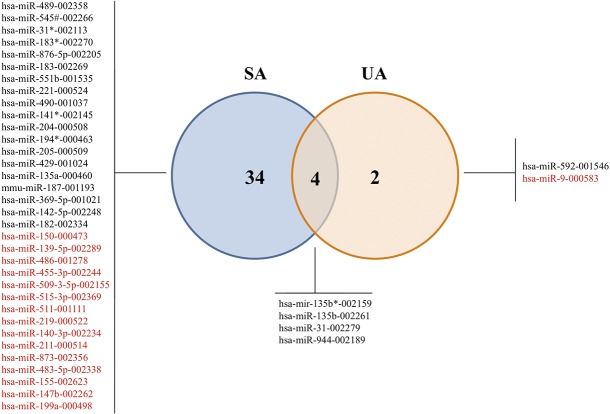
We identified 40 microRNAs differentially regulated in ameloblastomas, which are related to neoplastic development and differentiation, and with the osteogenic process. Further validation of the top ranked microRNAs revealed significant differences in the expression of 6 of them in relation to UA, 7 in relation to SA and 1 (miR-489) that was related to both types.
We identified a new microRNA signature for the ameloblastoma and for its main types, which may be useful to better understand the etiopathogenesis of this neoplasm. In addition, we identified a microRNA (miR-489) that is suggestive of differentiating among solid from unicystic ameloblastoma.
牙源性肿瘤(OT)是一类特殊的病理类型,其中一些病变具有不可预测的生物学行为。尽管这些病变大多为良性,但有些,如成釉细胞瘤,具有局部侵袭性和高复发率。成釉细胞瘤最常见的类型是实性/多囊型(SA)和单囊型成釉细胞瘤(UA);与SA相比,后者被认为侵袭性要小得多。微小RNA系统调节许多人类基因的表达,而其失调与肿瘤发生有关。本研究的目的是确定两种最常见类型的成釉细胞瘤中存在的微小RNA的表达谱。
使用TaqMan®低密度阵列(TLDA)评估24个样本(8个SA、8个UA和8个对照样本)中的微小RNA表达谱。研究结果在一个独立队列中通过定量RTqPCR进行验证,该队列包括19个SA、8个UA和19个含牙囊肿作为对照。
我们在成釉细胞瘤中鉴定出40种差异调节的微小RNA,它们与肿瘤发生、分化以及成骨过程有关。对排名靠前的微小RNA的进一步验证显示,其中6种在与UA相关的表达上存在显著差异,7种在与SA相关的表达上存在显著差异,还有1种(miR-489)与两种类型均相关。
我们为成釉细胞瘤及其主要类型鉴定出一种新的微小RNA特征,这可能有助于更好地理解该肿瘤的发病机制。此外,我们鉴定出一种微小RNA(miR-489)可提示实性与单囊型成釉细胞瘤之间的鉴别诊断。