Shibayama Sotaro, Kobayashi Yoshie
Sten K. Johnson Centre for Entrepreneurship, School of Economics and Management, Lund University, P. O. Box 7080, 220 07 Lund, Sweden.
National Institute of Science and Technology Policy, Ministry of Education, Culture, Sports, Science and Technology, Tokyo, Japan.
Scientometrics. 2017;113(1):387-415. doi: 10.1007/s11192-017-2479-7. Epub 2017 Aug 11.
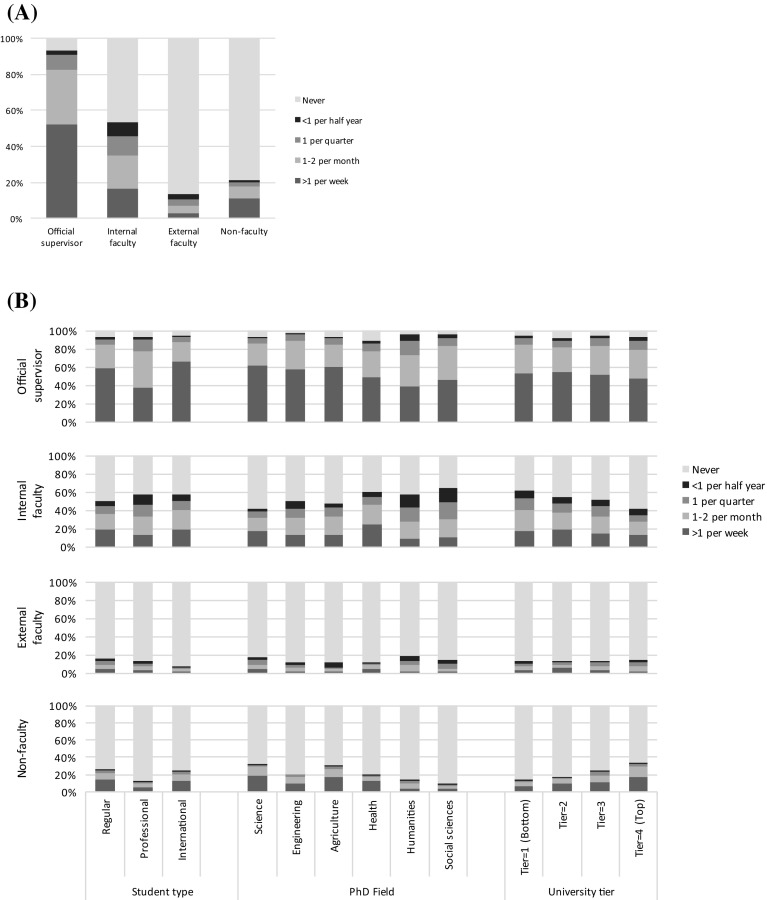
Ph.D. training in academic labs offers the foundation for the production of knowledge workers, indispensable for the modern knowledge-based society. Nonetheless, our understanding on Ph.D. training has been insufficient due to limited access to the inside of academic labs. Furthermore, early careers of Ph.D. graduates are often difficult to follow, which makes the evaluation of training effects challenging. To address these limitations, this study aims to illustrate the settings of Ph.D. training in academic labs and examine their impact on several training outcomes, drawing on a national survey of a cohort of 5000 Ph.D. graduates from Japanese universities. The result suggests that a supervising team structure as well as the frequency of supervision, contingent to a few contextual factors, determine the Ph.D. graduates' career decisions, performance, and degrees of satisfaction with the training programs.
在学术实验室接受博士培训为培养知识型工作者奠定了基础,而知识型工作者对于现代知识社会来说不可或缺。然而,由于难以深入了解学术实验室内部情况,我们对博士培训的认识一直不够充分。此外,博士毕业生的早期职业生涯往往难以追踪,这使得评估培训效果具有挑战性。为了克服这些局限性,本研究旨在通过对日本大学5000名博士毕业生群体进行全国性调查,阐明学术实验室中博士培训的情况,并考察其对若干培训成果的影响。结果表明,在一些背景因素的影响下,指导团队结构以及指导频率决定了博士毕业生的职业选择、表现以及对培训项目的满意度。