Aoki Motoki, Wakuno Ai, Kushiro Asuka, Mae Naomi, Kakizaki Masashi, Nagata Shun-Ichi, Ohta Minoru
Racehorse Clinic, Miho Training Center, Japan Racing Association, Ibaraki 300-0493, Japan.
Laboratory of Racing Chemistry, Tochigi 320-0851, Japan.
J Vet Med Sci. 2017 Dec 22;79(12):2011-2018. doi: 10.1292/jvms.16-0658. Epub 2017 Oct 23.
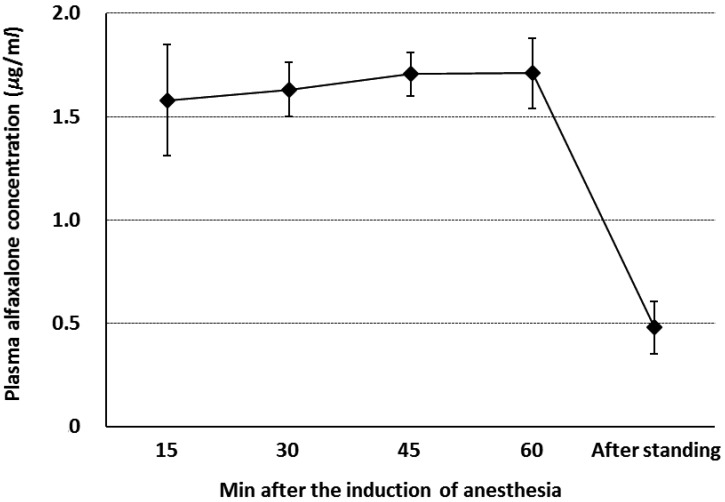
Anesthetic and cardiorespiratory effects of total intravenous anesthesia (TIVA) technique using propofol-guaifenesin-medetomidine (PGM) and alfaxalone-guaifenesin-medetomidine (AGM) were preliminarily evaluated in Thoroughbred horses undergoing castration. Twelve male Thoroughbred horses were assigned randomly into two groups. After premedication with intravenous (IV) administrations of medetomidine (5.0 µg/kg) and butorphanol (0.02 mg/kg), anesthesia was induced with guaifenesin (10 mg/kg IV), followed by either propofol (2.0 mg/kg IV) (group PGM: n=6) or alfaxalone (1.0 mg/kg IV) (group AGM: n=6). Surgical anesthesia was maintained for 60 min at a constant infusion of either propofol (3.0 mg/kg/hr) (group PGM) or alfaxalone (1.5 mg/kg/hr) (group AGM), in combination with guaifenesin (80 mg/kg/hr) and medetomidine (3.0 µg/kg/hr). Responses to surgical stimuli, cardiorespiratory values, and induction and recovery characteristics were recorded throughout anesthesia. During anesthesia induction, one horse paddled in group PGM. All horses from group AGM were maintained at adequate anesthetic depth for castration. In group PGM, 3 horses showed increased cremaster muscle tension and one showed slight movement requiring additional IV propofol to maintain surgical anesthesia. No horse exhibited apnea, although arterial oxygen tension decreased in group AGM to less than 60 mmHg. Recovery quality was good to excellent in both groups. In conclusion, TIVA using PGM and AGM infusion was available for 60 min anesthesia in Thoroughbred horses. TIVA techniques using PGM and AGM infusion provided clinically acceptable general anesthesia with mild cardiorespiratory depression. However, inspired air should be supplemented with oxygen to prevent hypoxemia during anesthesia.
在接受去势手术的纯种马中,初步评估了使用丙泊酚 - 愈创甘油醚 - 美托咪定(PGM)和阿法沙龙 - 愈创甘油醚 - 美托咪定(AGM)的全静脉麻醉(TIVA)技术的麻醉和心肺效应。12匹雄性纯种马被随机分为两组。在静脉注射(IV)给予美托咪定(5.0μg/kg)和布托啡诺(0.02mg/kg)进行术前用药后,用愈创甘油醚(10mg/kg IV)诱导麻醉,随后给予丙泊酚(2.0mg/kg IV)(PGM组:n = 6)或阿法沙龙(1.0mg/kg IV)(AGM组:n = 6)。以丙泊酚(3.0mg/kg/小时)(PGM组)或阿法沙龙(1.5mg/kg/小时)(AGM组)持续输注,并联合愈创甘油醚(80mg/kg/小时)和美托咪定(3.0μg/kg/小时)维持手术麻醉60分钟。在整个麻醉过程中记录对手术刺激的反应、心肺值以及诱导和恢复特征。在麻醉诱导期间,PGM组有一匹马划动四肢。AGM组的所有马匹均维持在足以进行去势手术的麻醉深度。在PGM组,3匹马提睾肌张力增加,1匹马出现轻微运动,需要额外静脉注射丙泊酚以维持手术麻醉。尽管AGM组动脉血氧分压降至低于60mmHg,但没有马匹出现呼吸暂停。两组的恢复质量均为良好至优秀。总之,使用PGM和AGM输注的TIVA可用于纯种马60分钟的麻醉。使用PGM和AGM输注的TIVA技术提供了临床上可接受的全身麻醉,伴有轻度心肺抑制。然而,麻醉期间应补充吸入氧气以预防低氧血症。