Glen Kate, Eston Roger, Loetscher Tobias, Parfitt Gaynor
School of Psychology, University of South Australia, Adelaide, South Australia.
Alliance for Research in Exercise, Nutrition and Activity (ARENA), Sansom Institute for Health Research, School of Health Sciences, University of South Australia, Adelaide, South Australia.
PLoS One. 2017 Oct 23;12(10):e0186526. doi: 10.1371/journal.pone.0186526. eCollection 2017.
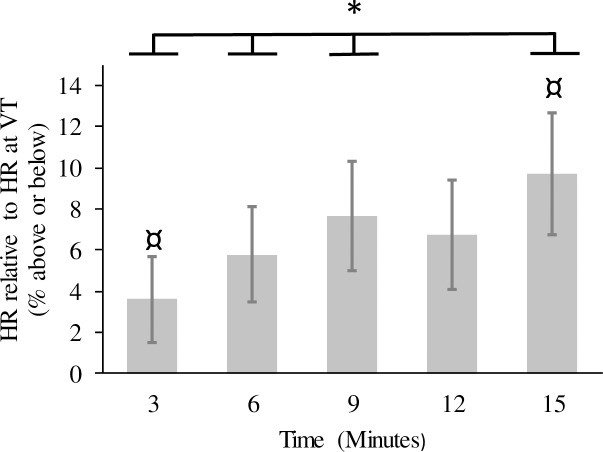
Strategies to encourage exercise have led to research on cycle ergometer 'exergaming', as a means of enhancing exercise enjoyment. This research has typically prescribed the exercise intensity and used one exercise mode. The aim of this study was to compare self-selected exercise intensity on a cycle ergometer with and without exergaming modes activated. A total of 20 participants aged between 18-40 years (M = 24.2 ± 5.9) completed a sub-maximal exercise test. Participants returned two days later to complete one 45 minute session of self-selected exercise with 15 minutes in each of 'control' (standard ergometer), 'track', and 'game' modes, with order randomized. Heart rate, work rate, perceived exertion, and affective valence were recorded during exercise. Dissociation and enjoyment were recorded in the rest interval between each mode. Participants exercised above ventilatory threshold (VT) in all three modes (track, M = 9.5 ± 12%; game, M = 6.2 ± 12%; and control, M = 4.4 ± 14% above VT) and at higher work rates (P < 0.05) exergaming (track, M = 94.5 ± 27.9; game, M = 96.2 ± 32.8 watts) than control (M = 86.6 ± 26.5 watts). Despite exercising at a higher intensity, participants perceived exercise during the exergaming modes to be most pleasant (P < 0.01), with greater enjoyment (P < 0.01) and dissociation (P < 0.01) in the game than track mode, and both modes higher on these variables than the control mode. Findings support the use of exergaming as a strategy to encourage individuals to exercise, with participants choosing to work harder physiologically, but reporting more positive psychological responses during and following the exercise.
鼓励锻炼的策略促使人们对自行车测力计“运动游戏”进行研究,以此作为增强锻炼乐趣的一种方式。这项研究通常规定了锻炼强度并采用单一的锻炼模式。本研究的目的是比较在激活和未激活运动游戏模式的情况下,参与者在自行车测力计上自行选择的锻炼强度。共有20名年龄在18至40岁之间(M = 24.2 ± 5.9)的参与者完成了一次亚极量运动测试。两天后,参与者回来完成一次45分钟的自行选择锻炼,在“对照”(标准测力计)、“赛道”和“游戏”模式下各锻炼15分钟,顺序随机。在锻炼过程中记录心率、工作率、主观用力程度和情感效价。在每种模式之间的休息间隔记录解离感和乐趣。参与者在所有三种模式下(赛道,高于通气阈值(VT)9.5 ± 12%;游戏,高于VT 6.2 ± 12%;对照,高于VT 4.4 ± 14%)均在通气阈值以上进行锻炼,并且在运动游戏(赛道,M = 94.5 ± 27.9;游戏,M = 96.2 ± 32.8瓦)时的工作率高于对照(M = 86.6 ± 26.5瓦)(P < 0.05)。尽管锻炼强度更高,但参与者认为运动游戏模式下的锻炼最愉快(P < 0.01),游戏模式下的乐趣(P < 0.01)和解离感(P < 0.01)高于赛道模式,并且这两种模式在这些变量上均高于对照模式。研究结果支持将运动游戏作为一种鼓励个体锻炼的策略,参与者在生理上选择更努力地锻炼,但在锻炼期间和锻炼后报告了更积极的心理反应。