Beseler Cheryl, Vollmer Timothy, Graner Michael, Yu Xiaoli
Department of Neurosurgery, University of Colorado Denver School of Medicine, Aurora, Colorado, United States of America.
Department of Neurology, University of Colorado Denver School of Medicine, Aurora, Colorado, United States of America.
PLoS One. 2017 Oct 23;12(10):e0186842. doi: 10.1371/journal.pone.0186842. eCollection 2017.
Intrathecal immunoglobulin G (IgG) and oligoclonal bands (OCBs) are the most consistent and characteristic features of Multiple Sclerosis (MS). OCBs in MS are considered products of clonally expanded B cells in the cerebrospinal fluid (CSF), representing the sum of contributions from B cells in the brain. However, large amounts of IgG can be eluted from MS plaques in which lymphocytes are absent, and there is no correlation between levels of plaque-associated IgG and the presence of lymphocytes. It is calculated that it would take 3.2 billion lymphocytes to generate such large amounts of intrathecal IgG (30 mg in 500 ml CSF) in MS patients. Therefore, circulating lymphocytes in CSF could only account for <0.1% of the extra IgG in MS.
We analyzed clinical laboratory parameters from sera and CSF of 115 patients including 91 patients with MS and 24 patients with other inflammatory central nervous system (CNS) disorders (IC). We investigated the relationship between oligoclonal bands, IgG antibodies, CSF cells, IgG Index, albumin, and total protein.
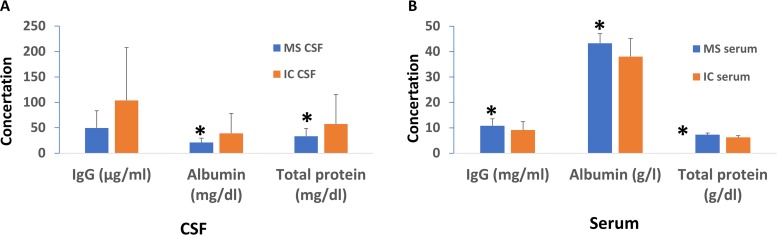
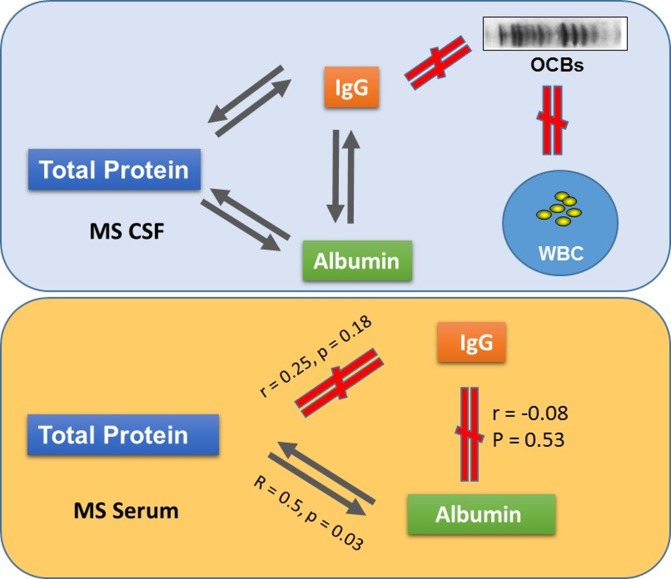
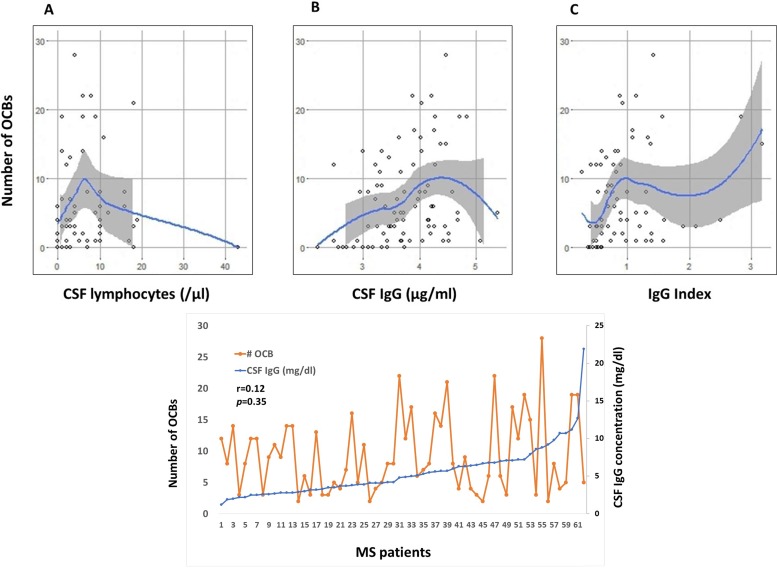
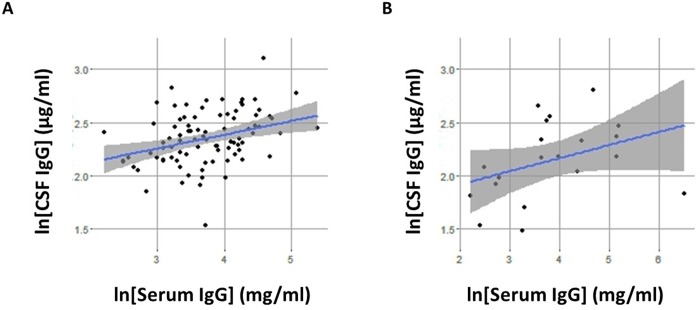
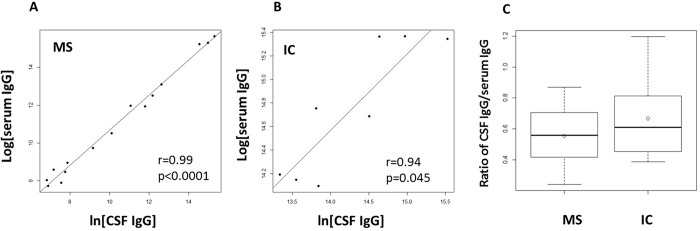
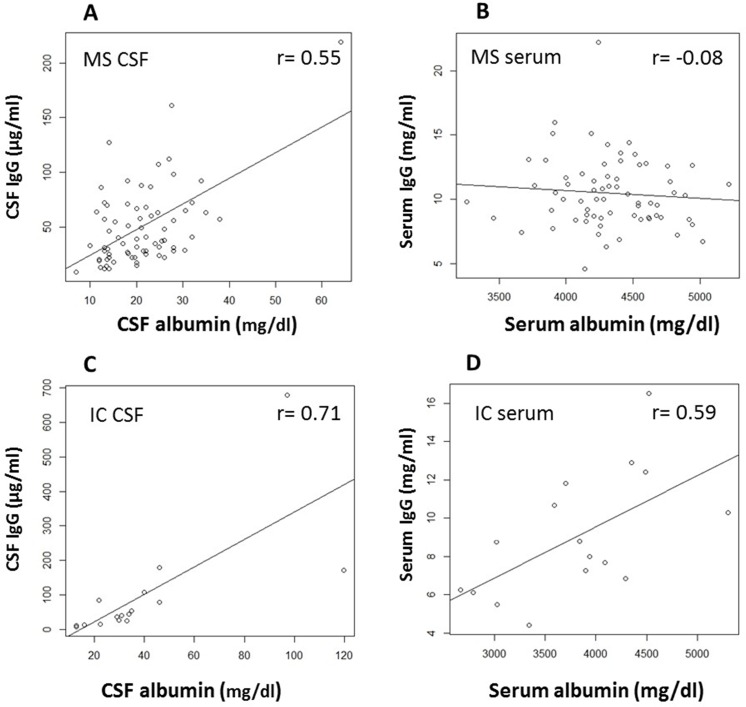
MS patients have significantly elevated serum concentrations of IgG antibodies, albumin, and total protein, lower levels of lymphocytes, albumin, and total protein in the cerebrospinal fluid, but no difference in CSF IgG concentration compared to those with other inflammatory neurological disorders. Furthermore, in MS there was no linear relationship between the numbers of OCBs, CSF lymphocytes, CSF IgG, and IgG Index, and between serum IgG and serum albumin, but significant correlation between IgG in CSF and serum, and between CSF IgG and CSF albumin.
There are unique differences between MS and patients with other inflammatory neurological disorders. Our data suggest that in MS patient (a) B cells and their products in the CSF may not be the sole source of intrathecal IgG; (b) oligoclonal bands may not be the products of single B cell clones in the CSF; and (c) there is a strong connection between serum components in the peripheral circulation and the central nervous system.
鞘内免疫球蛋白G(IgG)和寡克隆带(OCB)是多发性硬化症(MS)最一致且最具特征性的表现。MS中的OCB被认为是脑脊液(CSF)中克隆性扩增B细胞的产物,代表了脑内B细胞的综合贡献。然而,在无淋巴细胞的MS斑块中可洗脱大量IgG,且斑块相关IgG水平与淋巴细胞的存在之间无相关性。据计算,MS患者要产生如此大量的鞘内IgG(500ml脑脊液中30mg)需要32亿个淋巴细胞。因此,脑脊液中的循环淋巴细胞仅占MS中额外IgG的不到0.1%。
我们分析了115例患者血清和脑脊液的临床实验室参数,其中包括91例MS患者和24例患有其他炎症性中枢神经系统(CNS)疾病(IC)的患者。我们研究了寡克隆带、IgG抗体、脑脊液细胞、IgG指数、白蛋白和总蛋白之间的关系。
MS患者血清中IgG抗体、白蛋白和总蛋白浓度显著升高,脑脊液中淋巴细胞、白蛋白和总蛋白水平较低,但与其他炎症性神经系统疾病患者相比,脑脊液IgG浓度无差异。此外,在MS中,OCB数量、脑脊液淋巴细胞、脑脊液IgG和IgG指数之间,以及血清IgG和血清白蛋白之间无线性关系,但脑脊液IgG与血清之间、脑脊液IgG与脑脊液白蛋白之间存在显著相关性。
MS与其他炎症性神经系统疾病患者之间存在独特差异。我们的数据表明,在MS患者中:(a)脑脊液中的B细胞及其产物可能不是鞘内IgG的唯一来源;(b)寡克隆带可能不是脑脊液中单个B细胞克隆的产物;(c)外周循环中的血清成分与中枢神经系统之间存在紧密联系。