Nickels Marc R, Aitken Leanne M, Walsham James, Barnett Adrian G, McPhail Steven M
Department of Physiotherapy, Princess Alexandra Hospital, Woolloongabba, Queensland, Australia.
School of Health Sciences, City, University of London, London, UK.
BMJ Open. 2017 Oct 22;7(10):e017393. doi: 10.1136/bmjopen-2017-017393.
In-bed cycling with patients with critical illness has been shown to be safe and feasible, and improves physical function outcomes at hospital discharge. The effects of early in-bed cycling on reducing the rate of skeletal muscle atrophy, and associations with physical and cognitive function are unknown.
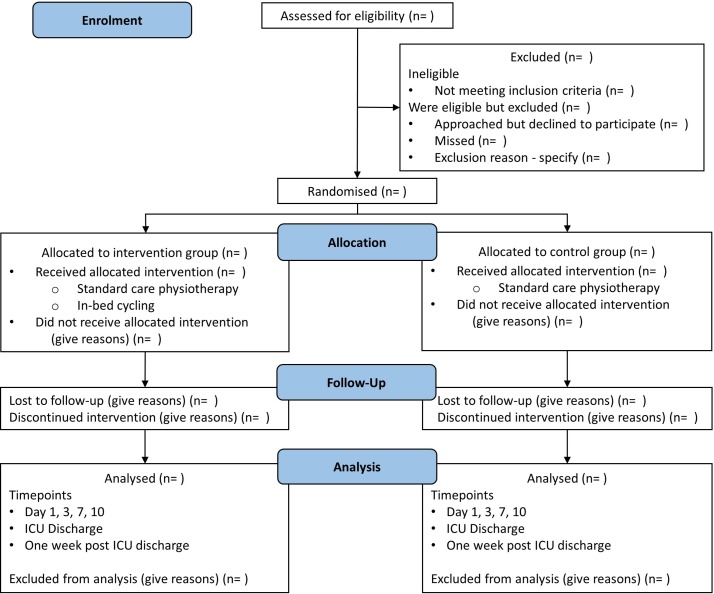
A single-centre randomised controlled trial in a mixed medical-surgical intensive care unit (ICU) will be conducted. Adult patients (n=68) who are expected to be mechanically ventilated for more than 48 hours and remain in ICU for a further 48 hours from recruitment will be randomly allocated into either (1) a usual care group or (2) a group that receives usual care and additional in-bed cycling sessions. The primary outcome is change in rectus femoris cross-sectional area at day 10 in comparison to baseline measured by blinded assessors. Secondary outcome measures include muscle strength, incidence of ICU-acquired weakness, handgrip strength, time to achieve functional milestones (sitting out of bed, walking), Functional Status Score in ICU, ICU Mobility Scale, 6 min walk test 1 week post-ICU discharge, incidence of delirium and quality of life (EuroQol Five Dimensions questionnaire Five Levels scale). Quality of life assessments will be conducted post-ICU admission at day 10, 3 and 6 months after acute hospital discharge. Participants in the intervention group will complete an acceptability of intervention questionnaire.
Appropriate ethical approval from Metro South Health Human Research Ethics Committee has been attained. Results will be published in peer-reviewed publications and presented at scientific conferences to assist planning of future multicentre randomised controlled trials (if indicated) that will test in-bed cycling as an intervention to improve the physical, cognitive and health-related quality of life outcomes of patients with critical illness.
This trial has been prospectively registered on the Australian and New Zealand Clinical Trial Registry (ACTRN12616000948493); Pre-results.
已证明对危重症患者进行床上骑行是安全可行的,且能改善出院时的身体功能结局。早期床上骑行对降低骨骼肌萎缩率的影响以及与身体和认知功能的关联尚不清楚。
将在一家综合内科-外科重症监护病房(ICU)进行一项单中心随机对照试验。预计需要机械通气超过48小时且自入组起在ICU再停留48小时的成年患者(n = 68)将被随机分配到以下两组之一:(1)常规护理组;(2)接受常规护理并增加床上骑行训练的组。主要结局是与由盲法评估者测量的基线相比,第10天时股直肌横截面积的变化。次要结局指标包括肌肉力量、ICU获得性肌无力的发生率、握力、达到功能里程碑(坐起、行走)的时间、ICU功能状态评分、ICU活动量表、ICU出院后1周的6分钟步行试验、谵妄发生率和生活质量(欧洲五维健康量表五级量表)。生活质量评估将在ICU入院后第10天、急性出院后3个月和6个月进行。干预组的参与者将完成一份干预可接受性问卷。
已获得南墨尔本健康人类研究伦理委员会的适当伦理批准。结果将发表在同行评审的出版物上,并在科学会议上展示,以协助规划未来的多中心随机对照试验(如有必要),这些试验将测试床上骑行作为一种干预措施,以改善危重症患者的身体、认知和与健康相关的生活质量结局。
本试验已在澳大利亚和新西兰临床试验注册中心(ACTRN12616000948493)进行前瞻性注册;预结果。