
HIV 暴露和感染与新生儿 GBS 病和直肠阴道 GBS 携带的关系:系统评价和荟萃分析。
Role of HIV exposure and infection in relation to neonatal GBS disease and rectovaginal GBS carriage: a systematic review and meta-analysis.
机构信息
Laboratory Bacteriology Research, Department of Microbiology, Immunology and Clinical Chemistry, Faculty of Medicine and Health Sciences, Ghent University, De Pintelaan 185, Ghent, Belgium.
Department of Clinical Infection, Microbiology and Immunology, Institute of Infection and Global Health, University of Liverpool, Brownlow Hill, Liverpool, UK.
出版信息
Sci Rep. 2017 Oct 23;7(1):13820. doi: 10.1038/s41598-017-13218-1.
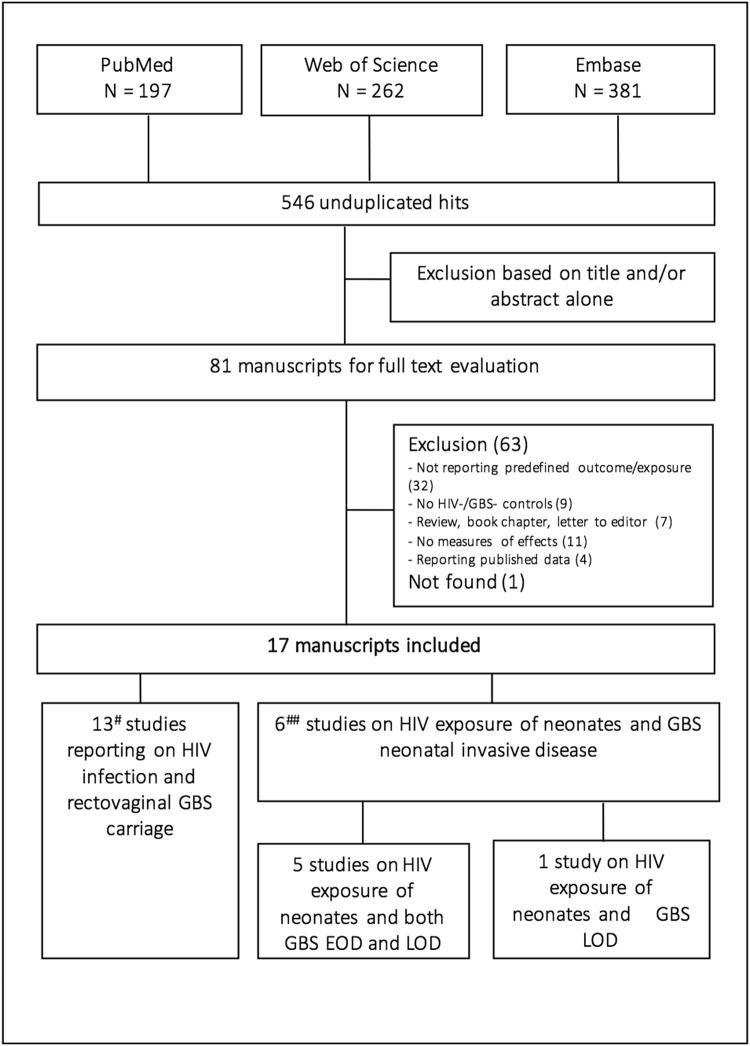
Streptococcus agalactiae (GBS) is the leading cause worldwide of neonatal sepsis. We sought to assess to which extent HIV exposure of neonates is associated with GBS neonatal disease. Furthermore, we assessed to which extent HIV infection in women is associated with maternal rectovaginal GBS carriage, the single most important risk factor for GBS neonatal disease. We searched Pubmed, Embase, and Web of Science for studies assessing the association between neonatal GBS disease and HIV-status of the mother and studies that assessed the association between rectovaginal GBS colonization and HIV status in women. HIV-exposed uninfected neonates were more than twice as likely to have neonatal GBS disease compared to unexposed neonates. HIV-exposed neonates were not at increased risk for early-onset neonatal disease, but were 4.43 times more likely to have late-onset neonatal GBS disease. There was no significant association between HIV infection status and rectovaginal GBS carriage. Public health interventions preventing neonatal GBS disease are urgently needed for the increasing group of HIV-exposed neonates. A framework integrating and explaining our findings highlights opportunities for the clinical practice and global health policy to prevent disease. Well-designed studies should clarify the relation between HIV-status and GBS carriage.
无乳链球菌(GBS)是全球导致新生儿败血症的主要原因。我们旨在评估新生儿 HIV 暴露与 GBS 新生儿疾病的关联程度。此外,我们还评估了女性中 HIV 感染与母体直肠阴道 GBS 定植之间的关联程度,这是 GBS 新生儿疾病的最重要单一危险因素。我们在 Pubmed、Embase 和 Web of Science 上搜索了评估新生儿 GBS 疾病与母亲 HIV 状况之间关联的研究,以及评估直肠阴道 GBS 定植与女性 HIV 状况之间关联的研究。与未暴露的新生儿相比,HIV 暴露的未感染新生儿发生新生儿 GBS 疾病的可能性高出两倍多。HIV 暴露的新生儿发生早发性新生儿疾病的风险没有增加,但发生迟发性新生儿 GBS 疾病的风险增加了 4.43 倍。HIV 感染状况与直肠阴道 GBS 定植之间没有显著关联。迫切需要针对越来越多的 HIV 暴露新生儿采取预防新生儿 GBS 疾病的公共卫生干预措施。整合和解释我们研究结果的框架突出了临床实践和全球卫生政策在预防疾病方面的机会。精心设计的研究应阐明 HIV 状况与 GBS 定植之间的关系。



 Zotero 插件