Foshan Institute of Fetal Medicine, Southern Medical University Affiliated Maternal & Child Health Hospital of Foshan, Foshan, Guangdong, 528000, China.
Department of Obstetrics, Southern Medical University Affiliated Maternal & Child Health Hospital of Foshan, Foshan, Guangdong, 528000, China.
Sci Rep. 2017 Oct 23;7(1):13815. doi: 10.1038/s41598-017-14261-8.
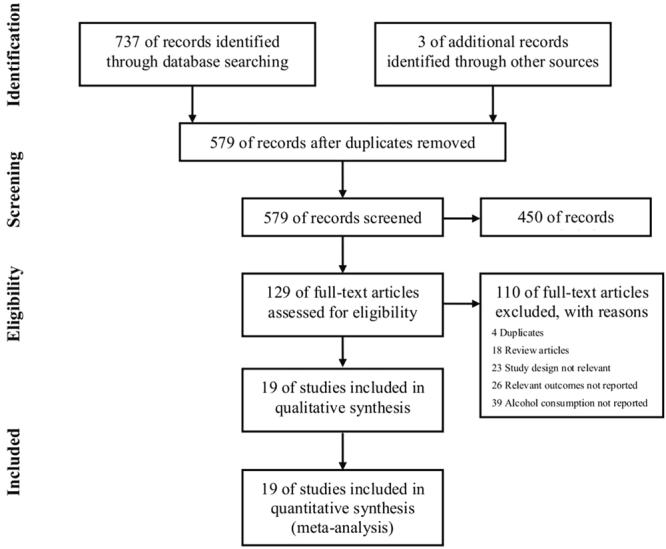
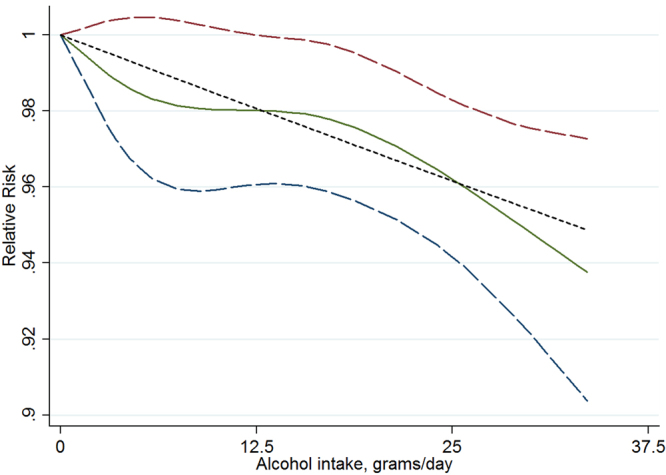
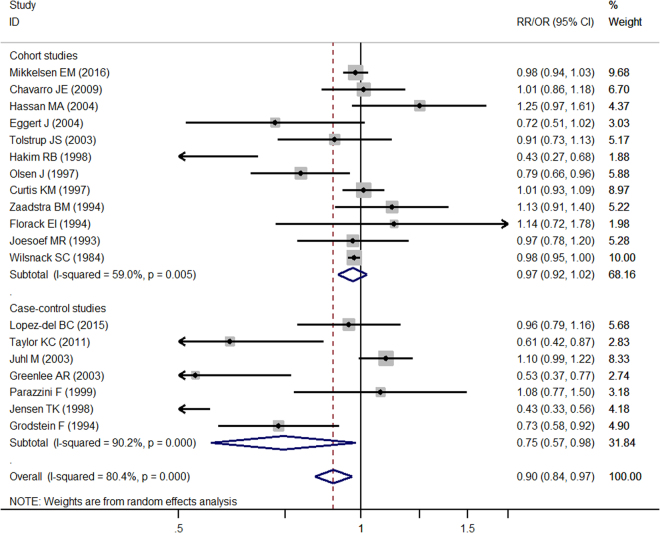
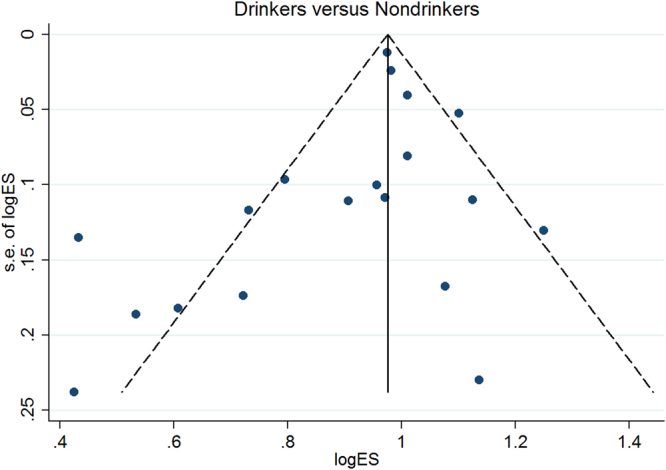
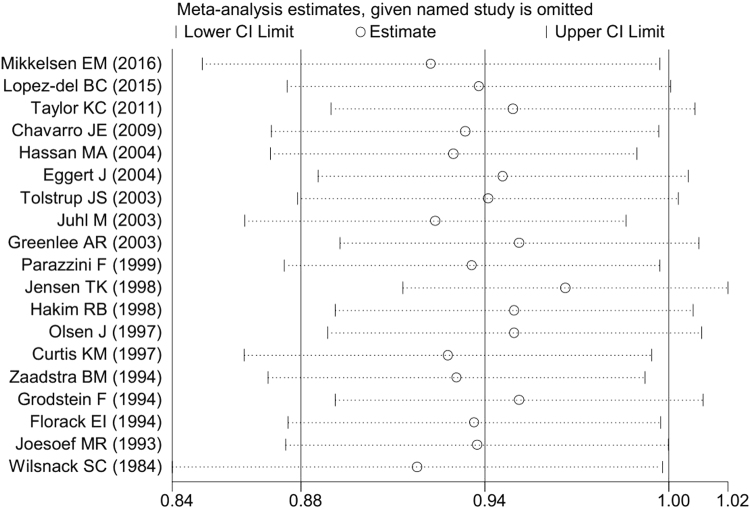
To what extent could alcohol consumption affects female fertility is still unclear. The aim of this study was to quantitatively summarize the dose-response relation between total and specific types of alcohol beverage (beer, wine, and spirits) consumption in female and the fecundability. Four electronic databases were searched. Observational studies (cohort and case-control) that provided female alcohol consumption and fecundity were eligible. Nineteen studies, involving 98657 women, were included in this study. Compared to non-drinkers, the combined estimate (with relative risk, RR) of alcohol consumers on fecundability was 0.87 (95% CI 0.78-0.95) for overall 19 studies. Compared to non-drinkers, the pooled estimates were 0.89 (95% CI 0.82-0.97) for light drinkers (≤12.5 g/day of ethanol) and 0.77 (95% CI 0.61-0.94) for moderate-heavy drinkers (>12.5 g/day of ethanol). Moreover, compared to non-drinkers, the corresponding estimates on fecundability were 0.98 (95% CI 0.85-1.11), 1.02 (95% CI 0.99-1.05), and 0.92 (95% CI 0.83-1.01) for studies focused on wine, beer and spirits, respectively. Dose-response meta-analysis suggested a linear association between decreased fecundability and every 12.5 g/d increasing in alcohol consumption with a RR 0.98 (95% CI 0.97-0.99). This first systematic review and meta-analysis suggested that female alcohol consumption was associated with a reduced fecundability.
饮酒在多大程度上影响女性生育能力尚不清楚。本研究旨在定量总结女性总饮酒量和特定类型(啤酒、葡萄酒和烈酒)饮酒与生育能力之间的剂量-反应关系。检索了四个电子数据库。纳入提供女性饮酒和生育能力的观察性研究(队列研究和病例对照研究)。本研究共纳入 19 项研究,涉及 98657 名女性。与不饮酒者相比,饮酒者的生育能力综合估计值(相对风险,RR)为 0.87(95%可信区间 0.78-0.95)。与不饮酒者相比,轻饮酒者(≤12.5 g/天乙醇)和中重度饮酒者(>12.5 g/天乙醇)的 pooled 估计值分别为 0.89(95%可信区间 0.82-0.97)和 0.77(95%可信区间 0.61-0.94)。此外,与不饮酒者相比,生育能力的相应估计值分别为 0.98(95%可信区间 0.85-1.11)、1.02(95%可信区间 0.99-1.05)和 0.92(95%可信区间 0.83-1.01),分别针对关注葡萄酒、啤酒和烈酒的研究。剂量-反应荟萃分析表明,生育能力下降与每增加 12.5 g/d 饮酒量呈线性相关,RR 为 0.98(95%可信区间 0.97-0.99)。这是首次系统的综述和荟萃分析表明,女性饮酒与生育能力降低有关。