Gimenez Francielli Mary Pereira, de Camargo Wesley Henrique Bueno, Gomes Ana Clara Beraldo, Nihei Thaylla Sumyre, Andrade Monique Walicheki Maria, Valverde Maria Laura de A F Sé, Campos Larissa D' Epiro de Souza, Grion Debora Carvalho, Festti Josiane, Grion Cintia Magalhães Carvalho
Universidade Estadual de Londrina, Londrina, PR, Brazil.
Hospital Evangélico de Londrina, Londrina, PR, Brazil.
Crit Care Res Pract. 2017;2017:6847124. doi: 10.1155/2017/6847124. Epub 2017 Sep 14.
To describe adverse events occurring during intrahospital transportation of adult patients hospitalized in an Intensive Care Unit (ICU) and to evaluate the association with morbidity and mortality.
Prospective cohort study from July 2014 to July 2015. Data collection comprised clinical data, prognostic scores, length of stay, and outcome at hospital discharge. Data was collected on transport and adverse events. Adverse events were classified according to the World Health Organization following the degree of damage. The level of significance was set at 5%.
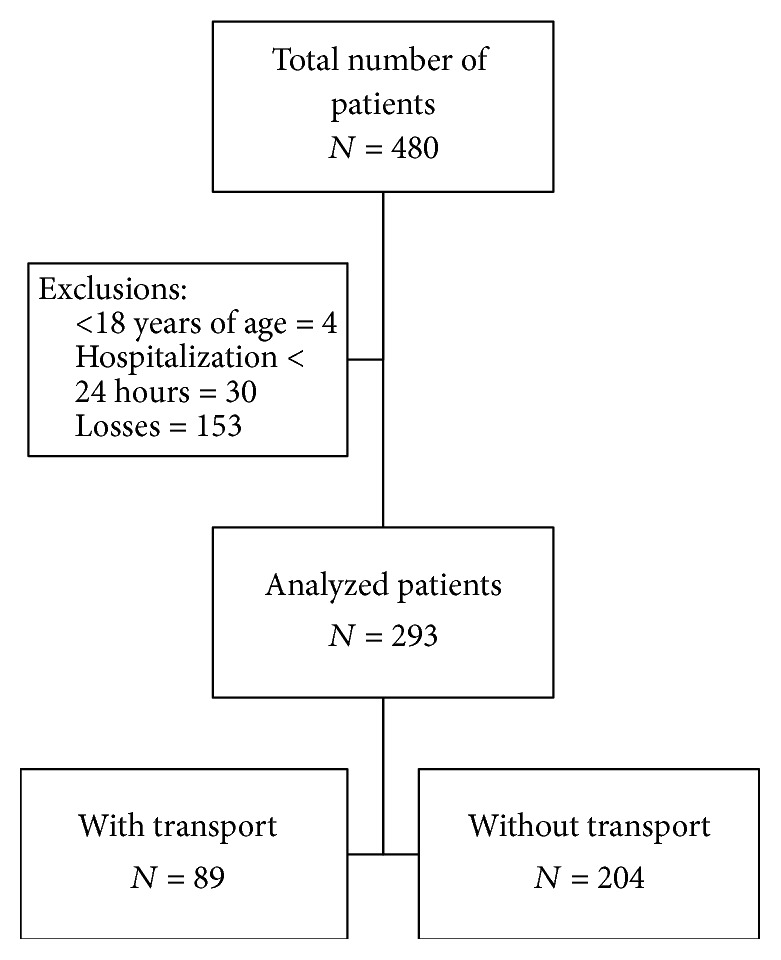
A total of 293 patients were analyzed with follow-up of 143 patient transportations and records of 86 adverse events. Of these events, 44.1% were related to physiological alterations, 23.5% due to equipment failure, 19.7% due to team failure, and 12.7% due to delays. Half of the events were classified as moderate. The mean time of hospital stay of the group with adverse events was higher compared to patients without adverse events (31.4 versus 16.6 days, resp., < 0.001).
Physiological alterations were the most frequently encountered events, followed by equipment and team failures. The degree of damage associated with adverse events was classified as moderate and associated with an increase in the length of hospital stay.
描述重症监护病房(ICU)住院成年患者在院内转运期间发生的不良事件,并评估其与发病率和死亡率的关联。
2014年7月至2015年7月的前瞻性队列研究。数据收集包括临床数据、预后评分、住院时间和出院时的结局。收集转运和不良事件的数据。不良事件按照世界卫生组织的标准根据损害程度进行分类。显著性水平设定为5%。
共分析了293例患者,随访了143次患者转运,记录了86起不良事件。在这些事件中,44.1%与生理改变有关,23.5%归因于设备故障,19.7%归因于团队失误,12.7%归因于延误。一半的事件被分类为中度。发生不良事件组的平均住院时间高于未发生不良事件的患者(分别为31.4天和16.6天,P<0.001)。
生理改变是最常遇到的事件,其次是设备和团队失误。与不良事件相关的损害程度被分类为中度,并与住院时间延长有关。