Program in Neuroscience, Florida State University, Tallahassee, FL 32306-4301.
Department of Psychology, Florida State University, Tallahassee, FL 32306-4301.
eNeuro. 2017 Oct 20;4(5). doi: 10.1523/ENEURO.0297-17.2017. eCollection 2017 Sep-Oct.
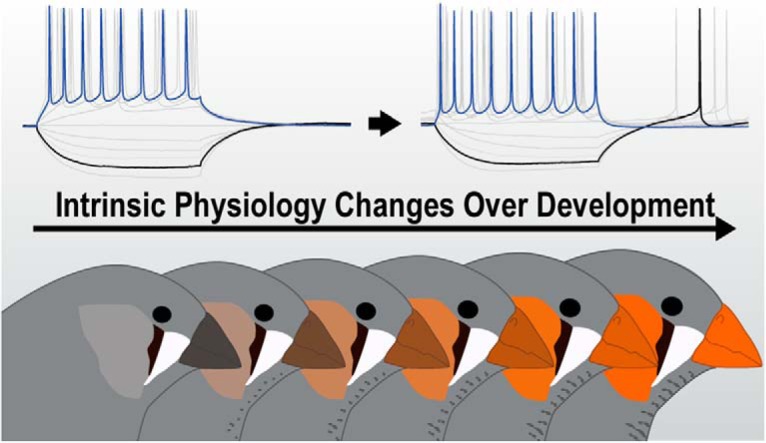
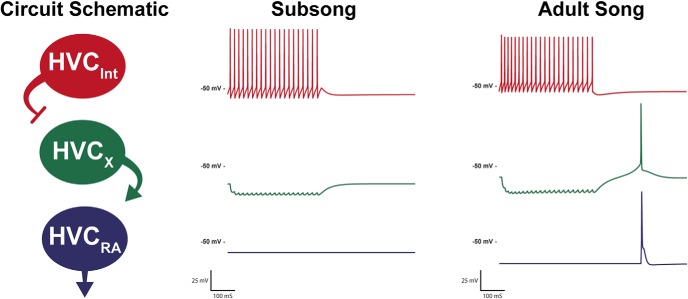
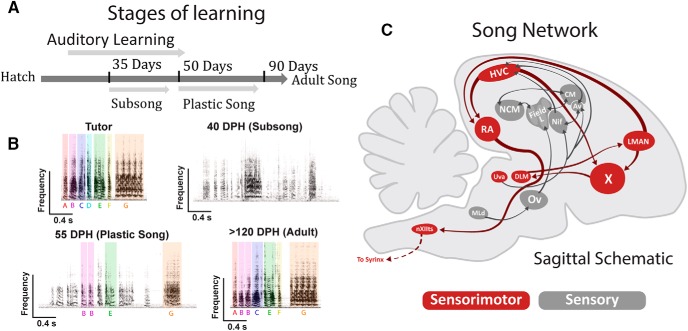
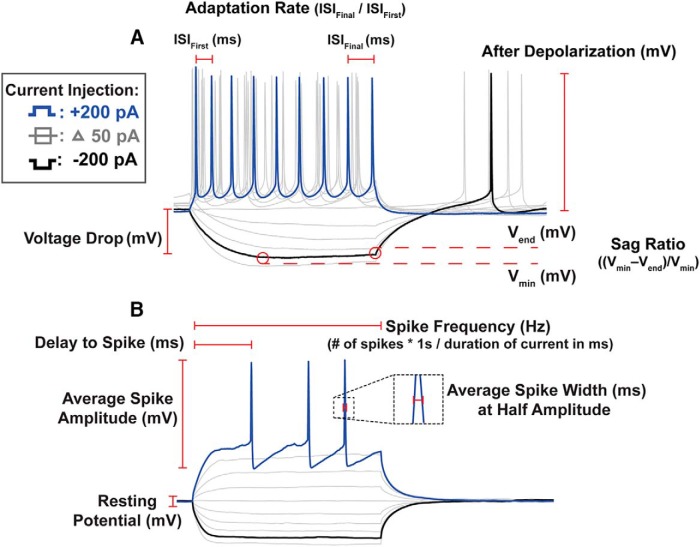
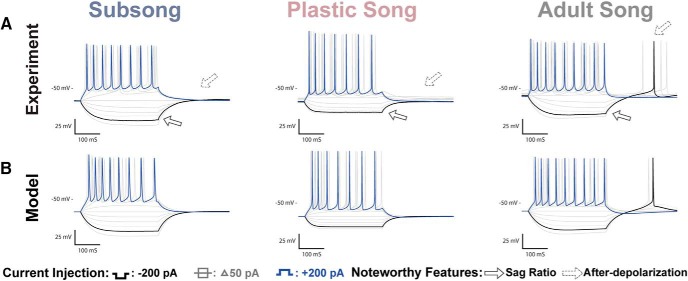
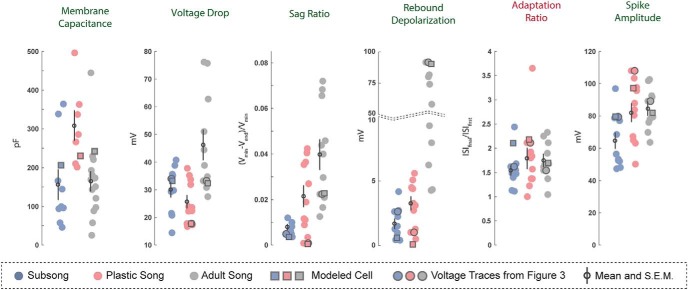
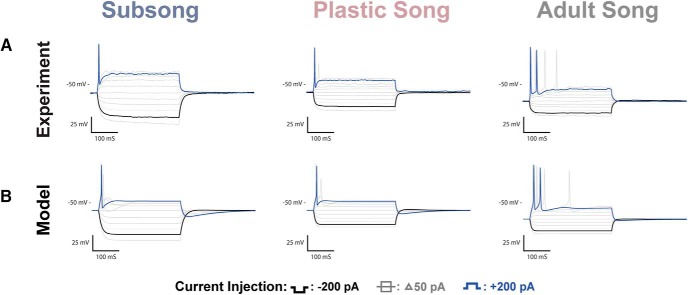
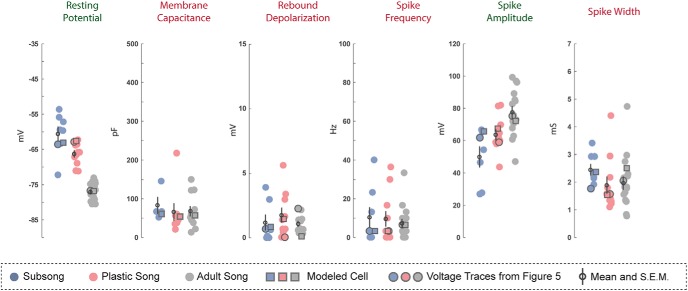
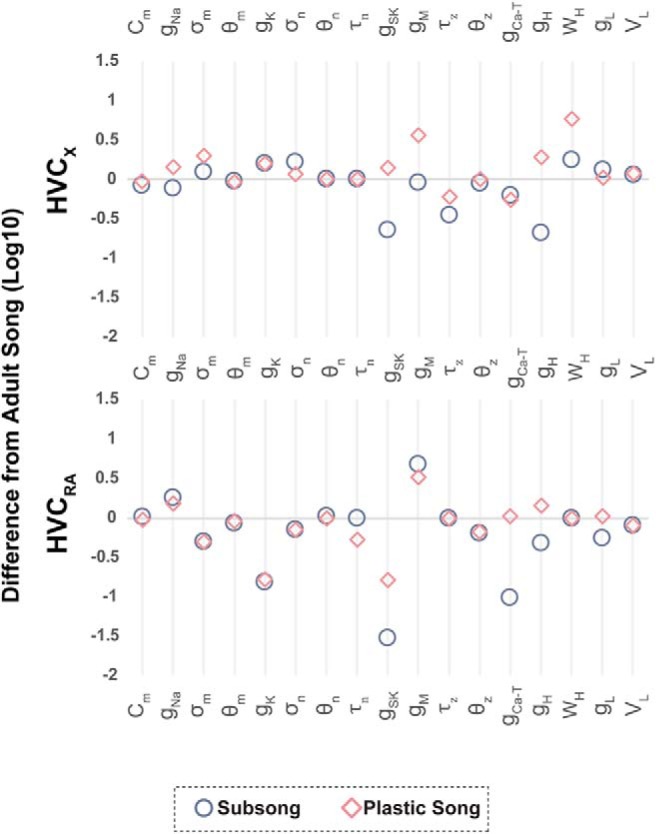
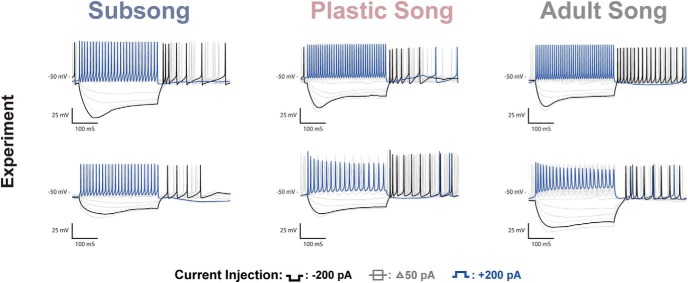
Juvenile male zebra finches learn their songs over distinct auditory and sensorimotor stages, the former requiring exposure to an adult tutor song pattern. The cortical premotor nucleus HVC (acronym is name) plays a necessary role in both learning stages, as well as the production of adult song. Consistent with neural network models where synaptic plasticity mediates developmental forms of learning, exposure to tutor song drives changes in the turnover, density, and morphology of HVC synapses during vocal development. A network's output, however, is also influenced by the intrinsic properties (e.g., ion channels) of the component neurons, which could change over development. Here, we use patch clamp recordings to show cell-type-specific changes in the intrinsic physiology of HVC projection neurons as a function of vocal development. Developmental changes in HVC neurons that project to the basal ganglia include an increased voltage sag response to hyperpolarizing currents and an increased rebound depolarization following hyperpolarization. Developmental changes in HVC neurons that project to vocal-motor cortex include a decreased resting membrane potential and an increased spike amplitude. HVC interneurons, however, show a relatively stable range of intrinsic features across vocal development. We used mathematical models to deduce possible changes in ionic currents that underlie the physiological changes and to show that the magnitude of the observed changes could alter HVC circuit function. The results demonstrate developmental plasticity in the intrinsic physiology of HVC projection neurons and suggest that intrinsic plasticity may have a role in the process of song learning.
幼年雄性斑马雀在学习歌曲时经历明显的听觉和运动感知阶段,前者需要接触成年导师歌曲模式。皮质前运动核 HVC(缩写是名称)在学习的两个阶段以及成年歌曲的产生中都发挥着必要的作用。与突触可塑性介导发育学习形式的神经网络模型一致,导师歌曲的暴露会在发声发育过程中驱动 HVC 突触的周转率、密度和形态的变化。然而,网络的输出也受到组成神经元固有特性(例如离子通道)的影响,这些特性可能会随发育而变化。在这里,我们使用膜片钳记录来显示 HVC 投射神经元固有生理学的细胞类型特异性变化作为发声发育的函数。投射到基底神经节的 HVC 神经元的发育变化包括对超极化电流的电压凹陷反应增加和超极化后复发性去极化增加。投射到发声运动皮层的 HVC 神经元的发育变化包括静息膜电位降低和尖峰幅度增加。然而,HVC 中间神经元在发声发育过程中显示出相对稳定的固有特征范围。我们使用数学模型推导出潜在的离子电流变化,这些变化是生理变化的基础,并表明观察到的变化幅度可能会改变 HVC 电路功能。结果表明 HVC 投射神经元的固有生理学具有发育可塑性,并表明固有可塑性可能在歌曲学习过程中发挥作用。