
电子显微镜连接组学揭示了序列生成网络中轴突靶点的变异。
EM connectomics reveals axonal target variation in a sequence-generating network.
作者信息
Kornfeld Jörgen, Benezra Sam E, Narayanan Rajeevan T, Svara Fabian, Egger Robert, Oberlaender Marcel, Denk Winfried, Long Michael A
机构信息
Max Planck Institute of Neurobiology, Martinsried, Germany.
NYU Neuroscience Institute and Department of Otolaryngology, New York University Langone Medical Center, New York, United States.
出版信息
Elife. 2017 Mar 27;6:e24364. doi: 10.7554/eLife.24364.
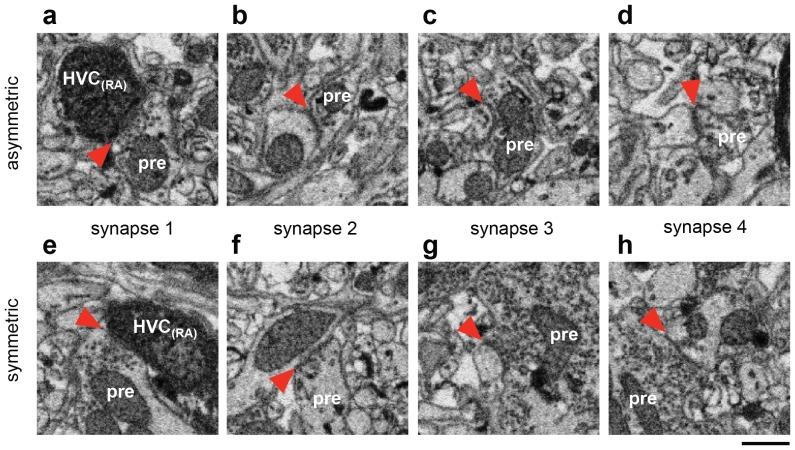
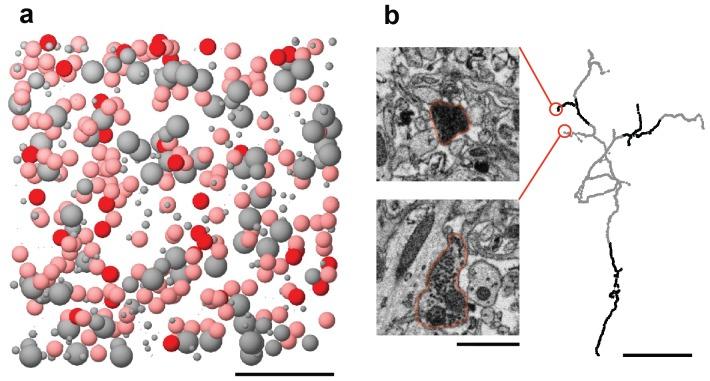
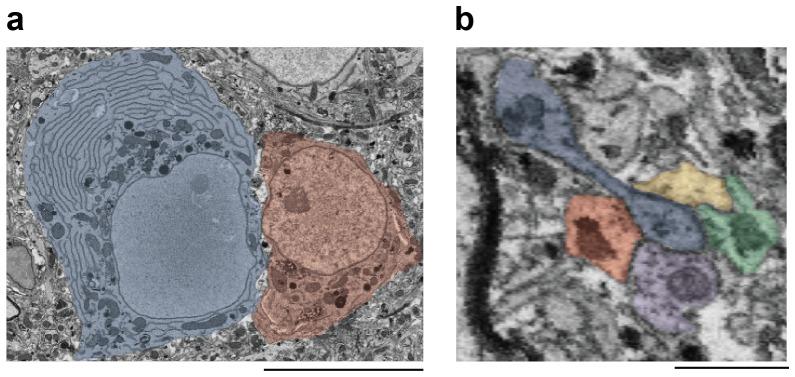
The sequential activation of neurons has been observed in various areas of the brain, but in no case is the underlying network structure well understood. Here we examined the circuit anatomy of zebra finch HVC, a cortical region that generates sequences underlying the temporal progression of the song. We combined serial block-face electron microscopy with light microscopy to determine the cell types targeted by HVC neurons, which control song timing. Close to their soma, axons almost exclusively targeted inhibitory interneurons, consistent with what had been found with electrical recordings from pairs of cells. Conversely, far from the soma the targets were mostly other excitatory neurons, about half of these being other HVC cells. Both observations are consistent with the notion that the neural sequences that pace the song are generated by global synaptic chains in HVC embedded within local inhibitory networks.
在大脑的各个区域都观察到了神经元的顺序激活,但在任何情况下,其潜在的网络结构都没有得到很好的理解。在这里,我们研究了斑胸草雀HVC的电路解剖结构,HVC是一个皮质区域,它产生歌曲时间进程背后的序列。我们将连续块面电子显微镜与光学显微镜相结合,以确定HVC神经元靶向的细胞类型,这些神经元控制着歌曲的时间。在其胞体附近,轴突几乎只靶向抑制性中间神经元,这与成对细胞的电记录结果一致。相反,在远离胞体的地方,靶点大多是其他兴奋性神经元,其中约一半是其他HVC细胞。这两个观察结果都与这样一种观点一致,即调节歌曲节奏的神经序列是由嵌入局部抑制网络中的HVC中的全局突触链产生的。





 Zotero 插件