Department of Botany and Plant Ecology, Wrocław University of Environmental and Life Sciences, Grunwaldzki Square 24A, 50-363, Wrocław, Poland.
Department of Plant Nutrition, Wrocław University of Environmental and Life Sciences, Grunwaldzka Street 53, 50-357, Wrocław, Poland.
Environ Sci Pollut Res Int. 2018 Jan;25(1):824-835. doi: 10.1007/s11356-017-0451-y. Epub 2017 Oct 23.
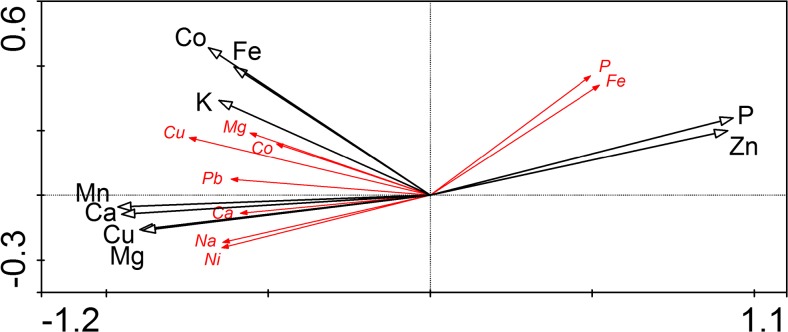
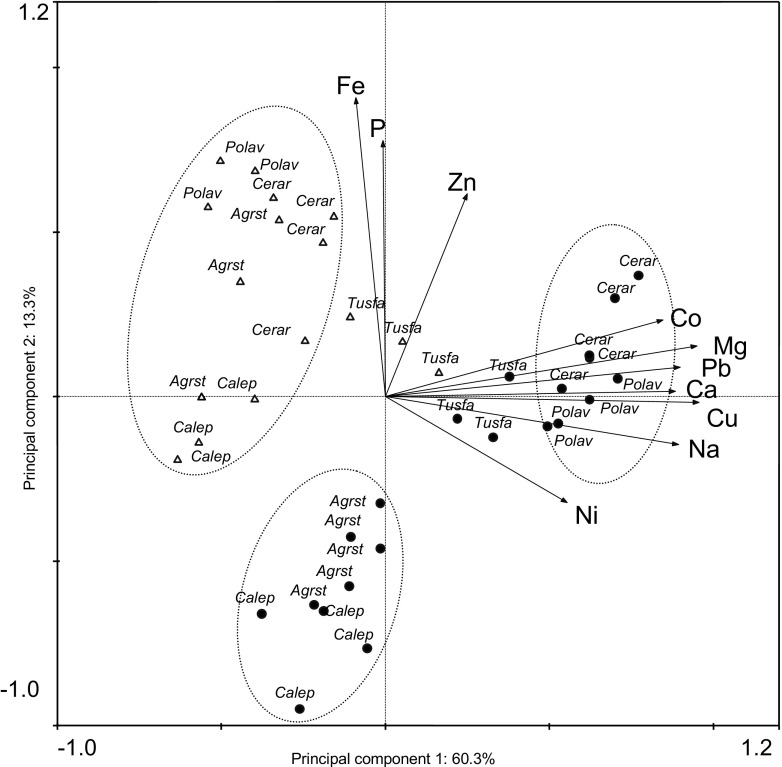
Copper ore mining and processing release hazardous post-flotation wastes that are difficult for remediation. The studied tailings were extremely rich in Cu (1800 mg kg) and contaminated with Co and Mn, and contained very little available forms of P, Fe, and Zn. The plants growing in tailings were distinctly enriched in Cu, Cd, Co, Ni, and Pb, and the concentration of copper achived the critical toxicity level in shoots of Cerastium arvense and Polygonum aviculare. The redundancy analysis demonstrated significant relationship between the concentration of available forms of studied elements in substrate and the chemical composition of plant shoots. Results of the principal component analysis enabled to distinguish groups of plants which significantly differed in the pattern of element accumulation. The grass species Agrostis stolonifera and Calamagrostis epigejos growing in the tailings accumulated significantly lower amounts of Cu, but they also had the lowest levels of P, Fe, and Zn in comparison to dicotyledonous. A. stolonifera occurred to be the most suitable species for phytostabilization of the tailings with regard to its low shoot Cu content and more efficient acquisition of limiting nutrients in relation to C. epigejos. The amendments improving texture, phosphorus fertilization, and the introduction of native leguminous species were recommended for application in the phytoremediation process of the tailings.
铜矿开采和加工会释放出危险的浮选后废物,难以修复。研究中的尾矿中铜含量极高(1800 毫克/千克),受到 Co 和 Mn 的污染,且几乎没有有效形式的 P、Fe 和 Zn。生长在尾矿中的植物明显富集了 Cu、Cd、Co、Ni 和 Pb,铜的浓度在雀麦属和Polygonum 属植物的地上部分达到了临界毒性水平。冗余分析表明,基质中研究元素有效形态的浓度与植物地上部分的化学成分之间存在显著关系。主成分分析的结果能够区分在元素积累模式上明显不同的植物组。在尾矿中生长的多年生禾本科植物匍匐翦股颖和高羊茅积累的 Cu 明显较少,但与双子叶植物相比,它们的 P、Fe 和 Zn 含量也较低。匍匐翦股颖在地上部分 Cu 含量较低且相对于高羊茅更有效地获取限制养分方面,是最适合尾矿植物稳定化的物种。推荐应用改善质地的改良剂、施磷和引入本地豆科物种,以应用于尾矿的植物修复过程中。